
The most reliable machine for your operation isn't necessarily the one with the lowest hours or the cleanest paint job. In the heavy equipment industry, a high-hour machine with a meticulous service record often outperforms a neglected low-hour unit that has been sitting idle. You're likely here because you recognize that finding a used Volvo wheel loader for sale involves more than just browsing a digital catalog. It's a high-stakes decision where the fear of hidden mechanical failures and the complexity of importing across European borders can feel overwhelming.
We understand that you need more than a broker; you need an advisor who understands industrial throughput and technical nuances. This 2026 sourcing guide provides the expert insights you need to master the complexities of the European market. We'll show you how to manage the procurement process with total transparency, from initial technical inspections to final delivery. We'll cover how to match model sizes to your specific operational needs while ensuring a verified service history. Our goal is to help you achieve maximum uptime and the lowest possible total cost of ownership through a methodical, professional approach.
Key Takeaways
- Learn why the 2026 market favors 5-8 year old machines to balance modern fuel efficiency with a lower total cost of ownership.
- Discover how to accurately match bucket capacity and static tipping load to your specific material density to ensure maximum operational throughput.
- Master the technical inspection of a used Volvo wheel loader for sale by identifying critical wear in TP-linkages and D-series engine efficiency.
- Understand the strategic advantage of sourcing from Northern European fleets, where rigorous service cultures result in better-maintained equipment.
- Gain insights into navigating the international procurement process with an independent advisor to access high-performance machines not found on the open market.
The Industrial Advantage: Why Target a Used Volvo Wheel Loader?
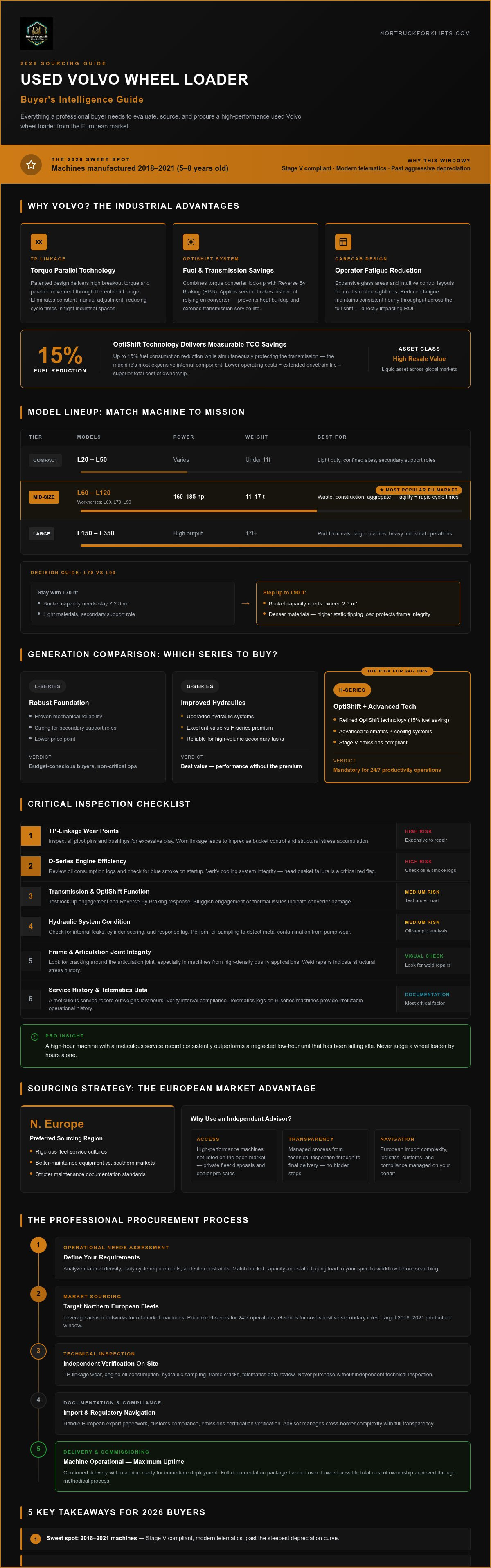
Volvo has long established itself as the benchmark for heavy lifting, balancing engineering precision with long-term durability. In the 2026 market, sourcing a used Volvo wheel loader for sale often points professionals toward machines manufactured between 2018 and 2021. These 5-8 year old units represent a strategic sweet spot. They provide modern Stage V emissions compliance and sophisticated telematics without the aggressive depreciation of a showroom-new purchase. Volvo loaders are widely regarded as liquid assets; their high resale value retention across global markets makes them a secure capital investment compared to many lower-tier alternatives.
One of the primary technical advantages is the patented Torque Parallel (TP) linkage. While most competitors rely on a standard Z-bar configuration, Volvo's TP-linkage delivers high breakout torque and exceptional parallel movement throughout the entire lifting range. This design allows for smooth, stable operation whether you're handling heavy buckets or using forks for palletized cargo. It eliminates the need for constant manual adjustments, reducing cycle times and increasing precision in tight industrial spaces.
Fuel Efficiency and the OptiShift Advantage
Operational costs in heavy industry are heavily influenced by fuel consumption and drivetrain wear. Volvo's integrated drivetrain technology, specifically the OptiShift system, addresses these costs directly. This system combines a torque converter with a lock-up function and the Reverse By Braking (RBB) feature. The RBB function is particularly valuable; it senses the machine's direction and applies the service brakes to slow the loader instead of relying on the torque converter. This prevents excessive heat buildup and significantly extends the transmission's service life. OptiShift technology contributes to a lower Total Cost of Ownership by reducing fuel consumption by up to 15% while protecting the machine's most expensive internal components.
Operator Environment and Productivity
In high-pressure settings like port terminals or aggregate plants, operator fatigue is a critical industrial metric that impacts the bottom line. Volvo’s CareCab design focuses on reducing this fatigue through superior ergonomics and noise suppression. The G and H-series models are known for their expansive glass areas and intuitive control layouts, which provide the operator with an unobstructed view of the work area. When an operator feels secure and comfortable, hourly throughput remains consistent throughout the shift. High cab comfort isn't just about the person in the seat; it's about maintaining a high-performance duty cycle that maximizes your return on investment.
Selecting the Right Model: From Compact L30 to Heavy-Duty L350
Identifying the ideal used Volvo wheel loader for sale requires an honest assessment of your material density and daily cycle requirements. A machine that excels in light waste handling will likely struggle in a high-density aggregate quarry. Volvo categorizes their lineup into three distinct tiers: Compact (L20 to L50), Mid-size (L60 to L120), and Large (L150 to L350). Selecting the wrong size leads to two outcomes: either the machine is underpowered and faces premature component failure, or it is over-specced, leading to unnecessary fuel expenditure and higher capital costs.
Understanding the evolution between series is critical for 2026 buyers. While the older L-series machines are robust, the G-series introduced improved hydraulics and the H-series brought the refined OptiShift technology. If your operation demands 24/7 productivity, the H-series is often the superior choice due to its advanced telematics and cooling systems. For secondary support roles, a well-maintained G-series provides excellent value without the premium price tag of the latest generation.
Mid-Range Versatility: The L60, L70, and L90
The L60, L70, and L90 models are the undisputed workhorses of the European market. These machines typically offer horsepower ranges between 160 hp and 185 hp, with operating weights between 11 and 17 tonnes. They are favored in the waste and construction sectors for their agility and rapid cycle times. If you find your bucket capacity needs consistently exceeding 2.3 cubic meters, stepping up from an L70 to an L90 is advisable. The L90’s higher static tipping load ensures stability when handling denser materials, protecting the structural integrity of the frame over time.
Heavy-Duty Power: The L120 to L350
For port terminals, large-scale quarries, and heavy industrial applications, the L120 through to the L350 are the standard. The L220 and L260 are specifically engineered for high-tonnage loading, featuring reinforced frames and heavy-duty axles. The L350 remains Volvo’s largest loader, designed for extreme environments where maximum breakout force is the only metric that matters. When sourcing these high-capacity units, prioritize condition monitoring data and service history over the year of manufacture. A 2017 machine with a documented mid-life overhaul is often a safer investment than a 2020 unit with neglected hydraulic maintenance. If you are struggling to determine which tonnage capacity fits your specific throughput, speaking with an independent advisor can help you avoid the pitfalls of over-speccing your fleet.
Attachments also play a vital role in model selection. While standard buckets are common, Volvo’s TP-linkage makes these loaders exceptionally capable with specialized timber grapples or pallet forks. Always verify that the machine’s hydraulic flow matches the requirements of your intended attachments to ensure smooth, responsive control.
Critical Inspection Points for Used Volvo Loaders
Buying a used Volvo wheel loader for sale requires looking past the hour meter. While total hours provide a baseline, they don't tell the full story of the machine's duty cycle. A professional inspection must focus on the specific engineering vulnerabilities that appear after years of heavy service. You need to verify that the high performance promised by Volvo's design hasn't been compromised by poor maintenance or extreme environments.
Start with the Volvo D-series engine. Check for blow-by by removing the oil filler cap while the engine is running; excessive pressure or smoke indicates worn piston rings. Listen to the turbocharger for any high-pitched whistling and inspect the intake pipes for oil residue. Next, examine the TP-linkage. While this system is a major advantage for parallel lifting, it relies on precise pin and bushing tolerances. Any visible play in the bucket or lift arms usually signals a history of neglected lubrication, which can lead to expensive line-boring repairs.
Hydraulic health is best assessed through cycle times. Operate the lift, tilt, and lower functions and compare the results to the original factory specifications. If the times are more than 10% slower than the manual suggests, the hydraulic pump or control valves are likely losing efficiency. Finally, consider the "Hour Meter Trap." 10,000 hours in a dusty, high-vibration quarry environment is significantly more taxing on the chassis than 10,000 hours on the paved surfaces of a port terminal. The quarry machine will face more abrasive wear, while the port machine requires a stricter check for electrical and cooling system corrosion.
The Drivetrain and Transmission Check
Test the transmission by shifting through all gears while the machine is under load. Any hesitation, slipping, or loud "clunking" during gear changes signals internal wear in the clutch packs. Verify the functionality of the axle and differential locks, as these are essential for maintaining traction in heavy-duty applications. You can detect early transmission wear by performing a professional fluid analysis to identify high levels of copper or iron particles before a total component failure occurs.
Structural Integrity and Undercarriage
The center articulation joint, often called the "waist," is the most critical structural point of the machine. Look for cracks in the paint or visible slackness when the loader turns under load. Be alert for "stress-welding," which refers to unoriginal welds on the frame or loader arms; these are clear indicators of past overloading or structural failure. Don't overlook the tires. On large-frame loaders, a full set of tires represents a massive capital expense, so factor their remaining tread life and sidewall integrity into your final valuation.
Sourcing Strategy: Navigating the European Market
Europe remains the primary destination for sourcing high-spec heavy equipment. This is largely due to the rigorous maintenance standards found across the continent, particularly in Scandinavia and Northern Europe. These regions possess a deep-seated service culture where machines are treated as long-term assets rather than disposable tools. When you search for a used Volvo wheel loader for sale in these markets, you're likely to find equipment with comprehensive service logs and a history of preventative care that far exceeds global averages. This documentation is your best defense against unexpected downtime.
Moving these machines requires a calculated approach to logistics. For large-frame loaders, Roll-on/Roll-off (Ro-Ro) shipping is often the most cost-effective method for international transit, while overland transport remains the standard for intra-European deliveries. Each method has its own set of risks, from salt-air exposure at sea to the complexities of oversized load permits on highways. Having an advisor to oversee these logistics ensures the machine arrives in the same condition it left the seller's yard.
Overcoming Cross-Border Procurement Barriers
Procuring equipment across borders in 2026 involves more than just a wire transfer. You must manage VAT reclaim processes, export licenses, and specific customs documentation that varies by country. Conducting remote inspections is a necessity for many buyers, which is why hiring third-party experts in the machine's country of origin is a standard practice to verify mechanical integrity. For a broader look at the logistical nuances of this region, consult our European Forklift Market Guide 2026.
The Advisor vs. The Broker
There's a fundamental difference between a broker and an advisor. A commission-based broker is often incentivized to close the sale quickly, regardless of the machine's long-term viability. In contrast, an advisor focuses on your operational uptime. With 40 years of experience, Lars G Tarby understands how to identify "red flag" machines that look good on paper but carry hidden risks. At Nortruck Forklifts, we leverage an extensive European network to find off-market units that aren't listed on public portals. This direct access allows us to vet machines before they even reach the open market, ensuring you get the first pick of the highest-quality inventory.
Procuring Your Volvo Wheel Loader with Nortruck Forklifts
Sourcing heavy machinery shouldn't feel like a gamble. At Nortruck Forklifts, we treat the acquisition of a used Volvo wheel loader for sale as a professional consultation rather than a simple retail transaction. Lars G Tarby brings over 40 years of industry experience to every deal, acting as your independent advocate in the complex European market. This deep-seated expertise allows us to vet machines with a level of scrutiny that standard brokers simply cannot match. We prioritize your operational uptime, ensuring that the equipment we source is a precise fit for your specific throughput requirements.
Our process begins with a thorough review of the machine's digital and physical history. We don't just look at the hour meter; we dive into service logs and analyze Volvo’s CareTrack telematics data whenever available. This data provides an objective look at how the machine was operated, including idle times, fuel consumption, and any recurring fault codes. By cross-referencing this data with a physical inspection of the TP-linkage and hydraulic cycle times, we create a transparent profile of the machine's actual health before any funds are committed.
Expert Advisory and Technical Vetting
Choosing the right equipment is often a matter of defining the specific duty cycle. For instance, we often help clients determine if a high-capacity Volvo loader or a specialized reachstacker is better suited for their port terminal operations. You can explore the nuances of port-specific equipment in our Used Reachstacker Sourcing Guide. Our final recommendation is always based on operational suitability and long-term TCO, not just the initial purchase price. We want to ensure that your investment remains a liquid asset that performs reliably under high-duty cycles.
The Next Steps in Your Acquisition
Starting the procurement journey is straightforward. Once you submit a customized sourcing request, we tap into our direct European networks to find units that often aren't visible on the open market. The timeline from initial sourcing to final delivery typically depends on the machine's location and the complexity of the technical inspection, but we maintain transparency at every stage. We handle the logistical friction of cross-border transport and customs, allowing you to focus on your core operations. If you are ready to secure a high-performance machine with a verified history, contact Nortruck Forklifts today for expert Volvo sourcing advice.
Securing Your Operational Future with the Right Asset
Sourcing a used Volvo wheel loader for sale in 2026 is a strategic decision that requires balancing technical precision with deep market intelligence. The key to a successful acquisition lies in looking beyond the hour meter and prioritizing machines with a verified service history from Northern European fleets. By focusing on critical inspection points like the TP-linkage and D-series engine health, you ensure your investment delivers the performance and fuel efficiency Volvo is known for.
Success in this market depends on moving beyond generic listings and engaging with an independent advisor who understands the nuances of heavy-duty industrial applications. With over 40 years of heavy lifting expertise, we provide the specialized sourcing and technical vetting necessary to secure a machine that fits your specific throughput needs. We manage the logistical friction and cross-border complexities so you can focus on maintaining maximum uptime for your facility. We look forward to helping you find a reliable, high-performance solution that serves your business for years to come.
Frequently Asked Questions
What is the typical lifespan of a used Volvo wheel loader in hours?
A well-maintained Volvo wheel loader can reach a lifespan of 20,000 to 30,000 hours before requiring a major engine or transmission overhaul. However, the operating environment dictates the actual longevity more than the hour meter. Machines used in light material handling often outlast those in abrasive quarry settings. When evaluating a used Volvo wheel loader for sale, prioritize units with documented mid-life component replacements to ensure the machine remains a productive asset.
Is it better to buy a Volvo G-Series or the newer H-Series?
The H-Series is generally the superior choice for high-duty operations due to its advanced OptiShift drivetrain and improved fuel efficiency. It offers better telematics integration and refined hydraulics compared to its predecessor. The G-Series remains a highly reliable and cost-effective option for secondary support roles where the latest technology isn't a strict requirement. Your choice should depend on whether the fuel savings of the H-Series outweigh its higher initial acquisition cost.
How much does it cost to ship a large Volvo loader across Europe?
Shipping costs for large Volvo loaders are determined by the machine's operating weight, dimensions, and the chosen transit method. Roll-on/Roll-off (Ro-Ro) shipping is typically used for port-to-port international transit, while specialized low-loader trailers handle overland routes. Factors such as pilot car requirements for oversized loads and fluctuating fuel surcharges also influence the final price. We coordinate the entire logistical process to ensure a transparent delivery from the European seller to your site.
What are the most common mechanical failures in high-hour Volvo L150 loaders?
High-hour L150 loaders can show wear in the hydraulic pumps, leading to slower cycle times and reduced breakout force. The center articulation joint and the TP-linkage pins are also critical areas where excessive play can develop if lubrication has been inconsistent. Additionally, transmission clutch packs may begin to slip under heavy load. A professional technical inspection focuses on these specific engineering points to prevent you from acquiring a machine with imminent component failure.
Can Nortruck Forklifts source specific attachments like high-tip buckets or log grapples?
Yes, we specialize in sourcing machines equipped with specific attachments like high-tip buckets, timber grapples, or pallet forks. We understand that your operational efficiency depends on having the right tool for the job. If a machine is found without the necessary attachment, we can often leverage our European network to locate the correct spec. Our goal is to provide a complete solution that's ready for immediate deployment upon arrival at your facility.
Why should I source from Europe instead of my local market?
Sourcing from Europe, particularly Northern regions, offers access to a larger inventory of high-spec machines with superior service cultures. Owners in these markets tend to follow manufacturer maintenance schedules strictly, providing a level of transparency that's often missing in other regions. This results in better-maintained equipment that retains its value. By looking beyond your local market, you increase the likelihood of finding a used Volvo wheel loader for sale with a verified history.
How does Volvo’s CareTrack telematics help in evaluating a used machine?
CareTrack telematics provides an objective, data-driven view of a machine's operational history that physical inspections might miss. It tracks fuel consumption, idle time, and engine load cycles, allowing us to identify if a loader has been overworked or neglected. We use this data to verify the seller's claims and ensure the machine has been used appropriately for its size. This transparency is vital for calculating the expected remaining life of major internal components.
Does Nortruck Forklifts provide financing for used heavy equipment?
We focus on providing independent advisory and direct sourcing services for heavy lifting equipment. While we don't offer internal financing programs, we provide the technical documentation and valuation data necessary for you to secure funding through your preferred industrial lender. Our role is to ensure you're investing in a high-quality asset that meets the criteria of most commercial finance providers. We recommend consulting with your financial institution regarding their specific requirements.

Article by
Lars Gunnar Tärby
Disclaimer
1. General Information and No AdviceThe information, articles, product descriptions, and specifications provided on this website (www.nortruckforklifts.com) are for general informational and educational purposes only. While we strive to provide accurate and up-to-date content regarding new and used forklifts and heavy machinery, the material published does not constitute professional, technical, or legal advice.
2. Product Specifications and PricingNortruck Forklifts acts as a facilitator for the trade of new and used forklifts. All equipment details, including but not limited to year of manufacture, operating hours, lift capacity, dimensions, conditions, and pricing, are provided based on the information available to us at the time of publication. Specifications and availability are subject to change without prior notice.
3. "As Is" and VerificationAll articles and product listings are provided on an "as is" and "as available" basis without any warranties of any kind, either express or implied. Nortruck Forklifts does not guarantee that the descriptions are entirely error-free, complete, or reliable. Buyers and traders are strongly encouraged to independently verify all technical specifications, machine history, and equipment conditions directly with the seller or an authorized inspector before finalizing any purchase or transaction.
4. Limitation of LiabilityIn no event shall Nortruck Forklifts, its owners, or its contributors be held liable for any direct, indirect, incidental, consequential, or economic loss or damage arising out of the use of, or the inability to use, the information provided on this website, or any transactions facilitated through this platform. This includes, but is not limited to, damages caused by technical inaccuracies, typographical errors, or reliance on the content of our articles.
5. Third-Party LinksOur website may contain links to external websites, dealer networks, or third-party services that are not owned or controlled by Nortruck Forklifts. We have no control over, and assume no responsibility for, the content, privacy policies, or practices of any third-party websites.


