
Choosing the narrowest possible aisle might actually slow your operation down if your inventory doesn't fit a standard pallet profile. Most warehouse managers feel the constant pressure of a shrinking footprint and the need to squeeze every possible pallet position out of their existing square footage. It's a frustrating balance between maintaining speed and avoiding the massive overhead of a facility expansion. You want a solution that doesn't just save space but actually improves how your team moves goods every day.
This expert comparison of the 4-way forklift vs VNA truck will help you identify which technology fits your specific load types and racking layout. We've spent decades advising businesses on how to optimize these environments through independent sourcing and technical insight. You'll learn how multidirectional trucks solve the problem of long, awkward materials in tight gaps, while very narrow aisle systems focus on maximizing vertical density for standard pallets. By the end of this guide, you'll have the clarity needed to select machinery that balances cost-effectiveness with genuine operational flow.
Key Takeaways
- Learn how VNA technology can increase your warehouse pallet density by up to 50% for standard storage configurations.
- Understand why multidirectional steering is the essential factor for safely moving materials over 6 meters in narrow corridors.
- Evaluate the total cost of ownership for a 4-way forklift vs VNA truck, including often overlooked infrastructure requirements like super-flat flooring.
- Discover the critical steps of a site survey that prevent costly mismatches between your racking layout and new equipment.
- Identify why independent advisory across brands like Combi-Lift and Linde provides a more objective path to operational efficiency.
Defining the Narrow Aisle Challenge: 4-Way Forklifts and VNA Trucks Explained
Warehouse real estate costs in 2026 continue to climb. This forces operators to rethink every square metre of floor space. Standard counterbalance trucks require wide turning circles, which creates significant dead space. To combat this, two primary technologies have emerged to reclaim that lost area. Your choice between a 4-way forklift vs VNA truck depends on whether you're optimizing for standard pallet density or specialized load geometry. The fundamental debate of 4-way forklift vs VNA truck usually comes down to the diversity of your inventory. While both systems reduce aisle widths, they solve fundamentally different operational bottlenecks. One prioritizes the ability to move in any direction, while the other focuses on reaching as high as possible in the tightest gaps.
The Mechanics of Multidirectional Movement
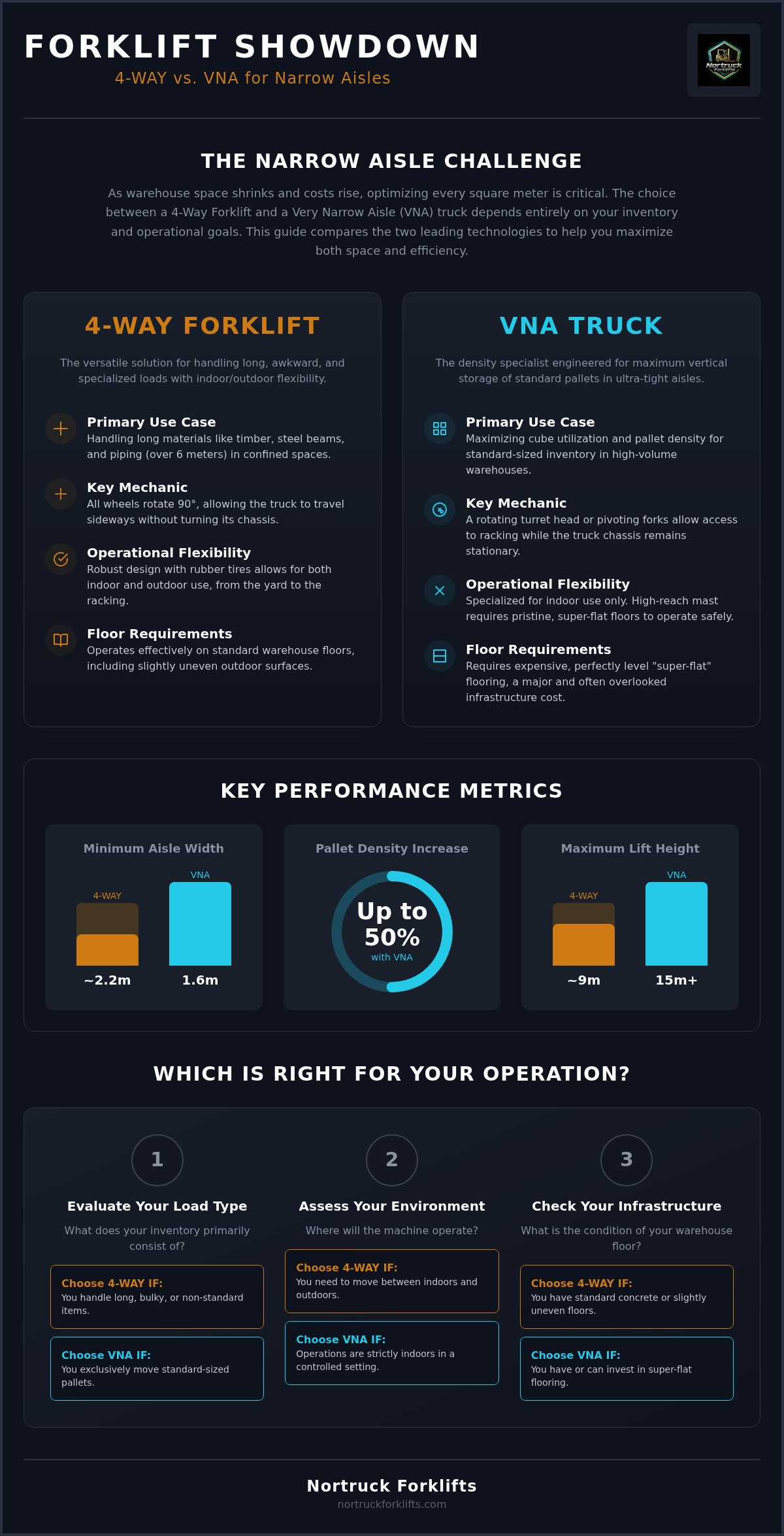
A 4-way forklift uses a unique steering geometry where all wheels can rotate 90 degrees. This allows the machine to travel sideways, effectively turning a long load into a narrow one for transport. It's a hybrid solution that blends the capabilities of a reach truck with a sideloader. These machines are the industry standard for the timber, steel, and plastics sectors. When you're handling 6-metre lengths of piping or timber packs, a standard truck is useless in a tight gap. The 4-way unit carries these loads parallel to the direction of travel. This keeps aisles slim without sacrificing the ability to handle standard pallets. Brands like Combi-Lift have pioneered this technology to ensure that a single truck can manage the entire warehouse workflow.
The Engineering Behind VNA Efficiency
VNA trucks are engineered for maximum cube utilization. Unlike a standard forklift that must turn its entire chassis to face the racking, a VNA truck uses a rotating turret head. This allows the forks to pivot 180 degrees while the truck remains stationary in the aisle. By eliminating the turning radius, aisles can be narrowed to as little as 1.6 metres. These machines often reach heights of 15 metres or more. This makes them ideal for high-throughput distribution centres where every pallet position counts. You can explore various Forklift Types to see how these specialized guided vehicles differ from general-purpose machinery.
Man-up configurations allow the operator to rise with the forks. This provides a massive advantage for high-level order picking and inventory accuracy. Conversely, man-down models keep the operator at ground level. This can be faster for pallet-only movements but sacrifices visibility at the highest rack levels. High-performance models from Linde and Toyota dominate this space, offering precision at heights that other trucks simply can't match.
The Versatility of 4-Way Forklifts for Long and Specialized Loads
Modern logistics managers are increasingly following the narrow aisle trend to maximize storage. However, standard VNA systems often fail when inventory exceeds the width of a standard pallet. This is where the 4-way forklift shines. It is the industry gold standard for handling timber, steel beams, and composite materials that are 6 metres or longer. While the 4-way forklift vs VNA truck debate often focuses on pallet density, the 4-way's true value lies in its ability to carry these long loads through gaps that would be impossible for any other machine. It transforms a logistical nightmare into a routine task.
Handling Long Loads in Narrow Aisles
Traditional forklifts must "snake" long loads through doorways or between racking. This is a primary cause of product damage and operator fatigue. A 4-way truck eliminates this risk by rotating its wheels 90 degrees to travel sideways. This keeps the load parallel to the aisle and completely stable. It offers a level of precision that even high-end sideloaders from brands like Baumann struggle to match in confined spaces. Multidirectional steering reduces the need for large turning circles because the truck changes direction without rotating the chassis. This ensures that expensive inventory remains safe and that your racking remains intact during every shift.
Operational Flexibility Beyond the Racking
One significant advantage of these machines is their indoor-outdoor capability. VNA trucks usually require perfectly flat, indoor floors to operate their high-reach masts safely. In contrast, many 4-way trucks feature large rubber tyres and robust traction control. This allows them to offload a lorry in a yard and then drive the same load directly into a narrow indoor racking system. It creates a "one-machine solution" that reduces the total number of vehicles you need to maintain. This versatility is a major factor when comparing a 4-way forklift vs VNA truck for facilities that don't have the luxury of separate indoor and outdoor fleets.
If you are currently evaluating your options, sourcing Combi-Lift 4-way trucks for sale can be a strategic move to future-proof your warehouse. These machines handle standard pallets just as easily as they manage 12-metre steel bars. Deciding on the right fleet requires a deep understanding of your throughput and load variety. You can consult with our expert team to get an independent assessment of which technology will actually improve your operational flow.
Maximising Cube Utilization: The Power of VNA Technology
While the previous section highlighted the agility of multidirectional units for long materials, the decision between a 4-way forklift vs VNA truck often rests on how many standard pallets you can fit into a fixed volume of space. High-density storage is the primary driver for very narrow aisle technology. In environments where land costs make horizontal expansion impossible, going vertical is the only viable path. According to industry analysis, VNA forklifts are essential for facilities that prioritize pallet positions over load variety. These machines don't just save space; they redefine the throughput potential of a modern distribution centre.
Achieving Maximum Storage Density
The most immediate benefit of VNA technology is the massive reduction in aisle width. A standard counterbalance forklift requires roughly 3.5 metres to turn and place a pallet. VNA trucks operate in aisles as narrow as 1.6 to 1.8 metres. By shrinking these corridors, you can often increase your total pallet density by up to 50% without changing the building's footprint. This is a far more aggressive space-saving strategy than using standard reach trucks, which still require significant turning room.
- Man-Up Advantage: Operators rise with the load, ensuring perfect visibility and picking accuracy at heights exceeding 15 metres.
- Standardized Storage: VNA systems are built for uniform pallet sizes, creating a highly disciplined and predictable warehouse flow.
- Vertical Reach: These machines utilize the full "cube" of the building, reaching heights that 4-way trucks often cannot match.
Guidance Systems and Speed
Because the tolerances in a VNA aisle are so tight, these trucks don't rely on manual steering while inside the racking. Instead, they use inductive wire guidance or physical steel rails to keep the machine perfectly centred. This automation removes the risk of rack collisions and allows the operator to focus entirely on the lift and travel speed. VNA trucks utilize simultaneous travel and lift functions, moving diagonally to reach the target rack location in one smooth, time-saving motion. This diagonal travel significantly reduces cycle times compared to machines that must stop moving forward before they begin to lift.
For operations that demand this level of precision and high-speed throughput, sourcing high-performance Linde forklifts for sale is a proven way to secure long-term reliability. These machines are engineered for the rigours of high-rack environments where downtime is not an option. Choosing the right 4-way forklift vs VNA truck configuration requires an honest look at your inventory profile; if 90% of your stock is on standard pallets, the VNA route is likely your most efficient path forward.
Side-by-Side Comparison: Throughput, Floor Quality, and TCO
Evaluating the 4-way forklift vs VNA truck requires looking beyond the purchase price. While both machines represent a significant investment, their impact on your facility's infrastructure and long-term operating budget differs sharply. The 4-way forklift vs VNA truck comparison shifts dramatically when you account for the civil engineering costs of floor preparation. You aren't just buying a machine; you're committing to a specific warehouse ecosystem that dictates your maintenance schedule and operator skill requirements.
Infrastructure Requirements
The most significant "hidden cost" of a VNA system is the floor. Because VNA trucks operate at extreme heights in very tight tolerances, they require super-flat floors that meet strict international standards like TR34 or DIN 18202. If your floor isn't perfectly level, the mast sway at 15 metres can become dangerous or even cause rack collisions. Grinding an existing floor to these specifications is an expensive and time-consuming process. In contrast, 4-way trucks are much more forgiving. Their larger tyres and robust chassis are designed to handle standard warehouse floors and even outdoor yard surfaces.
Power requirements also vary. High-intensity VNA shifts often demand sophisticated battery management systems or fast-charging infrastructure to maintain high throughput. Since these machines are often wire-guided, you'll also need to factor in the installation and maintenance of inductive wires or guide rails within your aisles. A 4-way truck avoids these secondary infrastructure costs, offering a simpler "plug-and-play" deployment for most facilities.
Total Cost of Ownership Analysis
Your CAPEX for a VNA truck is typically higher due to the complex electronic navigation and turret head engineering. Maintenance also tends to be more specialized; you're dealing with sensitive sensors and automated steering systems. 4-way trucks, while technically advanced, rely more on heavy-duty hydraulics. This can often be managed with more traditional service intervals. Throughput is another critical factor. VNA trucks excel in pure pallet-in, pallet-out cycles, often achieving higher pallets-per-hour than a 4-way unit in a dedicated racking environment.
Operator training is a distinct hurdle for both. Driving a multidirectional truck is a specialized skill that requires time to master, whereas VNA operators must be comfortable working at extreme heights in a cab that rises with the load. Resale value is another consideration in the European forklift market. Specialized machines hold their value well, but the broader versatility of a 4-way truck often makes it easier to move on the secondary market if your operational needs change.
Strategic Procurement: Sourcing the Right Narrow Aisle Machinery
Procurement is where the technical comparison of a 4-way forklift vs VNA truck meets the physical constraints of your facility. Selecting the wrong machinery is a costly error that can hinder your throughput for years. A successful acquisition begins with a rigorous assessment of your environment, rather than a preference for a specific brand. You're looking for a tool that solves a specific geometric problem, whether that's vertical density or long-load agility. Deciding between a 4-way forklift vs VNA truck requires a clear understanding of your current floor plan and your five-year growth projections.
The Site Survey Checklist
Before you commit to a fleet, you must conduct a detailed site survey. This isn't just about measuring the gap between racks. You need to evaluate several critical factors to ensure the machinery can actually perform. Clear ceiling height is often overlooked; you must account for light fixtures, sprinklers, and structural beams that might obstruct a high-reach VNA mast. Floor PSI is equally vital, as the concentrated weight of a VNA truck can exceed the load-bearing capacity of standard slabs.
- Aisle Width: Measure the "clear" width from pallet face to pallet face, not just rack to rack.
- Load Profiles: Document the percentage of standard pallets versus long or oversized materials.
- Floor Quality: Verify if your floor meets the super-flat standards required for VNA or if the versatility of a 4-way truck is more practical.
The Value of Expert Advisory
Most brand-tied salesmen are incentivized to move specific inventory, which can lead to biased recommendations. This is where independent advisory becomes a strategic asset. Lars G Tarby brings over 40 years of industry expertise to the table, helping you identify operational bottlenecks that a simple equipment swap might not fix. We specialize in sourcing the right technology across a spectrum of European manufacturers, from Combi-Lift 4-way units to high-performance Linde and Toyota VNA trucks.
Sourcing from the European used market is another effective way to mitigate the high CAPEX associated with specialized trucks. We provide direct access to high-quality machinery, removing the intermediaries and hidden markups that often inflate prices. Whether you are looking for narrow aisle solutions or Kalmar heavy lift trucks for your external logistics, our focus is on transparency and operational suitability. This independent approach ensures you invest in a fleet that actually fits your layout, rather than forcing your layout to fit a machine.
Selecting Your Path to Warehouse Efficiency
The choice between a 4-way forklift vs VNA truck ultimately hinges on your specific load profile and infrastructure capacity. If your daily operations revolve around standard pallets and you possess a super-flat floor, the VNA route offers unmatched vertical density. However, if you're managing long materials like timber or steel in a varied environment, the multidirectional agility of a 4-way truck provides the flexibility you need. It's about matching the machine's geometry to your inventory's physical reality.
Choosing the right fleet is a long-term commitment that impacts your total cost of ownership and daily throughput. We leverage over 40 years of heavy lifting expertise to ensure you don't overspend on technology that doesn't fit your layout. By providing independent advisory and direct access to the European used machinery market, we focus on operational suitability rather than brand-tied sales quotas. Identifying the right solution now prevents costly bottlenecks in the future.
Your warehouse space is an expensive asset. We're here to help you maximize its potential with the right equipment and honest, professional guidance.
Frequently Asked Questions
What is the minimum aisle width required for a 4-way forklift?
A multidirectional truck typically requires an aisle width between 2.1 and 2.5 metres depending on the specific load dimensions. While this is wider than a VNA corridor, it's significantly narrower than the 4-5 metres required by a standard counterbalance truck carrying long materials. The 4-way steering allows the machine to travel sideways, meaning the aisle width is dictated by the depth of the truck and its load rather than the material's length.
Do VNA trucks require a specialized warehouse floor?
Yes, VNA trucks generally require "super-flat" floors to operate safely at extreme heights. In very narrow aisles, even a tiny floor deviation can cause the mast to sway significantly when extended to 15 metres. This creates a high risk of rack collisions and safety hazards. These floors must meet international standards like TR34. If your current floor doesn't meet these specifications, you'll need to factor in the cost of professional floor grinding.
Can a 4-way forklift handle standard pallets as well as long loads?
Yes, 4-way forklifts are highly versatile and function as a hybrid between a reach truck and a sideloader. They manage standard Euro or ISO pallets as easily as 6-metre timber packs. This makes them an excellent "one-machine solution" for warehouses with mixed inventory profiles. Choosing a 4-way forklift vs VNA truck often comes down to this flexibility; the 4-way adapts to varied loads while the VNA specializes purely in pallet density.
Which is more expensive to maintain: a 4-way truck or a VNA turret truck?
VNA turret trucks often have higher maintenance costs due to their complex electronic navigation and turret head engineering. These systems require specialized technicians and precise calibration. 4-way trucks rely on robust hydraulic steering systems. While still advanced, they often follow more traditional service intervals. We recommend a full TCO analysis to compare the 4-way forklift vs VNA truck for your specific site, as environment and shift intensity play a major role in long-term costs.
What is the difference between wire guidance and rail guidance for VNA?
Wire guidance uses an inductive cable buried in the warehouse floor that the truck follows electronically. This leaves the floor clear but requires power and cable maintenance. Rail guidance uses physical steel rails bolted to the racking or floor to steer the truck. Rails are mechanically simple and provide a physical barrier, but they can collect debris and make floor cleaning more difficult. Both systems allow the operator to focus entirely on lifting and travel speed.
Is a 4-way forklift suitable for outdoor use in a timber yard?
Yes, many 4-way models are specifically designed for indoor-outdoor use. Unlike VNA trucks, which are strictly indoor machines, 4-way units often feature large rubber tyres and high ground clearance. This allows them to offload lorries in a yard and transport the materials directly into indoor racking. It eliminates the need for a separate yard fleet, which is a major operational advantage for industries handling timber, steel, or plastics in varied environments.
How high can a VNA truck reach compared to a multidirectional forklift?
VNA trucks are the clear leaders in vertical reach, often exceeding 15 to 18 metres in high-bay warehouses. They are engineered for maximum cube utilization in standardized environments. Multidirectional forklifts typically reach between 6 and 10 metres. While some specialized 4-way models can reach slightly higher, they aren't designed for the extreme heights found in automated distribution centres. If your racking exceeds 10 metres, a VNA system is usually the necessary choice.
Can I source used VNA trucks from Europe through Nortruck?
Yes, we specialize in sourcing high-quality used VNA trucks and 4-way forklifts from across Europe. Our independent advisory process focuses on finding the right machine for your operational needs rather than pushing new inventory. We handle the technical evaluation and logistics, providing you with direct access to top brands like Linde, Toyota, and Combi-Lift. This approach often secures specialized machinery at a significantly lower capital expenditure than buying new equipment directly from a manufacturer.

Article by
Lars Gunnar Tärby
Disclaimer
1. General Information and No AdviceThe information, articles, product descriptions, and specifications provided on this website (www.nortruckforklifts.com) are for general informational and educational purposes only. While we strive to provide accurate and up-to-date content regarding new and used forklifts and heavy machinery, the material published does not constitute professional, technical, or legal advice.
2. Product Specifications and PricingNortruck Forklifts acts as a facilitator for the trade of new and used forklifts. All equipment details, including but not limited to year of manufacture, operating hours, lift capacity, dimensions, conditions, and pricing, are provided based on the information available to us at the time of publication. Specifications and availability are subject to change without prior notice.
3. "As Is" and VerificationAll articles and product listings are provided on an "as is" and "as available" basis without any warranties of any kind, either express or implied. Nortruck Forklifts does not guarantee that the descriptions are entirely error-free, complete, or reliable. Buyers and traders are strongly encouraged to independently verify all technical specifications, machine history, and equipment conditions directly with the seller or an authorized inspector before finalizing any purchase or transaction.
4. Limitation of LiabilityIn no event shall Nortruck Forklifts, its owners, or its contributors be held liable for any direct, indirect, incidental, consequential, or economic loss or damage arising out of the use of, or the inability to use, the information provided on this website, or any transactions facilitated through this platform. This includes, but is not limited to, damages caused by technical inaccuracies, typographical errors, or reliance on the content of our articles.
5. Third-Party LinksOur website may contain links to external websites, dealer networks, or third-party services that are not owned or controlled by Nortruck Forklifts. We have no control over, and assume no responsibility for, the content, privacy policies, or practices of any third-party websites.


