
Waiting eighteen months for a new Kalmar or Linde unit isn't just an inconvenience; it's a structural bottleneck that can stall your entire terminal's throughput. You've likely seen the soaring price tags for new high-capacity machinery and felt the frustration of manufacturer backlogs that stretch well into next year. It's understandable to be wary of the used market, especially when a refurbished label often hides little more than a fresh coat of paint over aging hydraulics. You need equipment that performs, not a project that drains your maintenance budget.
This guide shows you how to bypass those lead times and secure reliable refurbished heavy forklifts for sale that meet rigorous European standards. By focusing on expert sourcing and technical transparency, you can acquire assets that are ready for immediate operational deployment at a more manageable price point. We'll explore the essential vetting process, the impact of the 2026 training updates, and how an independent advisory model ensures your machine's history is fully documented before it ever reaches your site. Discover how to balance capital efficiency with the uncompromising reliability your heavy-lift operations demand.
Key Takeaways
- Understand how to bypass manufacturer lead times exceeding 12 months by opting for high-capacity refurbished units that are ready for immediate deployment.
- Learn the technical benchmarks of a true industrial overhaul, including the importance of ultrasonic testing on the chassis and full hydraulic pressure testing under load.
- Discover the strategic advantage of sourcing refurbished heavy forklifts for sale through the European market to access a wider inventory of vetted Kalmar and Linde machinery.
- Identify critical inspection points for used assets, focusing on load-bearing welds and structural stress points that are vital for machines handling 10 to 50+ tonnes.
- Gain insight into an independent advisory model that prioritizes machine history and operational suitability over specific manufacturer quotas.
The Economics of Refurbished Heavy Forklifts in 2026
The decision to expand a heavy-lift fleet often hinges on a calculation of capital expenditure versus operational necessity. In the current market, the financial argument for refurbished heavy forklifts for sale has become increasingly compelling. While standard warehouse units see modest savings, the cost delta for machines in the 10 to 50 tonne range is substantial. This allows port authorities and industrial managers to allocate capital more effectively across their entire infrastructure without sacrificing the lifting capacity they need for daily operations.
High-capacity assets are unique because their structural components, particularly the chassis and mast, are engineered for extreme longevity. Brands like Kalmar and Linde utilize heavy-gauge steel frames that typically outlast their original engines and hydraulic systems. For a comprehensive overview of forklifts and their various industrial applications, one can see how these machines serve as the backbone of global logistics. Refurbishing these units involves stripping them to the frame and replacing wear components, essentially resetting the operational clock. This approach significantly reduces the Total Cost of Ownership by extending the machine's life while avoiding the steep initial depreciation of new equipment.
Refurbished vs. New vs. Used: The Heavy Lift Matrix
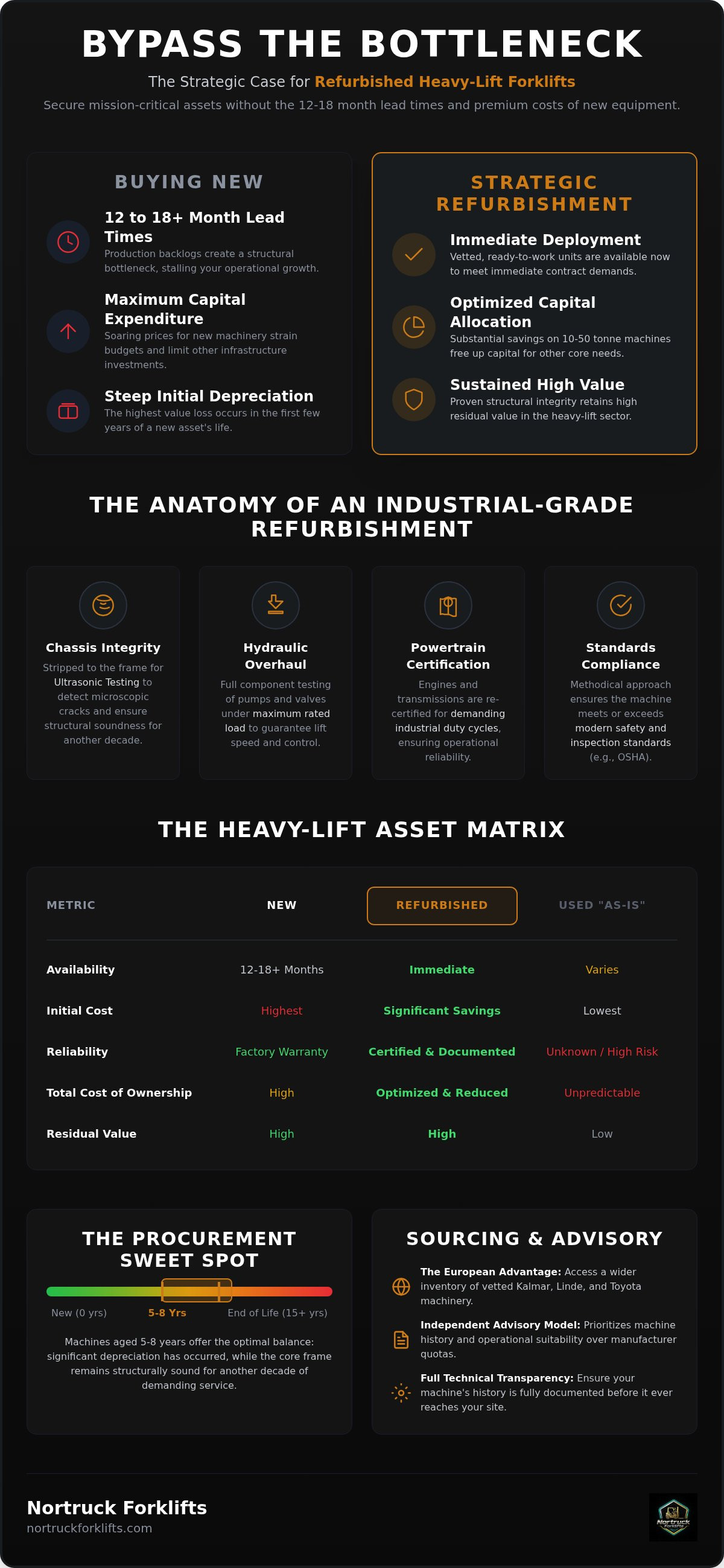
The "sweet spot" for procurement often lies in machines that are five to eight years old. These units have depreciated significantly but possess frames that remain structurally sound for another decade of service. In the 2026 market, finding high-quality refurbished heavy forklifts for sale is a calculated move to secure Tier-1 brands like Linde or Toyota without the prohibitive costs of a factory-fresh unit. Unlike the "as-is" used market, where machine history is often opaque, a vetted refurbishment provides a documented service life. These units retain high residual value because the heavy-lift sector values proven structural integrity over digital bells and whistles. Refurbished high-capacity assets provide the essential bridge between immediate operational demand and long-term fiscal responsibility for port and steel industries.
Bypassing Global Lead Times
As we move through 2026, the supply chain for new heavy equipment remains strained. Lead times for factory-new units often exceed 12 months, which can paralyze a growing operation or a terminal with an immediate contract to fulfill. Strategic sourcing allows you to bypass these delays entirely. By looking at Sourcing Kalmar Heavy Lift Trucks for Sale, managers can find ready-to-work alternatives that don't require a year-long wait. This immediate availability transforms procurement from a passive waiting game into an active tool for fleet expansion. Choosing a refurbished unit isn't just about saving money; it's about maintaining the momentum of your business while others are stuck on a manufacturer's waiting list.
Defining Refurbishment Standards for High-Capacity Equipment
A "used" machine and a "professionally refurbished" asset are fundamentally different tools. In the heavy-lift sector, where equipment manages loads between 10 and 50 tonnes, the stakes of a mechanical failure are immense. When searching for refurbished heavy forklifts for sale, it's vital to look beyond a fresh coat of paint. A true refurbishment involves stripping the machine to its chassis to perform ultrasonic testing. This process identifies microscopic cracks or structural fatigue in the heavy-gauge steel that visual inspections simply cannot detect. It ensures the frame can withstand another decade of high-intensity cycles in ports or steel mills.
The hydraulic system overhaul must go beyond simple seal replacements. High-capacity lifting requires precise pressure management. Professionals look for full component testing of pumps and valves under maximum rated capacity to ensure no loss of lift speed or control. Similarly, engines and transmissions are re-certified for industrial duty cycles. This methodical approach ensures the machine meets modern forklift safety and inspection standards, providing a level of reliability that "as-is" used units cannot match. If you aren't sure which standard a specific unit meets, you can discuss your technical requirements with an advisor.
The Core Components of a Heavy-Duty Overhaul
Proper mast and carriage alignment is critical when handling 20+ tonne loads. Even a slight deviation can lead to uneven wear or catastrophic failure under stress. Refurbishment also focuses on the steer axle and drivetrain, which face extreme torque in harsh terminal environments. By 2026, safety expectations have evolved; modernizing operator cabins is now a standard part of the process. This includes upgrading ergonomic controls and visibility aids to reduce operator fatigue and improve site safety during long shifts.
Brand-Specific Refurbishment: Kalmar and Linde
Different brands require specialized technical focus during a reset. For instance, Linde heavy forklifts are highly prized for their hydrostatic drive systems. These systems offer incredible longevity but require expert calibration to maintain their signature precision. Kalmar reachstackers and heavy lifts, on the other hand, often require specific attention to boom hydraulics and spreader attachments. While high-quality aftermarket parts have their place, critical load-bearing components should ideally remain OEM to maintain the machine's original engineering specifications. This brand-specific expertise is what separates a generic repair shop from a specialized heavy-lift partner.
Sourcing Heavy Lift Assets: The European Advantage
Europe serves as the global epicenter for high-capacity lifting gear. This isn't accidental; the continent's dense network of ports and heavy industrial zones creates a constant cycle of equipment renewal. Unlike other regions where machines are run until total failure, European maintenance cultures tend to be proactive. This results in a surplus of well-maintained assets that are ideal candidates for a second life. While the material handling economic outlook remains generally positive, the challenge for procurement managers isn't just finding a machine. It's navigating the different regulatory environments across borders to ensure the history of refurbished heavy forklifts for sale is fully transparent.
An independent advisor acts as a technical gatekeeper in this landscape. Finding "off-market" assets, units that aren't yet listed on public marketplaces, requires deep industry connections built over decades. Leveraging 40 years of expertise allows for the identification of machines coming off lease or from terminal upgrades before they reach the general used market. This insider access ensures you aren't just picking from the leftovers of a public auction but are selecting from the best available inventory in Europe.
The Sourcing Process: From Identification to Delivery
Procuring a 30 tonne Kalmar or a specialized Linde sideloader requires a methodical approach. The process follows four distinct stages to ensure operational suitability:
- Step 1: Technical specification matching. We define the exact mast height, carriage width, and attachment needs based on your specific operational load.
- Step 2: Identifying viable units. We scan the European forklift market to find machines that meet the core criteria.
- Step 3: Physical inspection. Industry experts conduct a hands-on vetting of the machine's structural and mechanical health.
- Step 4: Logistics. We manage the cross-border transport and final delivery to your industrial site, handling all documentation.
Bypassing Intermediaries for Direct Value
Working through an advisory model rather than a traditional broker network significantly reduces unnecessary markups. Most automated marketplaces don't offer human vetting; they simply list what's available. By bypassing these intermediaries, you gain direct access to the machine's true service history. Transparency is the priority here. Lars G Tarby's personal vetting in the procurement cycle means every machine is evaluated by someone who understands the internal nuances of heavy-duty duty cycles. When you look for refurbished heavy forklifts for sale, you're buying more than steel; you're buying the assurance that the machine's previous life won't become your future maintenance headache.
Critical Inspection Points for Used Heavy Forklifts
Inspecting a 30-tonne reachstacker or a high-capacity Linde unit is a far more rigorous process than checking a standard warehouse lift. When evaluating refurbished heavy forklifts for sale, the focus must be on structural integrity under extreme stress. We look specifically for hairline fractures in load-bearing welds and signs of fatigue around the mast mounting points. These areas bear the brunt of the machine's rated capacity, and any compromise here is a safety risk that paint cannot hide.
Testing the hydraulic system under maximum rated capacity is another non-negotiable step. A pump might operate quietly under a 10-tonne load but show significant pressure drop or cavitation when pushed to 40 tonnes. We monitor tire wear patterns very closely. On heavy machinery, uneven tread wear isn't just a maintenance issue; it's a primary indicator of axle misalignment or worn kingpins that could lead to costly drivetrain failures. We also verify that all electronic control systems and safety interlocks are responsive, ensuring the machine’s load-sensing technology correctly prevents unsafe maneuvers.
Specialized Inspections: Sideloaders and 4-Way Trucks
Technical vetting becomes even more complex for specialized machinery. For Combi-Lift 4-way trucks, we prioritize the synchronization of the multidirectional steering system. If the wheels don't align perfectly during a transition, the machine can crab, causing dangerous load shifts. For Baumann sideloaders, we verify platform stability and mast tilt accuracy. The platform must remain perfectly level under full extension to prevent lateral stress on the chassis, which is a common failure point in neglected units.
Port and Concrete Industry Specifics
Environmental factors dictate specific inspection priorities. Units sourced from coastal regions require deep corrosion checks, particularly in the electrical harnesses and hydraulic line fittings where salt air causes the most damage. Conversely, forklifts used in the concrete industry face issues with fine particulate ingress. Dust acts as an abrasive in the engine intake and hydraulic seals, leading to premature component wear. Rigorous steer-axle vetting is essential in these heavy-duty cycles to ensure the machine maintains its maneuverability despite the constant stress of high-capacity loads.
Expert Advisory: Navigating the Market with Nortruck
Acquiring heavy-duty equipment is a significant capital commitment that shouldn't feel like a gamble. When you look for refurbished heavy forklifts for sale, the goal isn't just to find a machine that fits your budget; it's to solve a specific lifting challenge. Whether you're managing a busy port terminal or a steel fabrication plant, the equipment must align with your duty cycles and infrastructure. This is where the transition from a transactional purchase to an expert-led strategy becomes critical.
With over 40 years of specialized experience, Lars G Tarby provides an independent perspective that manufacturer-bound dealers cannot offer. This advisory model focuses on transparency and technical suitability. We facilitate the sourcing of high-capacity assets from brands like Kalmar, Toyota, and Volvo, ensuring every unit is vetted against your specific operational requirements. By acting as an advocate for the buyer, we reduce the inherent risks of the secondary market, moving beyond surface-level aesthetics to verify the true mechanical health of the asset.
Why Experience Matters in Heavy Procurement
The primary difference between a salesperson and a heavy-lift consultant is the focus on long-term operational success. A salesperson is often driven by inventory quotas, whereas a consultant evaluates how a machine will perform in your unique environment. We tailor equipment choices to specific industrial applications, ensuring you don't overspend on unnecessary features or underspecify a machine for harsh conditions. Our global network provides access to specialized machinery that rarely reaches public auction sites, giving you a competitive advantage in a tight market.
Next Steps: Your Sourcing Consultation
Preparing for a sourcing request starts with a clear definition of your technical needs. Before we begin the search, it's helpful to document your maximum load requirements, typical surface conditions, and any height restrictions within your facility. During the Nortruck advisory process, we use these details to filter the European market for the most viable options. We don't just present you with a list of machines; we provide a technical rationale for why a specific asset is the right fit. This methodical approach ensures that your investment provides reliable service for years to come, bypassing the uncertainty of unvetted listings. If you're ready to secure a high-capacity asset, a focused consultation is the most efficient path forward.
Securing Your Next High-Capacity Asset
Navigating the heavy equipment market in 2026 requires a move away from passive waiting lists and toward active, expert-led sourcing. By prioritizing professionally vetted units over unverified used listings, you can secure the lifting capacity your operation needs without the 12-month delay typical of factory-new orders. It's about ensuring every structural weld and hydraulic pump meets industrial standards before the machine ever reaches your terminal.
Choosing refurbished heavy forklifts for sale provides a strategic path to fleet expansion that respects your capital budget and operational timelines. With the right advisory partner, you gain access to an extensive European network of premium brands like Kalmar, Linde, and Baumann. This independent approach guarantees that your next machine is selected for its technical suitability and proven history rather than a manufacturer's sales quota.
Lars G Tarby brings over 40 years of industrial experience to every consultation, offering the transparency and specialized knowledge required for high-stakes procurement. We're ready to help you find the right solution for your specific lifting challenges.
Frequently Asked Questions
What is the difference between a used and a refurbished heavy forklift?
Refurbishment goes beyond a basic checkup to include a full technical reset of the machine. While a used unit is typically sold in its current state with unknown wear, a refurbished asset is stripped to the chassis for structural vetting. This process involve ultrasonic testing of the frame and a complete overhaul of the hydraulic and drivetrain systems. It ensures the machine can handle its original rated capacity for another decade of service.
Which brands are best for heavy-duty refurbishment?
Brands with over-engineered frames like Kalmar and Linde are the most suitable candidates for high-capacity refurbishment. Kalmar's heavy-gauge steel chassis and Linde's durable hydrostatic drives are designed to outlast their original components. These manufacturers build machines that can be effectively reset to factory-like performance. We also see excellent results with Baumann sideloaders and Toyota heavy-duty units when they're sourced through vetted European networks.
How much can I save by purchasing a refurbished heavy lift truck?
Choosing refurbished heavy forklifts for sale allows you to secure Tier-1 lifting assets at a much lower capital entry point than new equipment. While factory-new units often carry a premium and 12-month lead times, refurbished models provide immediate operational availability. This approach preserves your cash flow for other infrastructure needs while still delivering a machine capable of handling loads from 10 to over 50 tonnes in demanding industrial environments.
Are refurbished heavy forklifts reliable for 24/7 port operations?
A professionally refurbished machine is fully capable of handling 24/7 duty cycles in port or steel terminal environments. Reliability depends entirely on the depth of the technical overhaul rather than the age of the machine. By vetting the service history and performing pressure tests under maximum load, we ensure these assets meet the same operational benchmarks as new units. Expert independent advisory is the key to identifying machines that are truly port-ready.
How long does it take to source a refurbished Kalmar forklift from Europe?
Sourcing a high-capacity Kalmar from the European market typically takes a fraction of the time required for a new factory order. While new builds currently face backlogs exceeding one year, we can often identify, vet, and deliver a refurbished unit within a few months. The exact timeline depends on your specific technical requirements, such as mast height or attachment needs. Our European network allows us to find off-market assets that are ready for immediate inspection.
Do you provide warranties on refurbished heavy lifting equipment?
Warranty terms for refurbished equipment are typically negotiated based on the specific machine and the scope of the overhaul. While we don't provide on-site maintenance ourselves, we act as your advocate to ensure the refurbishment includes documented guarantees on core components like the engine and transmission. We help you vet these contracts to ensure you have clear recourse and technical support. This transparency is a cornerstone of our independent advisory model.
Can I source specific attachments for a refurbished heavy forklift?
We can certainly source specialized attachments to match your refurbished heavy forklift. Whether you need container spreaders for a reachstacker or heavy-duty pipe clamps for a Volvo loader, these can be integrated during the procurement process. We ensure the hydraulic system is correctly calibrated to handle the additional attachments. This customization allows you to solve specific lifting challenges without the long wait times associated with ordering specialized equipment from a manufacturer.
What are the most common failure points in used high-capacity forklifts?
High-capacity machines often show wear in three critical areas: load-bearing welds, hydraulic pumps, and steer axles. Stress fractures in the chassis are common in units that have been consistently overloaded in port environments. Hydraulic systems may also suffer from pressure loss that only becomes apparent under maximum load. We prioritize the vetting of these points when searching for refurbished heavy forklifts for sale, ensuring that any potential failure points are addressed before delivery.

Article by
Lars Gunnar Tärby
Disclaimer
1. General Information and No AdviceThe information, articles, product descriptions, and specifications provided on this website (www.nortruckforklifts.com) are for general informational and educational purposes only. While we strive to provide accurate and up-to-date content regarding new and used forklifts and heavy machinery, the material published does not constitute professional, technical, or legal advice.
2. Product Specifications and PricingNortruck Forklifts acts as a facilitator for the trade of new and used forklifts. All equipment details, including but not limited to year of manufacture, operating hours, lift capacity, dimensions, conditions, and pricing, are provided based on the information available to us at the time of publication. Specifications and availability are subject to change without prior notice.
3. "As Is" and VerificationAll articles and product listings are provided on an "as is" and "as available" basis without any warranties of any kind, either express or implied. Nortruck Forklifts does not guarantee that the descriptions are entirely error-free, complete, or reliable. Buyers and traders are strongly encouraged to independently verify all technical specifications, machine history, and equipment conditions directly with the seller or an authorized inspector before finalizing any purchase or transaction.
4. Limitation of LiabilityIn no event shall Nortruck Forklifts, its owners, or its contributors be held liable for any direct, indirect, incidental, consequential, or economic loss or damage arising out of the use of, or the inability to use, the information provided on this website, or any transactions facilitated through this platform. This includes, but is not limited to, damages caused by technical inaccuracies, typographical errors, or reliance on the content of our articles.
5. Third-Party LinksOur website may contain links to external websites, dealer networks, or third-party services that are not owned or controlled by Nortruck Forklifts. We have no control over, and assume no responsibility for, the content, privacy policies, or practices of any third-party websites.


