
Is the most reliable forklift always the best investment for your specific operation? Many fleet managers assume the choice between a Linde vs Toyota heavy forklift comes down to a simple reliability contest, but that perspective often leads to mismatched machinery and inflated long-term costs. You likely already know that both manufacturers dominate the high-capacity market for a reason. However, the anxiety of choosing a drive system that doesn't fit your duty cycle or worrying about the hidden maintenance history of a used unit can make the procurement process feel like a high-stakes gamble.
I've designed this guide to provide an expert comparison that cuts through the marketing fluff to help you source the right heavy-duty truck for your environment. We'll examine the 2026 landscape, including how Linde's hydrostatic precision stacks up against Toyota's mechanical simplicity in high-capacity applications. You'll gain a clear understanding of which brand suits your specific floor conditions, learn professional criteria for inspecting used European stock, and discover how to navigate the latest 2026 regulations. By the end of this article, you'll have the technical insight needed to secure a machine that delivers operational efficiency without the traditional dealership bias.
Key Takeaways
- Understand why the choice between Linde's hydrostatic drive and Toyota’s torque converter system dictates your machine's performance in high-intensity heavy lifting.
- Evaluate the 2026 Total Cost of Ownership by comparing acquisition costs and the long-term maintenance trade-offs between precision engineering and mechanical simplicity.
- Master a professional 5-step inspection process to verify the "hidden" history of used European units before you commit to a purchase.
- Identify whether a Linde vs Toyota heavy forklift aligns better with your specific application, whether you require high-precision load handling or straightforward, rugged reliability.
- Learn how to leverage the European market to source high-capacity models that are often difficult to find in local inventory.
Linde vs Toyota: Engineering Philosophies for Heavy Lifting
Choosing between a Linde vs Toyota heavy forklift involves more than comparing lift capacities. It's an evaluation of two distinct engineering legacies. While the basic Forklift has existed for over a century, the technology used to manage 10 to 50 tonnes has split into two primary camps: hydrostatic precision and mechanical simplicity. Understanding these core differences is essential for any operation looking to source used equipment from the European market, where both brands are prevalent but serve very different operational needs.
Why does this matter for used equipment? In the heavy-lift world, a machine's "DNA" determines its second-life potential. As an independent advisor with 40 years in the field, I've seen how these philosophies impact maintenance costs five years down the line. We focus on matching the drive system to your specific duty cycle rather than pushing a single brand's agenda. When you're moving 30 tonnes, the way that power reaches the wheels changes everything from fuel consumption to operator safety.
The Linde Hydrostatic Advantage
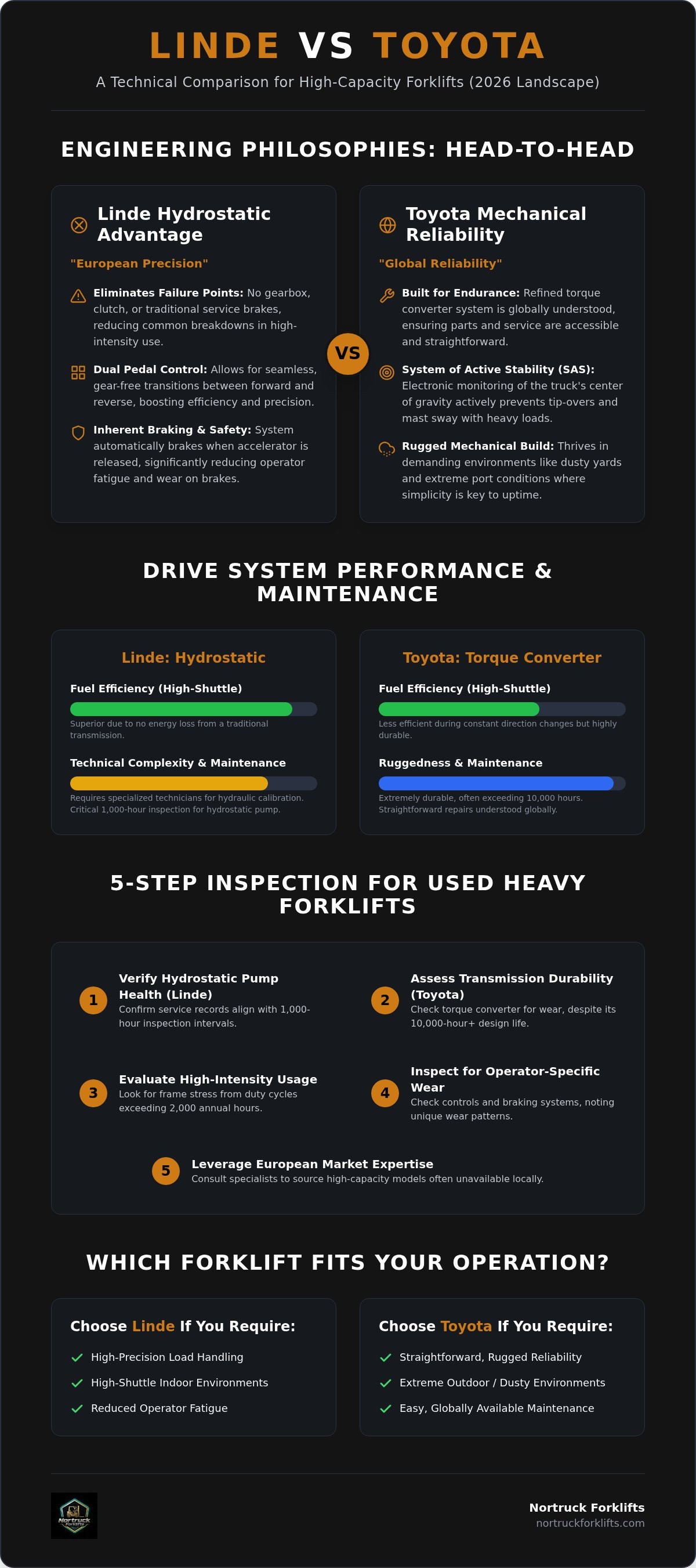
Linde’s hydrostatic drive is the hallmark of European precision. By eliminating the gearbox, clutch, and traditional service brakes, Linde removes the most common failure points in high-intensity applications. Operators benefit from a "dual pedal" control system, allowing for seamless transitions between forward and reverse without shifting gears. This is particularly valuable when maneuvering high-value heavy loads like concrete or steel, where jerky movements can lead to costly damage. The system provides an inherent braking effect the moment the accelerator is released, which significantly reduces operator fatigue during long shifts.
The Toyota Mechanical Reliability
Toyota's philosophy centers on global reliability and the "Toyota Production System." Their heavy-capacity trucks typically use a refined torque converter system that's built for endurance and familiarity. It's a mechanical approach that maintenance teams around the world understand, ensuring that parts are accessible and repairs are straightforward. A critical feature of a Toyota vs Linde heavy forklift comparison is Toyota's System of Active Stability (SAS). This electronic system monitors the truck’s center of gravity and mast height, automatically adjusting to prevent tip-overs or mast sway. When you're lifting massive loads, that electronic oversight provides a layer of security that complements the rugged, mechanical build.
Drive Systems and Operational Performance in Heavy Duty Roles
Operational success in heavy lifting depends entirely on how power is transferred from the engine to the ground. When evaluating a Linde vs Toyota heavy forklift, you're choosing between two fundamentally different drive architectures. Most standard warehouse trucks fall under basic OSHA forklift classifications, but once you move into the 10-tonne to 50-tonne range, the performance profile changes. In 2026, the duty cycle for a 15-tonne forklift is defined by high-intensity shifts exceeding 2,000 annual hours, requiring consistent hydraulic pressure for heavy load positioning and high-torque travel over uneven yard surfaces.
Linde’s hydrostatic system offers superior fuel efficiency in high-shuttle applications because it eliminates the energy loss found in traditional transmissions. However, this efficiency comes with a trade-off in technical complexity. Toyota’s torque converter system is less efficient during constant direction changes but provides a rugged, mechanical connection that thrives in dusty yards and extreme port environments. If you are unsure which drive system fits your yard's specific layout, consulting an independent specialist can prevent a costly technical mismatch.
Maintenance Realities for Used Units
Buying a used Linde vs Toyota heavy forklift requires a look at long-term component life. In used Linde trucks, the hydrostatic pump is the heart of the machine; if it hasn't been serviced according to the 2026 updated 1,000-hour inspection intervals, replacement costs can be substantial. Conversely, Toyota’s converter and transmission are known for their durability, often exceeding 10,000 hours without a major overhaul. While Linde requires specialized technicians to calibrate hydraulic pressures, Toyota models can typically be serviced by any competent heavy-machinery mechanic. This makes Toyota a safer bet for remote operations where specialized European support is limited.
Ergonomics and Precision at Capacity
Precision is paramount when you're handling a 25-tonne load. Linde’s dual-pedal system allows the operator to control movement with millimetre accuracy, which is a significant advantage in tight loading bays. The absence of a traditional gearbox means there's no "shift shock," reducing stress on the mast and the load. Toyota uses a more traditional layout, but their recent 10t+ models have integrated advanced mast stability controls to meet 2026 ergonomic standards. These standards prioritize operator visibility and vibration reduction, which directly impacts the resale value of used equipment. A machine that protects the operator from fatigue will always hold a higher value in the second-hand market.
Calculating the 2026 Total Cost of Ownership (TCO)
Financial decisions regarding heavy equipment often focus too heavily on the initial invoice. For a Linde vs Toyota heavy forklift, the real story unfolds over the first five years of operation. In the European market, used Linde units frequently command a higher upfront price compared to Toyota models of similar age and capacity. This premium is typically justified by the machine's efficiency and the sophisticated engineering discussed in earlier sections. However, your actual TCO depends on how you balance that acquisition cost against fuel consumption, maintenance frequency, and the eventual resale value in an evolving industrial market.
Asset management in 2026 requires a forward-looking perspective. As regulations like the CARB zero-emission mandates begin to influence global fleet strategies, the valuation of internal combustion (IC) trucks is changing. While the upfront cost of a used Toyota might be lower, you must account for the specific duty cycle of your facility. If your operation involves high-intensity shuttle work, the fuel savings from a more efficient drive system can pay for the price gap within eighteen months. Conversely, for lower-intensity tasks, the simpler mechanical layout of a Toyota may offer better long-term value through reduced service complexity.
Fuel and Energy Efficiency Trends
Energy costs remain a primary driver of TCO. Linde’s engine management systems are designed to minimize fuel consumption by precisely matching engine output to hydraulic demand. This can result in a lower operational cost per hour for 12-tonne units compared to traditional IC engines that lack such granular control. Toyota has countered this with their own fuel-efficient IC engines that prioritize high torque at low RPMs, which reduces engine wear while maintaining productivity. We're also seeing a significant impact from high capacity electric forklift trends. As electrification becomes the standard for new 10-tonne to 18-tonne models, the demand for used IC trucks is shifting. This transition is creating opportunities to source high-quality used diesel or LPG units at more competitive prices as larger European fleets begin their transition to zero-emission technology.
Resale and Long-term Asset Value
Residual value is where these two brands diverge most sharply. Linde heavy trucks are often viewed as premium assets in Europe. They maintain a higher percentage of their original value due to their specialized hydrostatic systems and reputation for longevity in demanding environments. Toyota, however, offers unmatched liquidity. Because Toyota parts are so widely available and the machines are simple to maintain, they're easier to sell quickly in the global second-hand market. Where you source the machine also plays a role. Sourcing from the European market allows you to tap into a higher density of well-maintained, high-spec machines. This typically leads to a more reliable maintenance history, which directly improves the long-term asset value compared to units sourced from regions with less stringent maintenance cultures.
Expert Sourcing: Finding High-Quality Used Heavy Forklifts
Sourcing a high-capacity machine requires a different level of scrutiny than buying a standard warehouse truck. When you move into the 10-tonne to 50-tonne range, the local market often lacks the specific models needed for specialized industrial roles. This is where my 40 years of experience in the European machinery market becomes a critical asset. An independent advisor understands the "hidden" history of a machine, looking past a fresh coat of paint to identify whether a unit was used in a clean timber yard or a corrosive coastal port. The choice between a Linde vs Toyota heavy forklift often depends on what is available in the used market and how well those specific units have been maintained by their previous owners.
The inspection process for a used Linde heavy forklift must prioritize the hydrostatic system. We use a 5-step process that includes testing hydraulic oil purity, checking pump pressure under full load, and verifying the responsiveness of the dual-pedal control. For a used Toyota heavy forklift, the focus shifts to the System of Active Stability (SAS) and the mechanical transmission. We look for "red flags" like inconsistent shifting or wear at the mast pivot points, which are common in high-capacity trucks that have been pushed beyond their duty cycle.
The European Sourcing Advantage
Europe offers the highest density of heavy-lift equipment in the world, providing a much wider inventory of specialized models than most regional markets. Working with an independent advisor like Nortruck allows you to navigate the logistics and technical inspections across different jurisdictions with confidence. We handle the complexities of verifying maintenance records and ensuring that the machine meets your specific operational requirements before it ever leaves the yard. This direct approach removes unnecessary intermediaries and ensures you receive honest, technical feedback on every potential unit.
Technical Checklist for High-Capacity Units
Every 20-tonne plus machine undergoes a rigorous technical evaluation. This includes pressure testing the hydraulic cylinders and pumps to ensure they can sustain rated capacity without drift. We also verify engine health and compliance with emission standards, such as Stage V requirements, which are increasingly important for 2026 industrial operations. Finally, we conduct a thorough structural integrity check. We look for stress fractures in the chassis and mast, particularly around high-stress weld points, to ensure the machine is safe for another decade of service.
Conclusion: Matching the Machine to Your Operation
The final decision between a Linde vs Toyota heavy forklift isn't about which brand is objectively superior. It's about which tool fits the specific geometry and intensity of your work. If your operation demands high-precision handling of specialized loads where every millimetre counts, Linde's hydrostatic system remains the industry standard. It thrives in high-intensity shifts where the reduction in operator fatigue and brake wear translates into direct bottom-line savings. Conversely, if you require a rugged workhorse for standard heavy-duty roles, Toyota’s mechanical reliability and ease of maintenance make it a formidable choice. Their machines offer high liquidity in the used market, making them excellent assets for businesses that value flexibility and straightforward serviceability.
Sometimes the best solution lies outside these two giants. For extreme lifting requirements over 30 tonnes, Kalmar heavy lift trucks offer specialized port and terminal performance that few others can match. If your application involves long, awkward loads like timber or steel beams, Baumann sideloaders provide a level of stability that standard counterbalance trucks cannot replicate. My role as an independent advisor is to look beyond the most popular brands to find the exact machine for your niche, ensuring you don't pay for technology you don't need or compromise on capacity you do.
Decision Matrix for Heavy Lift Procurement
Success in procurement depends on three primary factors. First, consider your operating environment. Indoor precision and smooth floors favor the Linde hydrostatic drive, while outdoor ruggedness and uneven yards often suit Toyota’s mechanical layout. Second, evaluate your maintenance infrastructure. Do you have an in-house team capable of managing complex hydraulics, or do you rely on external service contracts? Finally, define your asset strategy. Are you looking for a long-term performance machine to run for a decade, or do you need a liquid asset that can be easily resold if your contract requirements change?
Your Next Steps with Nortruck
Navigating the European market for high-capacity machinery requires more than just a list of specifications. It requires an "insider" perspective to verify the history and suitability of every unit. By consulting with Lars G Tarby, you gain access to 40 years of technical expertise and a network that identifies high-quality machines before they hit the open market. We specialize in helping you understand how to buy a used forklift that fits your specific duty cycle and budget without the pressure of a dealership sales quota.
If you're ready to secure a reliable, high-capacity machine from the European market, we're here to provide the direct, honest communication you need to make an informed investment. Let's discuss your operational requirements and find the machine that will drive your business forward through 2026 and beyond.
Securing the Right Heavy-Duty Asset for 2026
Deciding on a Linde vs Toyota heavy forklift requires a clear-eyed look at your specific operational duty cycle rather than following brand loyalty. You now understand that while Linde provides unmatched precision for specialized loads, Toyota offers the mechanical simplicity and global liquidity that many standard operations value. Balancing these technical merits against long-term maintenance costs and the shifting landscape of 2026 regulations ensures your investment remains productive for years to come.
I've spent over 40 years helping businesses navigate these exact decisions. As an independent advisor not tied to any single manufacturer, I leverage a global sourcing network across Europe to find the specific Kalmar, Linde, or Toyota units that meet your technical requirements. We focus on transparency and direct dealings to ensure you get a machine with a verifiable history and the right engineering for your floor.
Finding the right heavy lift truck doesn't have to be a gamble. With the right expert guidance and a focus on operational suitability, you can secure a high-capacity machine that delivers consistent value to your fleet.
Frequently Asked Questions
Is a used Linde heavy forklift harder to maintain than a Toyota?
Linde forklifts require a more specialized technical skill set but have fewer mechanical wearing parts. While Toyota’s mechanical layout is familiar to most heavy machinery mechanics, Linde’s hydrostatic system eliminates traditional brakes and clutches that frequently wear out. You don't have to worry about clutch replacements, but you must ensure your technicians understand how to calibrate hydraulic pressures to maintain peak performance levels.
Which brand offers better fuel efficiency in the 10-25 tonne range?
Linde typically provides superior fuel efficiency in high-intensity shuttle applications. The hydrostatic drive allows the engine to operate at its most efficient RPM regardless of the travel speed, reducing wasted energy. In a Linde vs Toyota heavy forklift comparison, Toyota’s torque converter is rugged but loses more energy during constant direction changes. Linde is the better investment if your duty cycle involves continuous movement and frequent reversing.
What is the life expectancy of a Linde hydrostatic drive in a heavy lift truck?
A well-maintained Linde hydrostatic drive can reliably last between 15,000 and 20,000 operating hours. Reaching this milestone depends entirely on strict adherence to hydraulic oil and filter change intervals. In 2026, we recommend a professional pressure test every 1,000 hours to monitor for internal wear. Once the system reaches its limit, a factory-authorized refurbishment is usually more cost-effective than attempting a local repair on the pump unit.
Does Toyota's SAS system work effectively on forklifts over 10 tonnes?
Toyota’s System of Active Stability (SAS) is a core safety feature that remains highly effective on models exceeding 10 tonnes. It uses electronic sensors to monitor the load center and mast height, automatically locking the swing lock cylinder to prevent lateral instability. This technology provides a critical safety net during high-capacity lifts. It offers operators peace of mind without complicating the rugged, mechanical nature of the truck’s drive system.
How do I verify the service history of a heavy forklift sourced from Europe?
Verifying history requires a combination of digital log analysis and physical forensic inspection. Many large European fleets maintain meticulous digital records, but these don't always tell the full story. We look for signs of "hidden" history, such as stress fractures in the chassis or specific wear patterns on the mast channels. An independent advisor can cross-reference the hour meter against component wear to ensure the machine’s history is transparent and accurate.
Are parts for older Linde heavy forklifts still readily available in 2026?
Parts support for older Linde heavy models remains robust across Europe in 2026. Linde’s logistics network is designed to support machines well into their second and third decades of service. While certain legacy electronic controllers may require longer lead times, the primary hydraulic pumps, seals, and engine components are stocked globally. We help clients identify specific model years that offer the most reliable long-term parts availability before they purchase.
Which brand has a higher resale value for high-capacity models?
Linde high-capacity trucks generally command a higher resale premium due to their specialized engineering and longevity. However, Toyota models often offer better liquidity in the global market. Because Toyota’s mechanical systems are easier to service in regions with basic infrastructure, they attract a wider pool of international buyers. You should choose Linde for a higher eventual price or Toyota if you value the ability to sell the asset quickly.
Can Nortruck help with the technical inspection of a used Toyota heavy forklift?
Nortruck provides detailed, independent technical inspections for Toyota heavy forklifts throughout the European market. We act as your technical advocate, performing pressure tests on the hydraulic system and conducting thorough engine diagnostics. Our 40 years of experience allow us to identify potential issues that a standard dealership inspection might overlook. We ensure that any used unit you consider is structurally sound and fit for your specific industrial application.

Article by
Lars Gunnar Tärby
Disclaimer
1. General Information and No AdviceThe information, articles, product descriptions, and specifications provided on this website (www.nortruckforklifts.com) are for general informational and educational purposes only. While we strive to provide accurate and up-to-date content regarding new and used forklifts and heavy machinery, the material published does not constitute professional, technical, or legal advice.
2. Product Specifications and PricingNortruck Forklifts acts as a facilitator for the trade of new and used forklifts. All equipment details, including but not limited to year of manufacture, operating hours, lift capacity, dimensions, conditions, and pricing, are provided based on the information available to us at the time of publication. Specifications and availability are subject to change without prior notice.
3. "As Is" and VerificationAll articles and product listings are provided on an "as is" and "as available" basis without any warranties of any kind, either express or implied. Nortruck Forklifts does not guarantee that the descriptions are entirely error-free, complete, or reliable. Buyers and traders are strongly encouraged to independently verify all technical specifications, machine history, and equipment conditions directly with the seller or an authorized inspector before finalizing any purchase or transaction.
4. Limitation of LiabilityIn no event shall Nortruck Forklifts, its owners, or its contributors be held liable for any direct, indirect, incidental, consequential, or economic loss or damage arising out of the use of, or the inability to use, the information provided on this website, or any transactions facilitated through this platform. This includes, but is not limited to, damages caused by technical inaccuracies, typographical errors, or reliance on the content of our articles.
5. Third-Party LinksOur website may contain links to external websites, dealer networks, or third-party services that are not owned or controlled by Nortruck Forklifts. We have no control over, and assume no responsibility for, the content, privacy policies, or practices of any third-party websites.


