
Why do most standard heavy lift trucks fail within their first year of service in a steel mill? It's a question we often hear from operators who are tired of seeing expensive machinery sidelined by dust-clogged radiators or heat-warped seals. You understand that raw lifting capacity is only half the battle. In an environment defined by extreme temperatures and abrasive particles, finding a reliable forklift for steel industry work requires a shift in perspective from general material handling to specialized engineering.
We've seen how the right machine can transform operational efficiency while the wrong one becomes a permanent resident of the maintenance bay. This 2026 guide will help you identify the critical technical requirements for high-heat environments and share proven strategies for sourcing robust machinery across Europe. We'll examine how to distinguish between a standard heavy lift and a true steel-spec machine; this ensures you reduce your total cost of ownership while maintaining a safe, productive floor. From navigating the June 2026 tariff changes to selecting specialized attachments, we'll give you the clarity needed to make a confident investment.
Key Takeaways
- Learn to identify the specific engineering modifications required to protect your machinery from the intense heat and abrasive dust found in steel mills.
- Discover when to utilize specialized Baumann sideloaders instead of traditional counterbalance trucks for handling long structural beams and pipes.
- Understand the technical specifications, such as reinforced chassis and elevated cabs, that define a reliable forklift for steel industry operations.
- Explore sourcing strategies for used high-capacity equipment across Europe to maximize your return on investment and reduce total cost of ownership.
- See how brand-agnostic advisory helps you match the right machine to your specific operational needs rather than settling for a standard catalog option.
The Brutal Reality of Steel Mill Logistics: Why Standard Lifts Fail
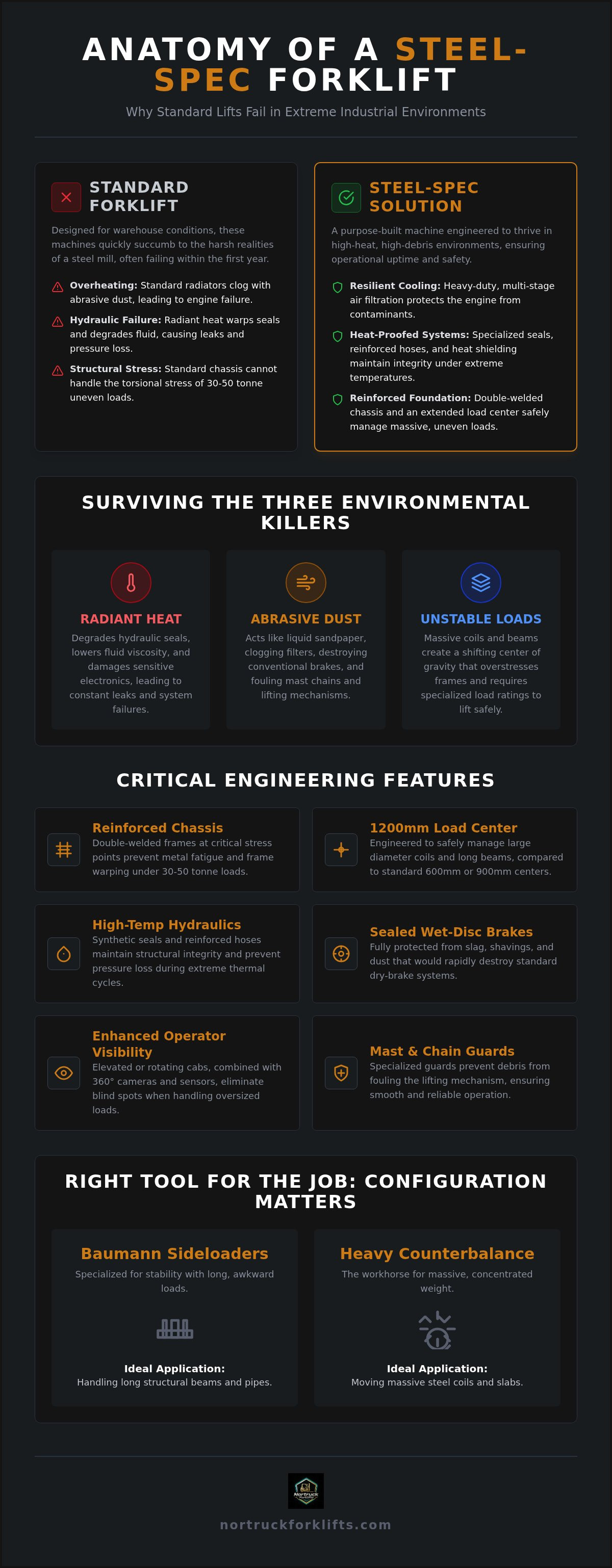
Operating in a steel mill isn't just about moving weight; it's about surviving a hostile environment. A standard 5-tonne warehouse lift is completely irrelevant in this sector. We operate in the 10 to 50-tonne range where the physics of the load and the chemistry of the air change the rules of engagement. When we talk about a forklift for steel industry applications, we aren't describing a beefed-up warehouse truck. We're describing a specialized industrial tool engineered to withstand three primary enemies: intense radiant heat, pervasive abrasive dust, and the shifting center of gravity found in uneven loads. These machines are the backbone of the yard, and their failure can halt an entire production line.
While a comprehensive overview of forklift types shows a wide range of utility, the "steel-spec" machine is a different breed. These units feature reinforced chassis and heavy-duty cooling systems that standard models simply don't possess. One of the most critical distinctions is the load center. While a standard truck might be rated at a 600mm or 900mm center, steel handling often demands a 1200mm load center. This is necessary to safely manage the massive diameter of steel coils or the extended reach required for structural beams. Without this specific rating, your lifting capacity drops off a cliff the moment you tilt the mast. It's a matter of safety and operational physics that cannot be ignored.
Thermal Challenges in Smelting and Casting
Radiant heat is a silent killer of machinery. It doesn't just make the operator uncomfortable; it actively degrades hydraulic seals and fries sensitive electronics. In smelting areas, the ambient temperature can spike rapidly, causing standard fluids to lose viscosity. To counter this, steel-spec trucks require heat-shielding on the carriage and high-temperature fluid options. Heat-resistant hydraulics for heavy lift trucks utilize specialized synthetic seals and reinforced hoses that maintain structural integrity when exposed to extreme thermal cycles. This prevents the frequent leaks and pressure losses that plague standard machinery in hot-run environments.
Managing Abrasive Metal Dust and Debris
Metal dust is essentially liquid sandpaper for your engine. Standard filters clog in hours, leading to overheating and catastrophic failure. Heavy-duty, multi-stage air filtration systems are mandatory to keep the intake clean. Just as critical are the brakes. We always recommend sealed wet-disc brakes because they're protected from the slag and metal shavings that would shred a standard dry-brake system. Protecting the mast and chains is equally vital; specialized guards prevent debris from fouling the lifting mechanism. This ensures the machine remains operational in the thick of production rather than sitting in the repair shop.
Engineering for Extremes: Key Features of a High Capacity Forklift
The structural integrity of a forklift for steel industry use begins with a chassis that can handle the torsional stress of 30 to 50-tonne loads. Unlike standard machinery, these frames are often double-welded and reinforced at critical stress points to prevent metal fatigue over years of high-cycle operation. This foundational strength is what allows for the precise movement of massive steel billets or slabs without the risk of frame warping. When sourcing Kalmar heavy lift trucks for sale, we prioritize these reinforced designs because they directly impact the long-term safety and resale value of the fleet.
Visibility remains a significant challenge when handling bulky, oversized loads like wide plates or structural beams. To solve this, high-capacity lifts often feature elevated or rotating cabs that give the operator a clear line of sight over the load. Modern 2026 models frequently integrate 360-degree camera systems and proximity sensors to eliminate blind spots. These technologies don't just protect the inventory; they're essential for complying with OSHA safety regulations regarding pedestrian safety in high-traffic industrial zones. If you're evaluating your current fleet's safety profile, speaking with a technical advisor can help identify which visibility upgrades are most cost-effective for your specific yard layout.
We're also seeing a significant shift toward electrification in the high-capacity sector. While diesel was once the only choice for 30-tonne lifts, lithium-ion technology has matured to handle the demanding duty cycles of a steel mill. These electric units offer the hydraulic precision needed for the delicate placement of high-value finished steel, such as cold-rolled coils that are easily damaged by jerky movements. The lack of engine vibrations and zero tailpipe emissions also significantly improves the working environment inside enclosed processing facilities.
Specialized Attachments for Steel Handling
The interface between the machine and the steel is where efficiency is won or lost. Choosing the right attachment is vital:
- Coil Rams: These heavy-duty probes are essential for moving steel coils through the center, offering better stability than standard forks.
- Magnetic Attachments: Ideal for plate handling, magnets allow for faster pickup and placement without the need for manual rigging or spacers.
- Wide Carriage Fork Positioners: These allow operators to adjust fork spread from the cab to accommodate varying widths of structural steel.
Operator Safety and Ergonomics in High-Stakes Zones
In a steel mill, the operator's cab is their sanctuary. Every machine must be equipped with FOPS (Falling Object Protective Structure) and ROPS (Roll-Over Protective Structure) certified cabs to guard against falling debris or accidental tips. Because of the abrasive dust mentioned in previous sections, high-end climate control and multi-stage air purification systems are no longer luxuries; they're requirements for operator health. Ergonomic joystick controls and air-suspension seating also play a critical role. By reducing physical fatigue, these features help prevent the late-shift lapses in judgment that lead to high-capacity handling accidents.
Choosing Your Configuration: Sideloaders vs. Heavy Forklifts
Selecting the right configuration for a forklift for steel industry operations is not a matter of brand loyalty. It is a decision driven by the geometry of your inventory. If your primary task involves moving compact, high-density items like steel coils or billets, a traditional counterbalance forklift is often the most versatile choice. These machines offer massive lifting capacities, often ranging from 10 to 50 tonnes, and provide the stability needed for high-density vertical stacking. However, their physical footprint is substantial. Because the load is carried in front, these trucks require wide aisles to navigate and turn, which can limit storage density in smaller yards or indoor facilities.
For operations where space is at a premium, multidirectional trucks, such as those from Combi-Lift, offer a hybrid solution. These machines combine the features of a standard lift and a 4-way truck, allowing for narrow-aisle storage of long steel products while maintaining the ability to handle standard pallets. Deciding between these configurations requires an honest assessment of your current aisle widths and the specific mix of products you handle daily. We often find that a mix of machine types provides the best balance of speed and storage efficiency.
Sideloaders: The Long-Load Specialists
When you're handling 12-meter structural beams or long bundles of rebar, a standard forklift becomes a safety liability. Carrying long loads perpendicular to the direction of travel creates significant "swing" hazards and requires massive aisle widths. This is where Baumann Sideloaders excel. By carrying the load on a side platform parallel to the direction of travel, these machines can navigate narrow aisles and doorways with ease. This configuration significantly improves safety by keeping the load stable on the truck's bed rather than suspended on forks. For structural steel and pipe transport, the sideloader is the specialized tool that prevents site accidents and inventory damage.
Heavy Forklifts and Reachstackers: The Powerhouses
In large-scale yard management, you might need to evaluate a heavy forklift vs reachstacker. While a traditional heavy lift is excellent for high-density stacking and general versatility, a reachstacker offers superior depth. Reachstackers can pick up a load from a second or third row, which is invaluable in crowded port terminals or large steel distribution centers. They provide a level of flexibility in yard layout that a standard counterbalance truck cannot match. This allows you to organize your yard by product type rather than just accessibility, potentially increasing your total storage capacity by 20 percent or more.
The Procurement Strategy: Sourcing Reliable Steel Machinery in Europe
Sourcing a forklift for steel industry operations in 2026 requires a balance of financial pragmatism and technical scrutiny. Buying new is a massive capital expenditure that doesn't always offer the best return on investment. High-capacity trucks from brands like Kalmar, Linde, or Toyota are engineered for decades of service. When you source a well-maintained five-year-old unit, you're often securing 70 percent of the machine's useful life at a fraction of the original cost. This logic has become even more compelling following the June 8, 2026, changes to Section 232 tariffs, which reduced rates on certain heavy machinery from 25 percent to 15 percent, easing the financial burden of cross-border acquisitions.
The danger lies in the "private" used market. In the heavy equipment sector, a deal that looks too good to be true usually is. We've seen buyers get burned by machines that look pristine but hide catastrophic structural fatigue. Verifying the service history in a harsh mill environment is non-negotiable. You're looking for evidence of proactive maintenance rather than just emergency repairs. Without a transparent paper trail, you're not just buying a machine; you're inheriting someone else's maintenance nightmare.
The Expert Inspection Checklist
A visual inspection is only the first step. You must look for mast stress cracks, which are common in steel handling due to the constant torsional stress of uneven loads. Check every hydraulic fitting for signs of heat-related hardening or weeping. We consider a professional oil analysis to be the ultimate trust factor in any transaction. By testing the engine and transmission fluids for metallic wear particles, we can identify internal component failure long before it sidelines the machine. This "blood test" for the truck provides a level of transparency that a simple test drive cannot match. For a deeper dive into these risks, review our Used Heavy Lifting Equipment Inspection Checklist.
Logistics and Importation for Heavy Assets
Moving a 40-tonne forklift for steel industry use across European borders is a complex logistical feat. It's not like shipping a standard pallet. It involves specialized low-loader transport, oversized load permits, and a deep understanding of local safety certifications. Ensuring the machine complies with specific regional regulations is vital to avoid costly delays at the port or site. An independent advisor simplifies this "source-to-site" journey by managing the technical verification and the logistical hurdles simultaneously. This ensures the machine arrives ready to work, with all necessary documentation and safety clearances in place.
Navigating the Market with a Specialized Forklift Advisor
Investing in a forklift for steel industry applications is a high-stakes decision where mistakes are measured in six figures. A manufacturer's sales brochure will always claim their machine is the perfect fit for every scenario. However, 40 years of industry experience, such as that provided by Lars G Tarby, offers a perspective that glossy marketing materials cannot. Experience tells us which machines actually survive the 24/7 radiant heat of a smelting plant and which ones suffer from recurring electronic failures in high-dust environments. This "insider" knowledge is what prevents you from over-speccing a machine with expensive features you'll never use or, worse, under-speccing a truck that fails under the pressure of a double shift.
Our advisory process is strictly brand-agnostic. Because we source from a diverse European network, we aren't incentivized to push one specific manufacturer. Our priority is finding the best tool for your specific yard geometry and budget. This network allows us to locate "hidden gems"—well-maintained, used machines from reliable European fleets that haven't yet hit the open market. We act as your advocate, ensuring the machine you purchase has the technical specifications to thrive in your specific mill environment while maintaining a transparent sourcing process from start to finish.
Tailored Sourcing: From Kalmar to Toyota
Matching your mill's requirements to the strengths of different manufacturers is key to reducing the total cost of ownership (TCO). While Kalmar is often the gold standard for pure lifting power in the 30 to 50-tonne range, a Linde or Toyota might offer superior fuel efficiency or parts availability for your specific region. We recently helped a client choose a machine that had a slightly higher purchase price but offered a 15 percent reduction in TCO over five years due to its lower maintenance requirements in abrasive environments. Understanding which brands hold their resale value best is also vital. In the steel sector, machines with a proven track record for durability, like those from Kalmar or Baumann, often command higher prices on the secondary market, protecting your long-term capital investment.
Ready to Secure Your Next Heavy Lift?
Procuring heavy machinery in 2026 doesn't have to be a gamble. By combining technical advisory with a deep knowledge of the European inventory, you can secure a machine that delivers both performance and reliability. We invite you to a professional consultation where we can discuss your specific operational needs without the pressure of a showroom environment. Our goal is to ensure you have the right equipment to keep your steel production moving safely and efficiently.
Securing Your Operational Future in Steel Logistics
Selecting a forklift for steel industry duty is a decision that dictates your operational uptime for the next decade. Success requires moving beyond standard catalog specifications to find machinery engineered for the high-heat, high-dust realities of a working mill. Whether your facility demands the precision of a Baumann sideloader for long structural loads or the sheer power of a Kalmar heavy lift, the focus must remain on reducing total cost of ownership through durability and specialized design.
Navigating the European market for these high-capacity assets is complex. It involves technical verification, cross-border logistics, and an understanding of which brands hold their value. We provide independent, brand-agnostic advisory based on 40 years of heavy lifting expertise. Our specialization in sourcing Kalmar, Baumann, and Combi-Lift machinery ensures you get a tool that fits your specific yard geometry without the pressure of a manufacturer's sales agenda.
We're ready to help you identify the right machinery to keep your production moving safely and efficiently.
Frequently Asked Questions
What is the average lifespan of a high-capacity forklift in a steel mill?
A high-capacity forklift typically lasts between 10,000 and 15,000 operating hours in a steel mill environment. This lifespan depends heavily on the rigors of the specific application and the consistency of the maintenance schedule. Because of the extreme heat and abrasive dust, these machines often reach their economic limit sooner than they would in a standard timber or port terminal setting. Proactive care can extend this window.
Can I use an electric forklift for heavy steel handling in 2026?
Yes, high-capacity electric forklifts are now a viable option for heavy steel handling in 2026. Advancements in lithium-ion technology allow these machines to match the lifting power of diesel units up to 30 tonnes and beyond. They offer superior hydraulic precision for finished products. You must ensure your facility has the necessary charging infrastructure to support the continuous duty cycles required by most mills.
What are the most common attachments for handling steel coils?
The most common attachments for steel coils are coil rams and specialized C-hooks. A coil ram, also known as a carpet pole or probe, enters the center of the coil to provide a stable lifting point for transport. For stacking and loading where vertical clearance is limited, C-hooks suspended from the carriage offer more flexibility. Both attachments must be rated for the specific torsional stress of high-density metal loads.
Why should I buy a used Kalmar heavy lift truck instead of a cheaper new brand?
Buying a used Kalmar heavy lift truck often provides better long-term value than a new, lower-tier brand due to superior chassis strength and engineering. Kalmar machines are designed for high-cycle durability in the most demanding environments. Their parts availability and high resale value across Europe make them a safer financial investment. A well-maintained used unit from a premium manufacturer will likely outlast a cheaper new machine in a steel mill.
How much floor space does a 30-tonne forklift need compared to a sideloader?
A 30-tonne counterbalance forklift typically requires an aisle width of 10 to 12 meters to turn and maneuver safely. In contrast, a sideloader carries long loads parallel to the direction of travel and can operate in aisles as narrow as 4 or 5 meters. This difference allows you to significantly increase your storage density. Choosing the right forklift for steel industry storage depends on whether you prioritize vertical stacking or narrow-aisle efficiency.
What safety certifications are required for forklifts in metal manufacturing?
Forklifts in metal manufacturing must primarily meet FOPS and ROPS certifications to protect operators from falling debris and tip-over accidents. In Europe, machines must carry the CE mark to signify compliance with health, safety, and environmental protection standards. You should also verify that the machine meets specific local requirements for noise levels and exhaust emissions, especially if the unit operates frequently inside enclosed processing halls.
How does heat impact the hydraulic performance of a heavy-duty forklift?
Intense radiant heat causes hydraulic fluid to lose viscosity, which leads to sluggish controls and reduced lifting power. Over time, high temperatures harden the rubber seals and hoses, resulting in leaks and pressure loss. To maintain performance, a forklift for steel industry use should be equipped with high-temperature synthetic fluids and reinforced cooling systems. These modifications prevent the thermal breakdown that often sidelines standard industrial machinery.
What are the benefits of sourcing a forklift from Europe versus buying locally?
Sourcing from Europe provides access to a much larger inventory of specialized heavy-lifting equipment that may not be available in your local market. Many European fleets maintain strict service protocols, ensuring that used machinery is in better mechanical condition. Working with an advisor who has access to these networks allows you to find a machine with the exact technical specifications your mill requires, rather than settling for what is locally available.

Article by
Lars Gunnar Tärby
Disclaimer
1. General Information and No AdviceThe information, articles, product descriptions, and specifications provided on this website (www.nortruckforklifts.com) are for general informational and educational purposes only. While we strive to provide accurate and up-to-date content regarding new and used forklifts and heavy machinery, the material published does not constitute professional, technical, or legal advice.
2. Product Specifications and PricingNortruck Forklifts acts as a facilitator for the trade of new and used forklifts. All equipment details, including but not limited to year of manufacture, operating hours, lift capacity, dimensions, conditions, and pricing, are provided based on the information available to us at the time of publication. Specifications and availability are subject to change without prior notice.
3. "As Is" and VerificationAll articles and product listings are provided on an "as is" and "as available" basis without any warranties of any kind, either express or implied. Nortruck Forklifts does not guarantee that the descriptions are entirely error-free, complete, or reliable. Buyers and traders are strongly encouraged to independently verify all technical specifications, machine history, and equipment conditions directly with the seller or an authorized inspector before finalizing any purchase or transaction.
4. Limitation of LiabilityIn no event shall Nortruck Forklifts, its owners, or its contributors be held liable for any direct, indirect, incidental, consequential, or economic loss or damage arising out of the use of, or the inability to use, the information provided on this website, or any transactions facilitated through this platform. This includes, but is not limited to, damages caused by technical inaccuracies, typographical errors, or reliance on the content of our articles.
5. Third-Party LinksOur website may contain links to external websites, dealer networks, or third-party services that are not owned or controlled by Nortruck Forklifts. We have no control over, and assume no responsibility for, the content, privacy policies, or practices of any third-party websites.


