
The most expensive heavy forklift isn't the one with the highest invoice price; it's the one that sits idle because its engineering philosophy doesn't align with your specific duty cycle. When you're deciding on a Kalmar vs Linde heavy forklift, you're not just picking a brand. You're choosing between two fundamentally different approaches to moving 30 to 50 tonnes. It's a high-stakes decision where the wrong choice leads to inflated operational costs and unnecessary CAPEX risk.
We understand the pressure of sourcing equipment that must perform for a decade or more. This 2026 guide provides a technical breakdown of Kalmar’s modular power and Linde’s hydrostatic precision to help you make a data-driven procurement decision. We'll examine everything from the latest EPA Tier 4 compliance to the specific factors that influence how these machines hold their value in the used market. By the end, you'll have the clarity needed to determine which brand truly fits your terminal or mill.
Key Takeaways
- Understand why the choice between a Kalmar vs Linde heavy forklift depends on your drive system preference, comparing Linde’s hydrostatic precision with Kalmar’s torque converter durability.
- Learn how to evaluate the 10-year depreciation curve and parts availability to ensure your high-capacity unit maintains its residual value in the used market.
- Identify the best machine for your specific duty cycle, whether you require the modular power needed for port terminal throughput or the heat-shielding precision of a steel mill build.
- Discover the "hidden traps" of direct-to-dealer sourcing and how leveraging an independent European network can secure a higher-spec machine for less CAPEX.
- Review the 2026 market availability for 18-50 tonne trucks, including current lead times and the impact of emission standards on your long-term operational uptime.
The Heavyweight Debate: Kalmar vs Linde in 2026
The heavy lift category consists of equipment exceeding 18 tonnes capacity used in high-cycle environments. Evaluating a Kalmar vs Linde heavy forklift requires a shift in perspective from standard warehouse procurement. In this segment, the variables aren't just lift height and battery life; they're structural integrity under 50-tonne loads and the ability to survive 24/7 port cycles. While a general forklift overview might suggest these brands are interchangeable, the technical reality in 2026 tells a different story. Brand loyalty often blinds buyers to the fact that both manufacturers have evolved their engineering to meet the Greenhouse Gas Emissions Standards for Heavy-Duty Vehicles Phase 3 arriving in 2027.
The Legacy of Kalmar: The Port and Industrial Standard
Kalmar has long been the benchmark for heavy logistics. Their reputation for over-engineered durability comes from decades of dominance in Scandinavian timber and global port terminals. The DCG series, particularly the DCG600-850, offers capacities up to 187,000 lbs, making it a staple for the heaviest industrial applications. In 2026, Kalmar remains the primary choice for operations where modularity and third-party repairability are prioritized over complex electronic integration. They've built their name on machines that can be serviced in remote locations with standard heavy-duty tools.
The Rise of Linde Heavy Lift: Precision Engineering
Linde’s ascent into the heavy-duty arena changed the market's expectations of operator comfort and precision. Known for German engineering, Linde applied its hydrostatic drive philosophy to chassis exceeding 30 tonnes. This creates a machine that handles a 40-tonne steel coil with the delicacy of a pallet jack. By 2026, their heavy-duty electric offerings, capable of handling up to 18 metric tons, have bridged the gap between environmental compliance and raw lifting power. Their focus isn't just on moving weight, but on the efficiency and ergonomics of the move itself.
As of late 2026, the supply chain for these machines is stabilizing, though lead times for the Kalmar DCG series still require advanced planning. Procurement teams must navigate the transition to stricter EPA standards while managing the high CAPEX of these units. Choosing the right brand involves looking past the badge and analyzing how each machine's specific drive system impacts your long-term uptime. Understanding these engineering philosophies is the first step in avoiding a costly mismatch between your equipment and your duty cycle.
Engineering Philosophies: Hydrostatic vs Torque Converter
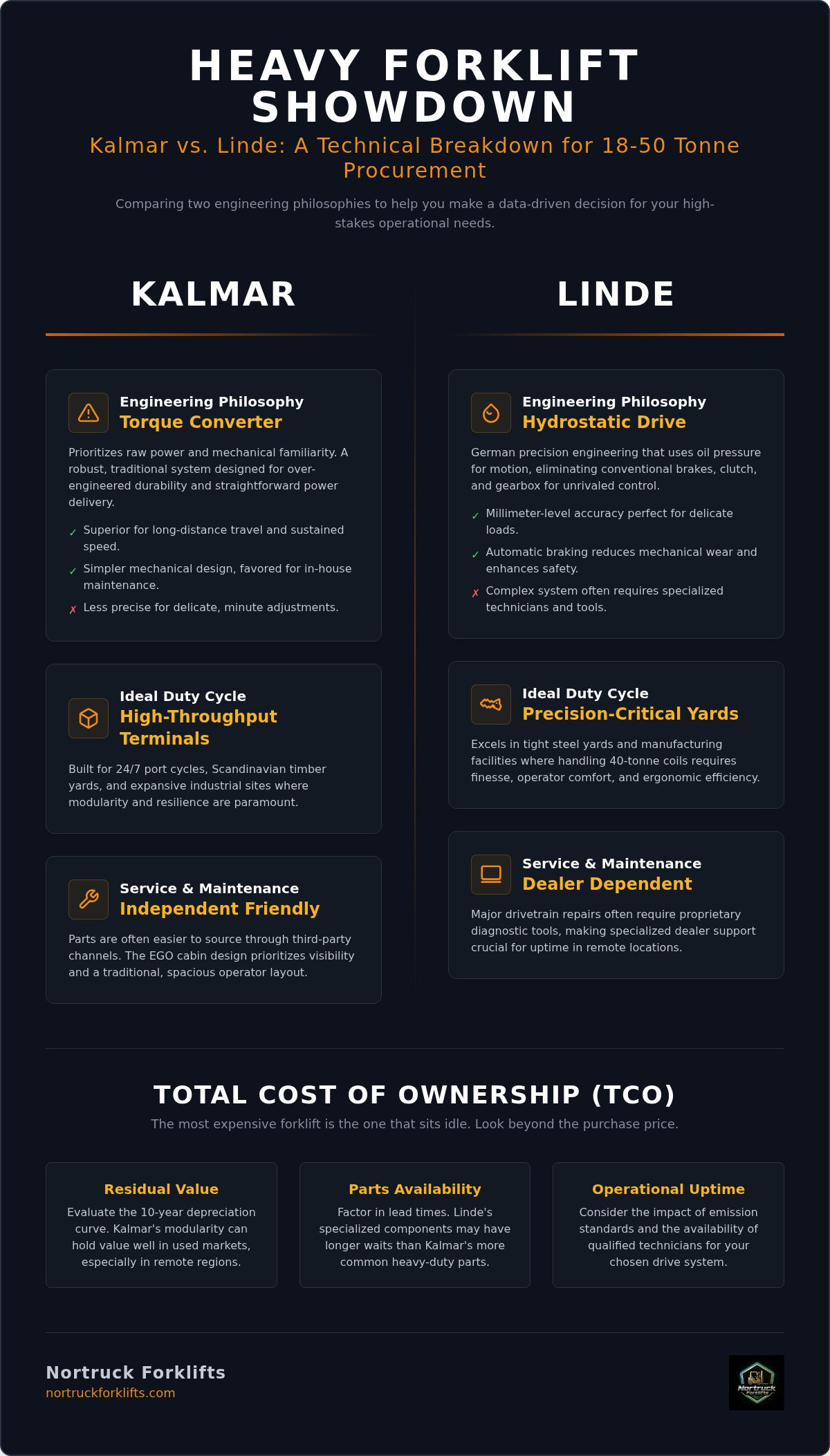
When you compare a Kalmar vs Linde heavy forklift, you're looking at two fundamentally different schools of engineering thought. The primary distinction lies in how power reaches the wheels. Linde relies on its signature hydrostatic drive system, while Kalmar utilizes a more traditional torque converter transmission. This choice dictates everything from how an operator feels the load to how much you'll spend on brake pads over a five-year period. In the high-capacity segment, these mechanical differences aren't just technical trivia; they're the primary drivers of your operational uptime.
Linde Hydrostatic Drive: The Pros and Cons
Linde's hydrostatic system eliminates the need for a gearbox, clutch, or conventional service brakes. By using oil pressure to control motion, it offers unrivaled precision. This is essential in tight steel yards where placing a 30-tonne coil requires millimeter accuracy. The system also provides automatic braking when the operator's foot leaves the pedal, significantly reducing mechanical wear. However, this sophistication comes with a trade-off. The drive-train is a complex system that usually requires specialized Linde technicians and proprietary diagnostic tools for major repairs, which can be a bottleneck in remote locations.
Kalmar G-Generation: Robust Simplicity
Kalmar takes a different path with its G-Generation and DCG series. By using a torque converter transmission, they prioritize raw power and mechanical familiarity. This setup is superior for long-distance travel across expansive port terminals where sustained speed is more important than minute shuffling. Parts for these systems are often easier to source through independent channels, making Kalmar a favorite for operations that prefer in-house maintenance. If you're unsure which mechanical profile fits your site layout, consulting with an independent advisor can prevent a costly technical mismatch.
The operator environment also reflects these philosophies. Kalmar’s EGO cabin is designed for visibility and modularity, often feeling more spacious for operators who prefer a traditional automotive layout. In contrast, the Linde cabin is a masterclass in ergonomic integration, with dual-pedal controls that allow for seamless directional changes without shifting gears. In the 2026 energy market, the choice of a Kalmar vs Linde heavy forklift often comes down to the specific duty cycle. Linde’s system is generally more fuel-efficient in high-shuttle cycles, while Kalmar’s drivetrain remains the champion of durability in high-torque, straight-line hauling applications.
Total Cost of Ownership and Residual Value
A 30-tonne machine is a significant capital investment that requires a decade-long outlook on value. The initial purchase price is just the starting point of your financial commitment. The most expensive forklift is the one that sits idle waiting for proprietary parts. In the Kalmar vs Linde heavy forklift debate, your total cost of ownership is heavily influenced by how easily you can access the European parts network and the specific engineering philosophy of the drive-train. While both brands are premium assets, their depreciation curves and maintenance profiles diverge significantly after the first five years of service.
Used Market Liquidity for Kalmar
Kalmar units are often considered the "gold standard" for resale in the heavy lift industry. Because their torque converter systems are familiar to mechanics worldwide, used Kalmar trucks frequently command a 15-20% premium over less established brands. This liquidity acts as a safety net for your CAPEX. If your operational requirements change, a well-maintained Kalmar is easy to liquidate to port terminals or heavy industrial sites globally. To ensure you aren't buying a unit with hidden structural issues, it's vital to use a Used Heavy Lifting Equipment Inspection Checklist before finalizing any purchase.
Linde Long-term Reliability
Linde machines offer excellent long-term value, but their residual worth depends heavily on a documented "Blue Chip" service history. A hydrostatic drive is incredibly durable, yet it's sensitive to the quality of hydraulic oil and filter intervals. When these machines approach the 15,000-hour mark, the condition of the hydraulic pumps becomes the primary driver of the asset's value. We focus on sourcing Linde units from European fleets that adhere to strict manufacturer maintenance schedules. This documentation proves the machine hasn't been neglected, protecting your investment from sudden, expensive drive-train overhauls that can occur if the system was contaminated by poor service practices.
Independent advisory plays a critical role in protecting your TCO. We don't just look at the hour meter; we verify the service history against manufacturer databases to ensure the machine’s life expectancy matches its price tag. Sourcing from the European market provides access to high-spec machines that have often benefited from professional preventative maintenance programs. This level of expert oversight ensures that your chosen machine remains an asset rather than a liability, holding its value well into its second decade of operation.
The Selection Matrix: Matching Machine to Industry
Choosing the right asset requires looking past the spec sheet and into the environment where the machine will actually live. In the Kalmar vs Linde heavy forklift comparison, the winner is usually determined by your facility's specific operational hazards and cycle requirements. A port terminal with high-speed straightaways needs a different engineering profile than a cramped steel mill where precision is the only way to prevent product damage. Before committing to a brand, you must evaluate which machine's strengths align with your primary duty cycle.
Steel and Heavy Metal Handling
Moving steel billets, coils, or heavy plates requires extreme control. Linde’s hydrostatic drive excels here because it allows for minute inching without the jerky movements sometimes found in torque converter systems. The visibility from a Linde cabin is often tailored for these delicate maneuvers. However, for exceptionally long loads like structural beams, a traditional forklift might not be the most efficient tool. In these cases, we often recommend considering Baumann Sideloaders to handle the unique geometry of the cargo while maintaining stability.
Concrete and Precast Logistics
Abrasive dust is the primary enemy of any heavy lift truck. It clogs radiators and grinds down hydraulic seals. Kalmar has historically set the industry benchmark for cooling systems and heavy-duty air filtration, making them the preferred choice for concrete and stone yards. Their G-Generation machines are built to withstand the grit that typically plagues more sensitive electronic systems. For a deeper dive into the technical requirements of this sector, see our Heavy Duty Forklifts for Concrete procurement guide.
Port terminals often favor Kalmar because of the synergy with their reachstacker fleets. Having a uniform engine and transmission platform across your terminal's heavy equipment simplifies your parts inventory and training requirements. Despite the technical merits of either brand, your final decision should also account for the proximity of qualified technicians. Even a superior Kalmar vs Linde heavy forklift becomes a liability if the nearest certified mechanic is two borders away. We prioritize technical suitability first, ensuring the machine you source from Europe can actually be supported at your local site.
Expert Sourcing: Finding Your Ideal Heavy Lift Truck
Direct-to-dealer sourcing often limits your options to what is currently on the lot or what the factory needs to move this quarter. When you're weighing the Kalmar vs Linde heavy forklift decision, you need a perspective that isn't tied to a specific sales target. We prioritize technical suitability and operational uptime over quick transactions. With 40 years of heavy lifting expertise, Lars G Tarby has built an insider network across Europe that provides direct access to high-capacity equipment that never reaches public auction sites. This network allows us to bypass the usual markups and find machines with impeccable service records.
The Advisory Process
Our process begins with an operational audit rather than a simple quote. We look at your yard surface, duty cycle, and local maintenance capabilities before suggesting a specific chassis. It's common for us to recommend a high-quality used Kalmar unit over a new, lower-tier budget brand. A used DCG series truck from a well-documented European fleet typically offers better long-term reliability and residual value than a cheap alternative. We handle the independent technical inspections and cross-border logistics to ensure the machine meets your exact specifications before the purchase order is signed. This vetting process is designed to eliminate the high CAPEX risk associated with choosing the wrong machine for your site.
Securing Your 2026 Fleet
The 2026 market remains competitive, and lead times for new Kalmar DCG series units can still be significant for many operators. This makes the used European market a strategic alternative for immediate needs. We find the "hidden gems" in fleets that are cycling out their 30-50 tonne trucks to make room for newer electric models. This allows our clients to acquire premium German or Scandinavian engineering at a more manageable price point without the multi-year wait times. We don't just find a machine; we find the right machine that fits your specific industrial environment.
An independent assessment is the only way to get an unbiased view of the Kalmar vs Linde heavy forklift debate. We act as your advocate, ensuring that the machine you buy is the one that will actually keep your terminal or mill running. Whether you're handling steel coils or shipping containers, our goal is to match you with an asset that holds its value and delivers the lowest possible total cost of ownership.
Securing Your High-Capacity Future
Choosing between a Kalmar vs Linde heavy forklift is a technical decision that defines your operational efficiency for the next decade. Success isn't found in a brand name, but in matching the specific engineering philosophy of the drive-train to your facility's duty cycle. Whether you require the precision of a hydrostatic system for delicate steel handling or the modular robustness of a torque converter for high-throughput port work, technical suitability is the only way to mitigate CAPEX risk.
We leverage 40 years of industry experience and an independent European sourcing network to find equipment that truly fits your requirements. As specialists in 18 to 50 tonne equipment, we prioritize transparency and technical verification to ensure your next acquisition is a reliable asset rather than a maintenance liability. We're here to help you navigate the complexities of the 2026 market with confidence.
We look forward to helping you source the right machine for your specific heavy lifting challenges.
Frequently Asked Questions
Which heavy forklift brand has better fuel efficiency in 2026?
Linde's hydrostatic drive typically offers superior fuel efficiency in high-shuttle operations where frequent directional changes occur. The system's ability to regenerate energy during braking reduces engine load. Kalmar’s torque converter is more efficient for long-haul transport across large terminals but tends to consume more fuel in tight, repetitive loading cycles. We recommend analyzing your specific travel distances before choosing between a Kalmar vs Linde heavy forklift to optimize your energy costs.
Is it easier to find spare parts for Kalmar or Linde in Europe?
Both manufacturers maintain extensive networks across Europe, but their availability models differ. Linde parts are highly proprietary and often require sourcing through official dealer channels to ensure system compatibility. Kalmar utilizes a more modular engineering approach, incorporating standard heavy-duty components that are often easier for independent technicians to source. This makes Kalmar a preferred choice for operations in remote areas where waiting for a specialized dealer part could result in costly downtime.
What is the maximum lifting capacity for a standard Linde heavy forklift?
A standard Linde heavy forklift in the internal combustion range can handle loads up to 18 metric tons, particularly in their newer high-capacity series. While Linde excels in the 10 to 18 tonne range, Kalmar dominates the super heavy category. Their DCG600-850 models can lift up to 85 tonnes, or approximately 187,000 lbs. If your operation consistently exceeds 20 tonnes, Kalmar’s chassis is often the more technically suitable option for long-term structural integrity.
How does the resale value of a used Kalmar compare to a Linde?
Kalmar heavy trucks generally maintain a higher residual value, often commanding a 15% to 20% premium in the used market. This liquidity is driven by the global familiarity mechanics have with their torque converter transmissions. Linde’s resale value is strong but depends heavily on a documented service history. Without proof of strict hydraulic maintenance, buyers are often wary of the high cost of refurbishing a hydrostatic drive system at the 15,000 hour mark.
Can a Linde hydrostatic forklift handle the rough terrain of a construction site?
Linde hydrostatic forklifts are optimized for precision on stable, paved surfaces like steel mills or logistics hubs. While they are incredibly durable, their sensitive hydraulic systems aren't ideal for the abrasive dust and uneven ground found on many construction sites. For these high-impact environments, the robust axle design and cooling systems of a Kalmar are usually superior. We focus on matching the machine to the surface conditions to prevent premature seal failure.
Why should I use a consultant like Nortruck instead of going direct to a Kalmar dealer?
Going direct to a dealer limits your perspective to one brand's current sales targets and available stock. Nortruck provides an independent assessment based on 40 years of industry experience. We aren't tied to a single manufacturer, allowing us to compare a Kalmar vs Linde heavy forklift based solely on your operational needs. Our European network provides access to high-spec used units that dealers often keep within their private rental fleets or preferred circles.
What are the common failure points in used high-capacity forklifts?
High-capacity machines often show wear in the steer axles and mast pivot points due to the extreme weights involved. In Linde units, the hydraulic pumps are a critical inspection point as they approach high hour counts. For Kalmar, we look for signs of transmission overheating or torque converter slip. We verify the technical history of every machine we source across Europe to ensure you don't inherit a machine with hidden structural fatigue or neglected maintenance.
Is Kalmar or Linde better for 24/7 port terminal operations?
Kalmar is the traditional choice for 24/7 port terminals due to its modular design and parts commonality with reachstackers. This synergy simplifies training and inventory management for terminal operators. However, Linde is becoming more common in specialized port applications where precision is vital. If your port operation involves high-density storage or delicate cargo, Linde’s superior operator control can significantly reduce the risk of accidental damage during high-pressure shifts.

Article by
Lars Gunnar Tärby
Disclaimer
1. General Information and No AdviceThe information, articles, product descriptions, and specifications provided on this website (www.nortruckforklifts.com) are for general informational and educational purposes only. While we strive to provide accurate and up-to-date content regarding new and used forklifts and heavy machinery, the material published does not constitute professional, technical, or legal advice.
2. Product Specifications and PricingNortruck Forklifts acts as a facilitator for the trade of new and used forklifts. All equipment details, including but not limited to year of manufacture, operating hours, lift capacity, dimensions, conditions, and pricing, are provided based on the information available to us at the time of publication. Specifications and availability are subject to change without prior notice.
3. "As Is" and VerificationAll articles and product listings are provided on an "as is" and "as available" basis without any warranties of any kind, either express or implied. Nortruck Forklifts does not guarantee that the descriptions are entirely error-free, complete, or reliable. Buyers and traders are strongly encouraged to independently verify all technical specifications, machine history, and equipment conditions directly with the seller or an authorized inspector before finalizing any purchase or transaction.
4. Limitation of LiabilityIn no event shall Nortruck Forklifts, its owners, or its contributors be held liable for any direct, indirect, incidental, consequential, or economic loss or damage arising out of the use of, or the inability to use, the information provided on this website, or any transactions facilitated through this platform. This includes, but is not limited to, damages caused by technical inaccuracies, typographical errors, or reliance on the content of our articles.
5. Third-Party LinksOur website may contain links to external websites, dealer networks, or third-party services that are not owned or controlled by Nortruck Forklifts. We have no control over, and assume no responsibility for, the content, privacy policies, or practices of any third-party websites.


