
By the time a heavy-lift truck reaches the EU border in 2026, the success of the transaction has already been decided by technical documentation rather than the shipping route. Mastering forklift import export Europe now requires navigating a landscape where ICS2 Phase 3 messaging and Carbon Border Adjustment Mechanism (CBAM) reporting are just as critical as the machinery's lifting capacity.
You likely feel the weight of complex customs paperwork or the fear that a used Kalmar or Linde sourced from abroad won't meet the latest safety standards. High freight costs and the risk of unexpected downtime only add to the pressure of a cross-border acquisition. It's a technical challenge that demands more than just a standard broker; it requires an insider's perspective on the market.
This guide provides a clear professional roadmap to help you secure high-quality equipment while maintaining full compliance. We will examine the 2026 regulatory updates, expert sourcing strategies for major brands like Toyota and Baumann, and logistics solutions that keep your operations moving without the typical headaches of international trade.
Key Takeaways
- Master the 2026 regulatory landscape, including ICS2 Phase 3 and CBAM reporting, to streamline your forklift import export Europe operations.
- Discover why the highest quality heavy-lift trucks from brands like Kalmar and Baumann often reside in "insider" networks rather than public auctions.
- Ensure full compliance with European safety standards by following a rigorous technical verification framework before committing to a wire transfer.
- Implement a structured logistics plan to mitigate high freight costs and prevent operational delays during the transit of heavy machinery.
- Learn how leveraging decades of specialized industry experience helps you navigate complex customs documentation and avoid substandard equipment.
The European Forklift Trade Landscape in 2026
The movement of heavy lifting equipment across borders is fundamentally different from general cargo logistics. In 2026, forklift import export Europe activities are defined by the technical specialization of regional hubs and the specific demands of heavy industry. While high-volume warehouse equipment often follows global supply chains, high-capacity machinery like Kalmar heavy lift trucks or Baumann sideloaders remains deeply rooted in European manufacturing centers. Understanding this landscape is the first step toward successful sourcing.
To understand why these machines are traded this way, it helps to look at the history and development of the forklift. From simple hoists to the sophisticated reachstackers used in port terminals today, the engineering has become increasingly regionalized. Intra-European trade remains the primary source for high-capacity machinery because equipment built in Sweden, Germany, or Italy is designed for the specific regulatory and operational environments of the continent. Buying within the EU ensures that equipment already aligns with necessary safety standards, reducing the friction of cross-border transfers.
Key Economic Drivers for Equipment Movement
Current trade dynamics are largely dictated by the expansion of port terminals and the modernization of heavy industrial sectors. As logistics hubs upgrade to handle larger containers, the demand for reachstackers and high-capacity forklifts shifts toward specific trade corridors. Our European forklift market guide details how these corridors influence availability. Currency fluctuations and regional demand also play a role; a local demand spike in German manufacturing can tighten the supply of reliable second-hand units, while economic shifts in other regions might open up export opportunities for used machinery at competitive prices.
Primary Manufacturers and Trade Hubs
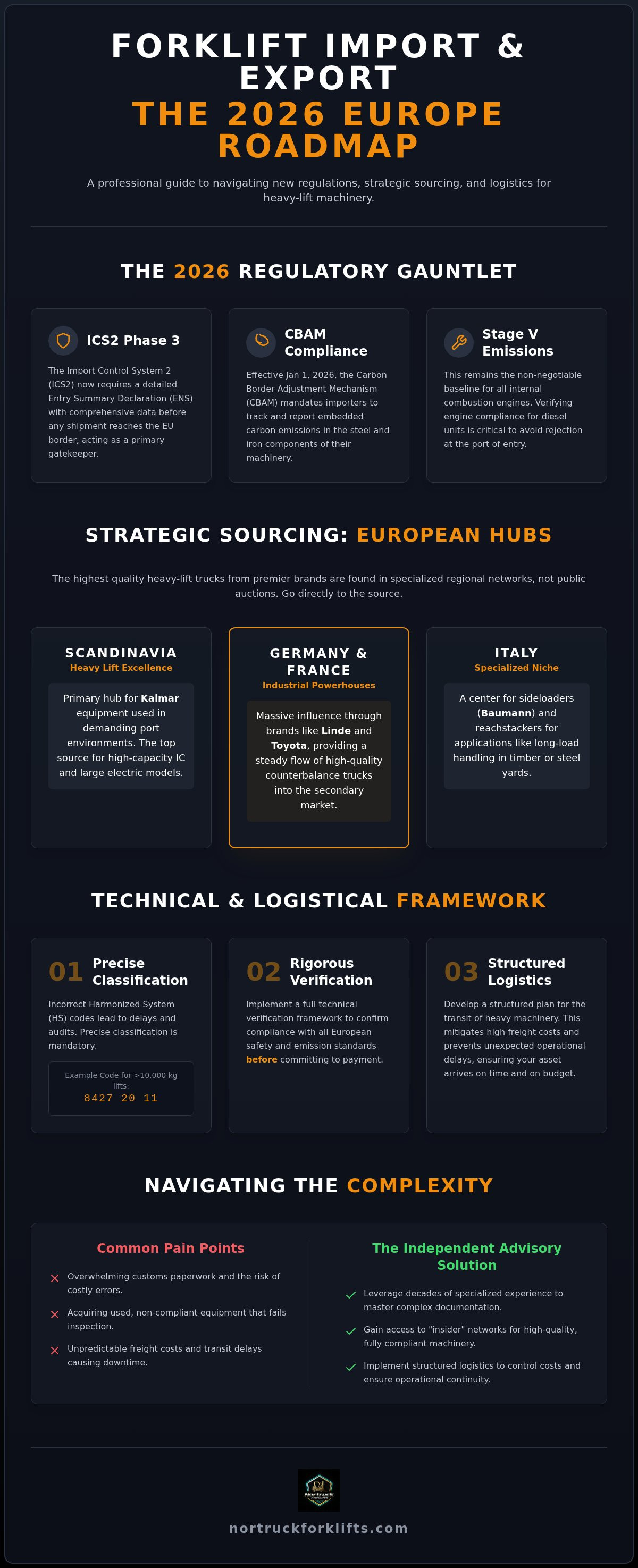
The geography of forklift production in Europe creates distinct sourcing opportunities. Scandinavia remains the primary hub for heavy lift excellence, particularly for Kalmar equipment used in demanding port environments. If you're looking for high-capacity internal combustion or large electric models, this region is the first place to look. Germany and France continue to exert massive influence through brands like Linde and Toyota, providing a steady flow of high-quality counterbalance trucks into the secondary market.
Italy has carved out a specialized niche as a center for sideloaders and reachstackers. Manufacturers there focus on applications that standard forklifts can't handle, such as long-load handling in timber or steel yards. By identifying these regional strengths, you can bypass general brokers and go directly to the source where the equipment was originally commissioned. This "insider" approach is what differentiates a successful forklift import export Europe strategy from a risky gamble on a public auction site.
Navigating Regulatory Compliance and Customs
Compliance in 2026 is a data-heavy process that dictates the success of any forklift import export Europe transaction. With the Import Control System 2 (ICS2) Phase 3 now active, every shipment requires a detailed Entry Summary Declaration (ENS) before it reaches the border. Additionally, the Carbon Border Adjustment Mechanism (CBAM) compliance phase started on January 1, 2026, requiring importers to track and report embedded carbon emissions in the steel and iron components of their machinery. These aren't just administrative hurdles; they're the primary gatekeepers for your equipment.
For used machinery, Stage V emission standards remain the baseline for internal combustion units. If you're moving a diesel Kalmar or Volvo wheel loader across borders, verifying the engine's compliance is non-negotiable to avoid rejection at the port of entry. An EUR.1 certificate is also vital as it can significantly reduce customs duties through preferential trade agreements, while a formal Certificate of Origin prevents transit delays by proving the machine's manufacturing roots. Understanding these forklift import export Europe requirements is essential for maintaining your project timeline.
Customs Classification and HS Codes
Precise classification prevents you from overpaying duties or triggering unnecessary audits. The Combined Nomenclature distinguishes machines by power source, lifting height, and capacity. For heavy machinery, the HS code 8427 20 11 specifically categorizes self-propelled trucks with a lifting capacity exceeding 10,000 kg. Using the wrong code often leads to machines being held at the border for manual inspection, which can derail your logistics schedule.
Safety Standards and Certification
CE Marking remains the gold standard, but the requirements tightened significantly in 2026. Customs authorities now demand a complete technical construction file and third-party test reports rather than a simple declaration of conformity. This is especially critical for electric forklifts, which must meet EN ISO 12100:2010 standards and include a full set of electrical safety documentation.
'Grey market' machines sourced from outside Europe often lack this documentation entirely. Retrofitting a machine to meet EU safety standards is expensive and, in some cases, technically impossible. If you're unsure about a machine's paperwork, it's wise to consult with a technical advisor who understands the 'insider' European market. Verifying safety compliance before the machine leaves the seller's yard is the only way to avoid a total loss at the border.
Strategic Sourcing: Finding Value Across Borders
Sourcing heavy machinery across borders is a strategic decision that balances immediate operational needs with long-term financial health. While local procurement might seem simpler, it often limits your options to what's currently available in a narrow geographic radius. In the context of forklift import export Europe, expanding your search to international markets allows you to access a much deeper pool of high-capacity equipment. However, the best machines rarely appear on public auction sites. This "hidden market" consists of equipment held by specialized dealers or industrial sites that prioritize direct, professional transactions over the chaos of open bidding.
When you're evaluating Kalmar heavy lift trucks for sale, risk mitigation is paramount. Buying "as-is" from an industrial site might offer a lower initial price, but dealer-refurbished units often provide better value through technical verification and documented service histories. The goal is to avoid the "grey market" issues mentioned previously by ensuring every machine has a clear paper trail from a reputable source. Transparency in the sourcing process is what separates a reliable investment from a costly mistake.
New vs. Used: The Cross-Border Decision
Lead times for new factory orders in 2026 can often stretch into several months, which isn't always compatible with urgent project demands. Sourcing a used machine provides immediate availability, but you must factor in the Total Cost of Ownership (TCO). This includes the purchase price, transport costs, and potential maintenance requirements to bring the machine up to your local operational standards. For many businesses, the most reliable path is to prioritize Linde forklift for sale listings from established European dealers who offer refurbished machinery with verified hour meters.
Sourcing Specialized Equipment
Finding specialized machinery like Baumann sideloaders or Combi-Lift 4-way trucks requires a targeted approach. These machines are often concentrated in regions with specific industrial clusters, such as timber or steel manufacturing hubs. Sourcing used reachstackers for ports presents a unique challenge because these units work in high-intensity environments. Verification of service history is the only way to ensure the machine isn't near the end of its structural life. For multi-directional needs, evaluating a Combi-Lift 4-way truck involves checking the hydraulic synchronization and steering modes, technical details that generalist brokers often overlook. A successful forklift import export Europe strategy relies on this level of technical precision.
Logistics and Technical Verification Framework
Moving a 40-tonne forklift across European borders is a feat of engineering and coordination. Unlike standard palletized freight, forklift import export Europe logistics involve specialized transport methods and rigorous technical verification. Success depends on a framework that identifies mechanical failures before the equipment leaves the seller's yard. If you skip the verification stage, you risk inheriting a machine with structural fatigue or hydraulic leaks that are prohibitively expensive to repair once the unit is on-site.
Choosing the right shipping method is the next critical decision. Roll-on/Roll-off (Ro-Ro) is often the most efficient for self-propelled machinery, provided the unit is operational and can be driven onto the vessel. However, for non-running units or oversized reachstackers that exceed standard height limits, flat-rack shipping or specialized low-loader trailers are necessary. Regardless of the method, high-value industrial machinery requires comprehensive transit insurance that covers the full replacement value, including the cost of recovery if an incident occurs during heavy haulage.
The Pre-Purchase Inspection (PPI)
A professional inspection focuses on three critical areas: hydraulic pressure and seal integrity, mast alignment and wear, and documented engine hours versus actual component wear. The 'Point of No Return' in a technical inspection occurs the moment the wire transfer is initiated, as post-payment recourse in international trade is notoriously difficult to enforce. Third-party inspections are mandatory for cross-border sourcing because they provide an unbiased assessment of the machine's condition. These inspectors check for "grey market" modifications and ensure the technical construction file matches the physical machine.
Heavy Haulage and Freight Logistics
Transporting oversized equipment on European motorways requires more than just a truck. You must manage permits for oversized loads, which vary significantly between countries like Germany, France, and Sweden. Coordinating crane hire for loading and unloading at port terminals is another layer of complexity; a delay in the truck's arrival can lead to expensive "wait time" charges from the crane operator. The transport distance and the complexity of these permits directly impact the final landed cost of the machine. It's often more cost-effective to source a slightly more expensive machine closer to your location than a cheaper one that requires thousands of kilometers of specialized haulage.
The Value of Independent Forklift Advisory
In the high-stakes environment of forklift import export Europe, data alone isn't enough to secure a reliable asset. While modern AI market reports can summarize trade flows or list average prices, they can't inspect the hydraulic seals of a Kalmar or verify the structural integrity of a reachstacker mast. Real-world expertise is what prevents a cross-border acquisition from becoming a liability. Lars G Tarby brings over 40 years of industry experience to the table, providing a level of "insider" knowledge that algorithms simply can't replicate. He understands the nuances of European trade because he's spent decades building the relationships that drive it.
This experience allows for a shift from being a mere buyer to becoming a strategic partner. Instead of just searching for any available machine, an independent advisor navigates a specialized network of manufacturers and industrial contacts across Europe to find equipment that hasn't even hit the public market yet. This approach ensures that you aren't just buying what's convenient, but what's operationally sound. It's about finding long-term solutions rather than quick transactions, ensuring your fleet remains efficient for years to come.
Beyond the Broker: Technical Consultancy
The distinction between a standard sales broker and a technical advisor is significant. A broker focuses on the transaction and often includes hidden markups or glosses over undisclosed damage to close a deal. In contrast, a technical consultant acts as your advocate. They ensure that the machine's technical specifications align perfectly with your operational environment. For instance, when sourcing forklifts for the concrete industry, an advisor looks beyond lifting capacity to check for dust protection, specialized attachments, and cooling systems required for heavy-duty cycles. Transparency is the foundation of this process, ensuring you know exactly what you're buying before the logistics phase begins.
Your Next Steps in Equipment Procurement
Initiating a professional sourcing request is a straightforward process designed to save you time. It begins with an operational audit where we discuss your specific lifting requirements, site constraints, and budget. From there, we leverage our European network to identify suitable machinery, handle the technical verification, and manage the forklift import export Europe documentation on your behalf. This methodical progression culminates in the final delivery of a machine that is ready for immediate work. If you're looking for a personalized sourcing strategy that prioritizes integrity over a quick sale, contacting an expert is the logical next step. We're here to ensure your fleet expansion is handled with the precision it deserves.
Securing Your Fleet's Future in the European Market
Navigating the technical and regulatory landscape of forklift import export Europe in 2026 requires a steady hand and an insider's perspective. Success hinges on mastering the details, from ICS2 customs declarations to the rigorous pre-purchase inspections that prevent costly mechanical failures. By prioritizing transparency and technical precision over the convenience of public auctions, you ensure that every Kalmar or Linde truck you acquire is a reliable long-term asset.
Lars G Tarby offers the grounded confidence that comes from 40+ years of heavy lifting expertise. As an independent advisor, he provides a specialized sourcing strategy for brands like Toyota and Baumann without the bias of manufacturer intermediaries. This direct, honest approach focuses on your specific operational needs, ensuring that the equipment you source today will drive your productivity for years to come.
Your next successful cross-border acquisition is just a conversation away. We're ready to help you build a fleet that meets the highest professional standards.
Sourcing and Logistics FAQ
What are the most common customs codes for heavy forklifts in Europe?
The most common HS code for heavy forklifts with a lifting capacity exceeding 10,000 kg is 8427 20 11. For electric-powered trucks, the classification typically falls under 8427 10. Accurate classification is essential for determining duty rates and ensuring compliance with the latest EU Combined Nomenclature. Incorrect codes often lead to border delays and manual inspections that disrupt your supply chain and increase landed costs.
Do I need a CE certificate to import a used forklift from outside the EU?
Yes, you must have a complete CE technical construction file to import used machinery into the European Union. In 2026, customs authorities require more than just a single certificate; they demand third-party test reports and proof of compliance with Machinery Directive 2006/42/EC. Importing equipment without these documents can result in a total loss, as retrofitting non-compliant machines to meet EU safety standards is often technically impossible.
How much does it typically cost to ship a 30-tonne forklift across Europe?
Shipping costs vary significantly based on the dimensions of the machine, the transport distance, and the required permits for oversized loads. Moving a heavy-lift truck involves specialized low-loader trailers and often requires pilot cars in certain jurisdictions. Instead of looking for a flat rate, you should consider the total landed cost, which includes port fees, crane hire for loading, and transit insurance for high-value industrial assets.
What is the difference between Ro-Ro and flat-rack shipping for forklifts?
Roll-on/Roll-off (Ro-Ro) shipping allows operational machinery to be driven directly onto a vessel, making it an efficient choice for forklift import export Europe projects. Flat-rack shipping is used for non-running units or oversized machinery that exceeds standard height and width limits. While Ro-Ro is generally more cost-effective, flat-rack provides a stable platform for heavy reachstackers that need to be dismantled or secured as static cargo during transit.
Are there specific emission standards I must meet for used machinery in 2026?
Stage V emission standards are the mandatory baseline for all internal combustion forklifts operating within the EU. In 2026, you must also account for the Carbon Border Adjustment Mechanism (CBAM), which requires reporting the embedded carbon emissions in the steel and iron components of imported machinery. Additionally, new ATEX directives apply to equipment used in explosive atmospheres, requiring real-time load path simulation for lithium-battery and hydrogen-fuel models.
How can I verify the service history of a forklift sourced from another country?
Verifying a service history requires a combination of manufacturer database checks and physical technical inspections. You should look for stamped service logs from authorized dealers and verify that the hour meter readings align with the physical wear on the mast and hydraulic seals. Working with an independent advisor like Lars G Tarby provides an extra layer of security, as he leverages an "insider" network to verify a machine's operational history before purchase.
What documentation is required for the export of heavy machinery from the EU?
Exporting heavy machinery requires a Bill of Lading, a commercial invoice, and a packing list detailing the machine's specifications. You will also need an EUR.1 movement certificate to benefit from preferential trade agreements and a Certificate of Origin to satisfy the importing country's customs. For forklift import export Europe, ensuring that the technical construction file and CE declaration are included will prevent the equipment from being rejected by foreign authorities.
Should I use a general freight forwarder or a specialized machinery mover?
Specialized machinery movers are strongly recommended for heavy lifting equipment due to the complexity of the permits and equipment involved. General forwarders often lack the experience to coordinate crane hire or manage the multi-country oversized load permits required for reachstackers and high-capacity trucks. A specialized mover understands the technical requirements for securing heavy loads, reducing the risk of damage during transit and ensuring the machine arrives ready for immediate operation.

Article by
Lars Gunnar Tärby
Disclaimer
1. General Information and No AdviceThe information, articles, product descriptions, and specifications provided on this website (www.nortruckforklifts.com) are for general informational and educational purposes only. While we strive to provide accurate and up-to-date content regarding new and used forklifts and heavy machinery, the material published does not constitute professional, technical, or legal advice.
2. Product Specifications and PricingNortruck Forklifts acts as a facilitator for the trade of new and used forklifts. All equipment details, including but not limited to year of manufacture, operating hours, lift capacity, dimensions, conditions, and pricing, are provided based on the information available to us at the time of publication. Specifications and availability are subject to change without prior notice.
3. "As Is" and VerificationAll articles and product listings are provided on an "as is" and "as available" basis without any warranties of any kind, either express or implied. Nortruck Forklifts does not guarantee that the descriptions are entirely error-free, complete, or reliable. Buyers and traders are strongly encouraged to independently verify all technical specifications, machine history, and equipment conditions directly with the seller or an authorized inspector before finalizing any purchase or transaction.
4. Limitation of LiabilityIn no event shall Nortruck Forklifts, its owners, or its contributors be held liable for any direct, indirect, incidental, consequential, or economic loss or damage arising out of the use of, or the inability to use, the information provided on this website, or any transactions facilitated through this platform. This includes, but is not limited to, damages caused by technical inaccuracies, typographical errors, or reliance on the content of our articles.
5. Third-Party LinksOur website may contain links to external websites, dealer networks, or third-party services that are not owned or controlled by Nortruck Forklifts. We have no control over, and assume no responsibility for, the content, privacy policies, or practices of any third-party websites.


