
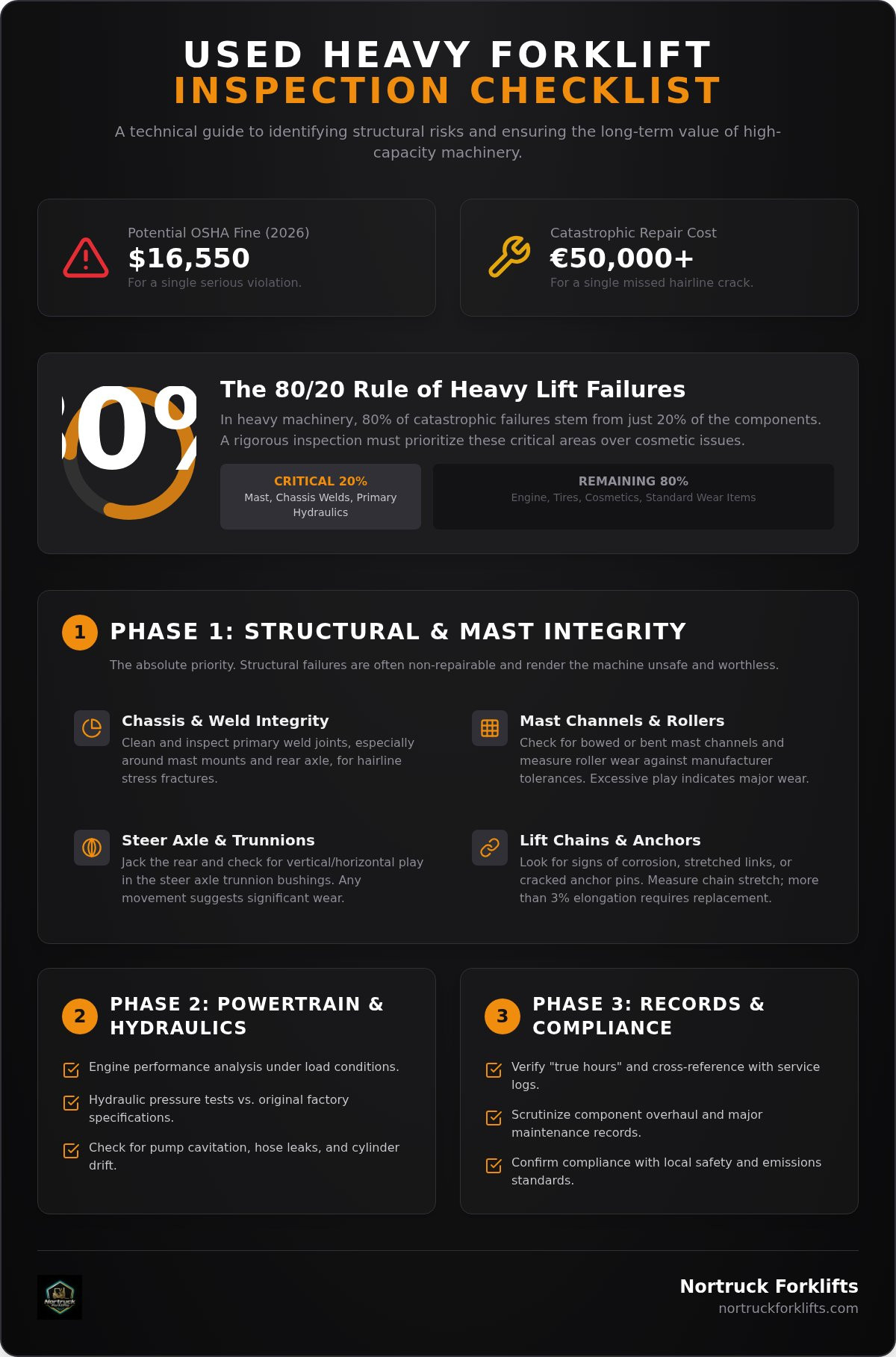
You can rebuild a diesel engine in a weekend, but you cannot easily repair a fatigued chassis on a 30-tonne lift truck without compromising the machine's safety. When you're investing in high-capacity equipment, the stakes are significantly higher than a standard warehouse unit. It is natural to feel uneasy about hidden structural issues or the complexities of heavy-duty hydraulics, especially when dealing with cross-border sales where service history feels opaque. With OSHA fines for serious violations reaching up to $16,550 in 2026, a thorough inspection is your primary defense against operational failure.
This guide provides a definitive used heavy forklift inspection checklist designed to give you total confidence in your next acquisition. By mastering the technical nuances of these machines, you'll learn how to spot the hidden problems that others miss. We will walk through the critical physical and operational checks you need to perform, covering everything from mast wear tolerances to hydraulic integrity. This methodical approach helps you accurately evaluate a machine's remaining lifespan and reduce your total cost of ownership, ensuring your investment is both safe and profitable.
Key Takeaways
- Understand why high-capacity lifting equipment requires specialized scrutiny due to the extreme torsional stress and hidden structural fatigue standard trucks never face.
- Utilize a technical used heavy forklift inspection checklist to evaluate chassis integrity, mast wear tolerances, and hydraulic system health.
- Learn how to verify "true hours" and component overhaul records to avoid the risks of tampered meters or neglected major maintenance.
- Gain the ability to analyze engine performance under load, specifically looking for pump cavitation and valve drift that signal upcoming repairs.
- Discover the strategic advantage of using independent European sourcing to secure reliable machinery while bypassing the risks of direct auction purchases.
Why Used Heavy Forklift Inspections Differ from Standard Fleet Checks
Heavy lifting equipment operates in a world of extreme torsional stress. While a 2-tonne warehouse forklift might suffer from battery issues or tire wear, a 30-tonne machine faces forces that can literally tear steel apart over time. A standard daily log won't catch these issues. You need a specialized used heavy forklift inspection checklist that prioritizes structural integrity over cosmetic appearance. These machines are engineered for decades of service, but that longevity depends entirely on the health of the primary steel components. Without a deep dive into the chassis, you're essentially gambling on the previous owner's maintenance habits.
Visual inspections are often insufficient because fatigue hides beneath the surface. For high-capacity machines, the scope of a professional evaluation must include a few critical layers:
- Non-destructive testing of load-bearing welds on the carriage.
- High-magnification visual checks of the mast pivots and steer axle.
- Verification of hydraulic pressure against original factory specifications.
In the 2026 market, where machinery costs are rising, your procurement strategy must focus on the machine's remaining economic life. A machine that looks clean but has a compromised chassis is a liability. You're not just buying a tool; you're buying thousands of hours of safe lifting capacity.
Capacity-Specific Stress Points
Load centers play a massive role in how these machines age. When a 30-tonne Kalmar lifts at its limit, the steer axle and mast pivots absorb immense pressure. You'll often see "work hardening" in the steel of older Linde or Kalmar units, where the metal becomes brittle from repeated stress. Understanding Forklift design and components is essential here; the way a carriage is welded dictates where the first cracks will appear. If the machine spent its life in a corrosive port environment, the inspection depth must double to account for salt-induced fatigue. These environmental factors often dictate the actual value of the machinery more than the hour meter does. It's common to find a low-hour machine that is structurally compromised because of poor storage or aggressive duty cycles.
The 80/20 Rule of Heavy Lift Failures
In heavy-duty machinery, 20% of the components are responsible for 80% of catastrophic failures. Structural fatigue is the progressive and localized structural damage that occurs when a material is subjected to cyclic loading. This isn't just a technicality. Missing a single hairline crack in a 30-tonne carriage can lead to a repair bill exceeding €50,000. It's the difference between a cosmetic scuff on the counterweight and an operational deal-breaker like a bowed mast channel. Professional procurement in 2026 requires looking past the fresh paint to find the "hidden" fatigue that threatens your investment, making a rigorous used heavy forklift inspection checklist an essential part of the process. Focus your energy on the mast, the main chassis welds, and the primary hydraulic cylinders to ensure the machine is operationally sound.
Phase 1: Structural Integrity and Mast Component Checklist
Phase 1 of any used heavy forklift inspection checklist must prioritize the machine's skeleton. Unlike smaller units, a heavy forklift's chassis is subject to massive counter-leverage forces. You should start by cleaning the primary weld joints to look for hairline fractures or stress fractures, particularly around the mast mounting points and the rear axle housing. These are not just maintenance issues; they are terminal structural failures that can render a machine useless. In the 2026 market, we see more machines being pushed to their absolute limits, making this foundational check the most important step in your procurement process.
The Chassis and Steer Axle
Check the counterweight mounting bolts for signs of shifting or polished metal. This often indicates the machine has been operated on uneven ground under excessive load. You should also examine the steer axle trunnion bushings. If there is noticeable vertical or horizontal play when the machine is jacked up, the bushings and possibly the axle housing itself are worn. Verifying the integrity of engine and transmission mounts requires a heavy load simulation; if the powertrain shifts visibly during a stall test, the mounts are likely compromised and will need immediate attention.
Mast and Carriage Precision
The mast is where the most expensive wear occurs. You need to measure the gap between mast rollers and channels with a feeler gauge to ensure they are within the manufacturer's wear tolerances. Excessive play here leads to bowing and scoring of the inner channels, which is a costly repair on high-capacity Kalmar or Linde models. Inspect the tilt cylinder bushings and the chrome plating on the rods for pitting or leaks. Fork thickness at the heel must be within 90% of the original specification to remain in service. When evaluating high-capacity assets, seeking independent advisory for heavy machinery ensures these structural nuances aren't overlooked.
Finally, assess the lift chains and anchor pins. Chains don't just break; they stretch over time. Use a chain gauge to measure elongation. If the stretch exceeds the limits specified in the service manual, the chain requires replacement to ensure safety. Anchor pins should be checked for grooves or "necking" caused by high-cycle fatigue. A thorough carriage inspection must also include checking the fork tip alignment. If one tip sits significantly lower than the other, it's a clear sign that the carriage or the forks themselves have been bent under load.
Phase 2: Hydraulics, Powertrain, and Load-Bearing Performance
Once the structural integrity is confirmed, the next stage of your used heavy forklift inspection checklist focuses on the powertrain and hydraulic systems. These components represent the operational muscle of the machine. Unlike standard warehouse trucks, high-capacity units like Kalmar or Linde reachstackers rely on complex high-pressure systems where even a minor failure leads to massive downtime. You aren't just looking for external leaks; you're looking for signs of internal component fatigue that a simple visual check will miss.
Hydraulic System Deep Dive
The 'Lift and Hold' test is the gold standard for evaluating hydraulic health. Raise a rated load to a specific height and measure the cylinder drift over a 10-minute period. If the carriage drops beyond factory specifications, you're likely dealing with internal valve spool wear or piston seal bypass. You should also pull the dipstick to check hydraulic oil clarity. If it smells burnt or looks cloudy, it's a sign the system has been consistently overheating, which significantly shortens the life of the pump and control valves. Listen closely for pump cavitation, a high-pitched whining sound that suggests air is entering the system or the pump is failing.
Powertrain and Cooling Efficiency
When evaluating the engine, pay close attention to the exhaust color under load. Blue smoke indicates oil consumption, while thick black smoke suggests fuel system issues or turbocharger wear, which is common in high-hour Volvo or Cummins engines. Check for 'blow-by' by removing the oil fill cap while the engine is running; excessive pressure here suggests worn piston rings. For the transmission, test the torque converter stall speed. If the engine RPM doesn't reach the specified range or if you feel a distinct 'shudder' during engagement, the powershift unit is likely slipping and nearing a major overhaul.
Heavy duty cycles generate immense heat, making the cooling system a critical check point. Inspect the radiator and oil coolers for bent fins or packed-in debris, which are common in industrial environments. Finally, don't overlook the braking system. Heavy units almost exclusively use wet disc brakes for their superior heat dissipation. If the brakes feel 'spongy' or if there is a delay in engagement, the internal friction discs may be worn, requiring a costly axle teardown. These technical nuances are what separate a sound investment from a machine that will spend more time in the shop than on the yard.
Phase 3: Maintenance Logs, Hour Meters, and Compliance Records
A clean chassis and a strong engine are only half the battle. The final layer of a professional used heavy forklift inspection checklist involves a deep dive into the machine's history. Paperwork can be harder to verify than steel; however, it often reveals the true commercial value of the asset. You're looking for consistency between the physical wear you've seen and the records provided. If a machine shows 5,000 hours but the operator's seat is shredded and the control pedals are worn smooth, the hour meter has likely been replaced or tampered with.
Interpreting the Service History
A 15,000-hour machine with a meticulous service history is often a safer investment than an 8,000-hour unit with none. Gaps in maintenance suggest deferred repairs, which usually lead to cascading failures in the powertrain. You should pay special attention to Major Component Overhaul (MCO) records for engines and transmissions. Knowing that an engine was professionally rebuilt at 12,000 hours adds significant value to a high-hour machine. This is particularly vital when sourcing equipment from the European Forklift Market Guide 2026, where cross-border records must be verified for accuracy and compliance.
Regulatory and Certification Paperwork
Compliance is non-negotiable for safety and legal reasons. Ensure the machine has its original CE certificate, which is essential for any equipment operating within Europe. You must also verify that the load capacity plate matches the current mast and attachment configuration. If a previous owner swapped a standard mast for a triple-stage unit without updating the plate, the machine is technically non-compliant and potentially dangerous. Look for recent thorough examination certificates like LOLER or PUWER to confirm the machine has passed independent safety audits.
It's also vital to distinguish between calendar age and operational age. A 2018 machine used in a high-intensity timber yard faces far more stress than a 2014 machine used in a light-duty port application. Environmental factors like salt air or abrasive dust accelerate the "operational aging" of seals and electrical components regardless of what the meter says. Low-hour machines that have sat idle for years often suffer from dry-rotted seals and internal corrosion, making them a higher risk than a well-maintained, high-hour workhorse. Always check for manufacturer-specific recall and safety bulletin compliance to ensure the machine hasn't missed critical factory updates.
The Independent Advisor's Role in Sourcing Used Heavy Machinery
Even with a comprehensive used heavy forklift inspection checklist, the final barrier to a sound investment is the sourcing process itself. Buying high-capacity machinery directly from an end-user or through an auction platform carries significant hidden risks. While the price might look attractive, these channels offer little protection against the structural fatigue or hydraulic cavitation we've analyzed in previous sections. A seller's primary goal is a quick transaction, not your long-term operational efficiency. You need more than just a list of checks; you need the technical intuition to interpret what those checks reveal in a real-world setting.
Independent advisors like Nortruck provide a layer of security by acting as your technical advocate across the European market. We don't just look at the machine; we look at the environment it worked in and the reputation of the people who maintained it. By verifying machinery at the source, we help you avoid "lemon" units that would otherwise drive up your total cost of ownership through constant repairs and unplanned downtime. This methodical approach mirrors the deliberate nature of heavy equipment acquisition, ensuring every Euro spent contributes to a safe and reliable fleet.
Eliminating Intermediaries and Bias
Most dealers are incentivized to move the stock they have on their lot. Our independent advisory model removes this bias entirely. Lars G Tarby brings over 40 years of industry experience to every evaluation, focusing on the functional benefits of the equipment rather than a sales quota. This direct sourcing approach ensures you get a machine suited to your specific application, whether you're sourcing Kalmar heavy lift trucks for sale or evaluating high-capacity Linde units. We prioritize transparency, giving you an "insider" perspective on the machine's true condition before you commit any capital.
Your Next Steps in Heavy Lift Procurement
Transitioning from inspection to procurement starts with a clear definition of your operational needs. You must define your required tonnage, lift height, and any specialized attachments like coil rams or container spreaders. Once these parameters are set, an expert advisor can source machines that aren't yet available on the public market. This off-market access is often where the highest quality, well-maintained units are found. It's about finding a long-term solution rather than a quick fix for a pressing need.
Don't settle for a machine that just fits the budget; find one that fits the job and will last for the next decade. Professional guidance ensures your used heavy forklift inspection checklist results in a safe, operationally sound investment that protects your bottom line.
Securing Your High-Capacity Future
Acquiring high-capacity lifting equipment is a significant capital commitment that requires more than a casual walk-around. You've seen how structural fatigue, hydraulic cavitation, and opaque service histories can turn a seemingly good deal into a costly liability. By applying a rigorous used heavy forklift inspection checklist, you protect your operation from the "hidden" problems that standard fleet checks often miss. Focus on the integrity of the chassis and the precision of the mast components to ensure your machine remains a productive asset for years to come.
Navigating the complexities of the European market alone is a daunting task. With over 40 years of specialized experience, I provide the independent, unbiased advisory you need to source reliable machinery directly from the source. This transparency ensures you avoid unnecessary intermediaries and secure a machine that is truly fit for purpose. My direct access to the European used equipment market means you get the right machine at the right time without the usual guesswork.
Your next heavy lift investment should be a source of confidence, not concern. We're here to help you make that a reality with expert guidance and honest dealings that prioritize your long-term success.
Frequently Asked Questions
Is 10,000 hours considered high for a used heavy forklift?
For a heavy lift truck, 10,000 hours is generally considered mid-life rather than high, provided the machine has a documented service history. These robust units are often engineered for a lifespan of 20,000 to 30,000 hours in many industrial applications. However, the operational environment is a more critical factor than the raw number. A machine used in a corrosive port environment for 10,000 hours often shows more wear than one used for 15,000 hours in a clean warehouse.
What is the most common structural failure in used Kalmar forklifts?
The most frequent structural issues in high-capacity Kalmar units occur at the mast pivot points and the primary carriage welds. Because of the immense torsional stress of heavy loads, hairline cracks can develop in the steel over time. This is why a used heavy forklift inspection checklist must include a detailed examination of all load-bearing welds. Ignoring these "hidden" fatigue points can lead to catastrophic failure during operation, which is why independent expert verification is so valuable.
Should I prioritize a newer year or lower hours when buying used?
You should almost always prioritize lower hours and a verified maintenance history over the calendar year. A 2021 model with 12,000 hours of heavy-duty port work is often in worse condition than a 2016 model with only 5,000 hours of light industrial use. Focus on the "operational age" and the quality of major component overhauls. A well-documented history of engine and transmission care is the most reliable indicator of a machine's remaining economic lifespan.
How do I check for hydraulic pump cavitation during a field inspection?
Listen for a high-pitched, metallic whining sound when the mast is under load or during high engine RPMs. This specific noise indicates that air is entering the system or the pump isn't receiving an adequate oil supply. You can also check the hydraulic tank for foaming or aerated oil. Cavitation quickly destroys internal pump surfaces, leading to expensive repairs and system-wide contamination that a simple visual check will often miss during a standard walk-around.
Why is the CE certificate so important when sourcing forklifts from Europe?
The CE certificate is a mandatory legal document for machinery operating within the European Economic Area, proving the equipment meets specific safety and environmental standards. Without it, you may face significant hurdles with insurance, safety audits, and potential resale. When sourcing from the European market, verifying this document ensures the machine is compliant with local regulations and maintains its commercial value. It's a critical piece of the compliance puzzle that protects your long-term investment.
Can I trust the hour meter on a used heavy forklift?
You should never trust the hour meter as your sole source of information without verifying physical wear patterns. It's common for meters to be replaced or tampered with in the used machinery market. Compare the reported hours to the wear on the control pedals, the operator's seat, and the steer axle bushings. If a machine shows low hours but has significant "play" in the mast channels or heavily worn floor plates, the meter likely doesn't reflect the machine's true history.
What are the red flags in a forklift's maintenance log?
Look for significant gaps in service dates and a lack of major component overhaul records. If a machine has reached 12,000 hours without any record of transmission or engine work, you're likely facing "deferred" maintenance costs. Another red flag is a consistent history of hydraulic overheating or repeated repairs on the same component. Using a professional used heavy forklift inspection checklist helps you identify these patterns and avoid machines that will spend more time in the shop than on the yard.
How much does a professional heavy lift inspection typically cost?
As of 2026, a comprehensive third-party pre-purchase inspection for a heavy forklift typically costs between $999 and $1,099. This fee covers a detailed technical evaluation of the chassis, hydraulics, and powertrain by a specialized technician. While this is an upfront cost, it's a small investment compared to the $16,550 OSHA fines for serious violations or the €50,000 repair bills associated with a failed carriage. An independent inspection provides the transparency needed to make a sound financial decision.

Article by
Lars Gunnar Tärby
Disclaimer
1. General Information and No AdviceThe information, articles, product descriptions, and specifications provided on this website (www.nortruckforklifts.com) are for general informational and educational purposes only. While we strive to provide accurate and up-to-date content regarding new and used forklifts and heavy machinery, the material published does not constitute professional, technical, or legal advice.
2. Product Specifications and PricingNortruck Forklifts acts as a facilitator for the trade of new and used forklifts. All equipment details, including but not limited to year of manufacture, operating hours, lift capacity, dimensions, conditions, and pricing, are provided based on the information available to us at the time of publication. Specifications and availability are subject to change without prior notice.
3. "As Is" and VerificationAll articles and product listings are provided on an "as is" and "as available" basis without any warranties of any kind, either express or implied. Nortruck Forklifts does not guarantee that the descriptions are entirely error-free, complete, or reliable. Buyers and traders are strongly encouraged to independently verify all technical specifications, machine history, and equipment conditions directly with the seller or an authorized inspector before finalizing any purchase or transaction.
4. Limitation of LiabilityIn no event shall Nortruck Forklifts, its owners, or its contributors be held liable for any direct, indirect, incidental, consequential, or economic loss or damage arising out of the use of, or the inability to use, the information provided on this website, or any transactions facilitated through this platform. This includes, but is not limited to, damages caused by technical inaccuracies, typographical errors, or reliance on the content of our articles.
5. Third-Party LinksOur website may contain links to external websites, dealer networks, or third-party services that are not owned or controlled by Nortruck Forklifts. We have no control over, and assume no responsibility for, the content, privacy policies, or practices of any third-party websites.


