
If your standard forklift is forcing you to maintain six-meter aisles just to shuffle timber or steel, you aren't just losing floor space; you're losing profit every time that machine turns a corner. It's a common frustration in yards across Europe. Professional long load handling requires more than just raw power. Standard counterbalances simply weren't built for twelve-meter loads, and forcing them into that role often leads to expensive product damage or a high risk of tipping that puts your operators in danger.
Mastering these complexities isn't about finding a bigger truck; it's about matching European engineering to your specific yard constraints. As independent advisors, we understand that every warehouse has its own unique geometry and safety requirements. This 2026 guide provides the expert guidance you need to select equipment that can reduce your aisle widths by up to 50% while keeping you fully compliant with the latest safety regulations. We'll look at the functional benefits of multidirectional trucks and sideloaders from brands like Baumann and Combi-Lift, helping you source a machine that fits your operation perfectly.
Key Takeaways
- Understand the physics of instability and why standard forklifts struggle with the longitudinal centers of gravity inherent in long materials.
- Compare the high-speed stability of Baumann sideloaders against the precision maneuverability of Combi-Lift multidirectional trucks for tight warehouse spaces.
- Learn how to calculate your facility's "True Aisle Width" to optimize long load handling and potentially reclaim up to 50% of your storage footprint.
- Discover the strategic advantages of sourcing from the broader European market to find specific machine configurations that local, brand-locked dealers often lack.
- Identify industry-specific lifting solutions, from protecting delicate timber bundles to managing high-capacity steel loads with Kalmar heavy lift trucks.
What is Long Load Handling and Why Does It Require Specialization?
Long load handling refers to the specialized management of materials that exceed standard pallet dimensions, such as timber packs, steel beams, and industrial piping. While a standard forklift handles a predictable, centered load, these materials present a unique physics problem. When you lift a 12-meter steel pipe with a standard truck, the weight isn't just in front of the mast; it's extended far to the sides. This creates a longitudinal center of gravity that shifts dangerously with every turn.
Using the wrong tools for these tasks often results in a "seesaw" effect. Even a minor bump in the yard can cause the load to oscillate, putting immense stress on the mast and hydraulics. This instability is why many operations are moving toward specialized lifting equipment designed specifically for lateral stability. Without it, you're looking at more than just a safety risk; you're looking at a massive waste of industrial real estate and a high probability of expensive product damage.
Common Long Load Challenges in 2026
In 2026, the pressure on industrial yards has intensified, making efficient long load handling a core operational requirement. Managing 6-meter to 12-meter loads in restricted spaces is no longer just a logistical hurdle; it's a financial one. As land costs rise, businesses are transitioning from sprawling outdoor storage to high-density, narrow-aisle indoor warehousing. This shift demands precision. You can't afford the luxury of "dead space" required for a standard truck to swing a long load around. Additionally, European safety regulators are looking closer at load stability, making "make-do" solutions with standard forklifts a significant liability.
Why Counterbalance Trucks Often Fail
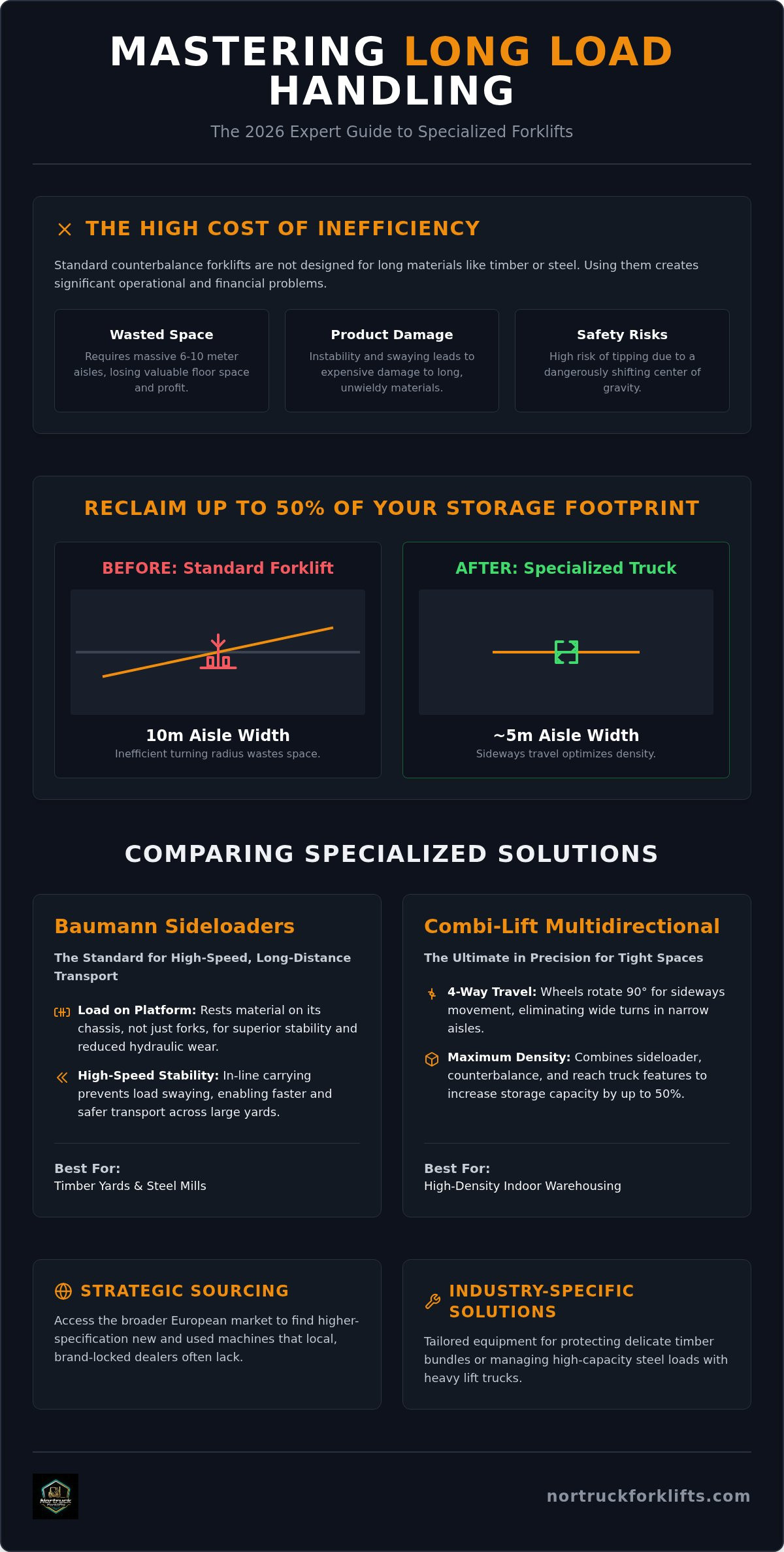
The most obvious failure of a counterbalance truck in this context is the "wide load" problem. To move a 6-meter timber pack safely, a standard forklift often requires an aisle width of 10 meters or more to accommodate the turning radius and the load length. This inefficiency effectively doubles your storage footprint requirements. It's a bottleneck that modern operations can no longer justify.
Beyond space, there's the mechanical toll. Counterbalance masts aren't designed for the torsional forces exerted by long, swaying loads. This leads to premature hydraulic failure and mast fatigue. Loading or unloading flatbed trailers also becomes a choreographed nightmare. Operators must approach from the side, lift, and then perform a wide, sweeping turn that stops all other yard traffic. This process is slow, dangerous, and prone to error, which is why specialized solutions like sideloaders or 4-way trucks have become the industry standard.
Comparing Specialized Solutions: Sideloaders vs. Multidirectional Trucks
Selecting the right machine for long load handling depends on two primary variables: travel distance and aisle width. While standard trucks struggle with weight distribution, specialized equipment solves this by repositioning the load relative to the chassis. This shift in engineering allows for safer transport and significantly tighter storage configurations.
The Baumann Sideloader Advantage
Baumann sideloaders are the industry standard for timber yards and steel mills where loads must travel long distances across a site. Unlike a forklift that carries weight on its forks alone, a sideloader rests the material on its internal platform chassis. This design reduces hydraulic wear and ensures the machine remains stable at higher speeds. Carrying the load "in-line" rather than across the forks prevents the swaying that leads to product damage. When sourcing these machines, looking toward the European market often reveals higher specifications and better-maintained units than what's available through local, brand-locked dealers.
Multidirectional Versatility with Combi-Lift
For tight warehouses, multidirectional trucks offer unmatched precision by combining the features of a sideloader, counterbalance, and reach truck. By allowing the wheels to rotate 90 degrees, they enable "sideways" travel, which is essential for optimizing narrow aisles. If you're looking for a Combi-Lift 4-Way Truck for Sale, focusing on multidirectional sourcing ensures you get a machine capable of increasing your storage density by up to 50%.
When raw capacity is the priority over maneuverability, Kalmar heavy lift trucks are the preferred choice for port terminals and heavy industrial sites. These machines handle extreme tonnage where smaller multidirectional units might reach their mechanical limit. Regardless of the brand, you must also evaluate mast types carefully. Duplex masts offer superior visibility and strength for heavy lifting; triplex masts are necessary if you need to navigate through low doorways while still achieving high lift heights in your racking.
Adhering to OSHA safety regulations requires operators to understand these technical differences. Each machine type has a specific load chart and stability profile that must be respected to prevent workplace accidents. If you're unsure which technology suits your yard geometry, an independent advisory session can help you map your facility's requirements to the right equipment.
Optimizing Yard Geometry and Safety Protocols
Efficient long load handling is as much a geometry challenge as a mechanical one. To optimize your facility, you must calculate the "True Aisle Width." This dimension isn't just the width of the machine; it's the combined measurement of the machine's turning radius, the maximum load length, and a necessary safety buffer. While a standard truck might require a 12-meter aisle to swing a 6-meter steel beam, a specialized sideloader or 4-way truck carries that same beam parallel to the direction of travel. This fundamental shift in orientation is the key to reclaiming lost floor space.
Ground conditions dictate machine longevity and operational safety. Sideloaders, while robust, require consistent surfaces to maintain chassis integrity over time. Even a slight incline can shift the center of gravity when a 12-meter load is elevated. Modern 2026 models address this with advanced hydraulic leveling systems, but the foundation of safety remains a well-maintained yard surface and a clear understanding of the machine's specific stability envelope.
Aisle Width Reduction Strategies
Transitioning from 12-meter aisles to 5-meter guided aisles is a standard outcome when moving away from counterbalance trucks. In high-density environments, guide rails are often installed to allow machines to move at full speed within the racking without the risk of steering errors. Aisle optimization is the strategic reconfiguration of storage layout to achieve a 50% space-saving improvement by matching equipment capabilities to load dimensions. This allows you to double your storage capacity without expanding the physical footprint of your warehouse.
Load Stability and Operator Safety
Safety in 2026 relies on mitigating the "pendulum effect," which is the dangerous swaying that occurs when long materials are lifted to high racking levels. This is particularly critical for long load handling in the timber industry, where uneven yard surfaces can compromise stability. 2026 models prioritize platform leveling systems that keep the chassis horizontal even on sloping ground. Essential safety features now include load moment indicators (LMI) that provide real-time feedback on stability and high-definition camera systems mounted on the mast to eliminate blind spots at the ends of 12-meter loads.
When operators transition to 4-way systems, specialized training is mandatory. Navigating a machine that can travel in any direction requires a different mental map than driving a traditional forklift. Mastery of these controls ensures the equipment is used to its full potential without compromising site safety. It isn't just about moving the load; it's about managing the physics of the environment.
Procurement Strategy: Sourcing New and Used Equipment in Europe
The European market is the global epicenter for specialized lifting technology. Because manufacturers like Baumann, Combi-Lift, and Kalmar are headquartered there, the region offers a depth of inventory that local markets simply cannot match. When you're refining your long load handling strategy, sourcing from European hubs allows you to find machines with exact specifications, such as specialized mast attachments or specific platform lengths, that are often unavailable through regional, brand-locked dealers. Balancing new and used equipment requires a clear look at your timeline. New machines offer the latest 2026 safety standards, but lead times can stall your operations for months. Used machinery provides an immediate solution, provided you can verify its operational history across borders.
The Used Equipment Inspection Checklist
Inspecting a machine designed for long loads requires more than a standard forklift check. You must look for stress fractures specifically along the platform chassis, as these areas bear the brunt of twelve-meter loads over time. Hydraulic integrity is also paramount; verify that pressure remains consistent across all stages of the mast, especially during lateral movements. For a more detailed breakdown of what to look for, see our Used Heavy Lifting Equipment Inspection Checklist. This rigorous process ensures you aren't inheriting someone else's maintenance backlog.
Navigating the European Market
The challenge of the European Forklift Market Guide 2026 is identifying "hidden" inventory that hasn't hit the public marketplaces yet. Independent advisors provide a significant advantage here because they aren't restricted to a single brand's stock. With over 40 years of industry experience, Lars G Tarby focuses on verifying machine provenance, ensuring that service histories are legitimate and that the equipment meets current European export regulations. This independent oversight is what prevents expensive mistakes when importing heavy machinery across borders.
Logistics for heavy equipment involves more than just finding a flatbed. You need to account for 2026 distance-based tolls in regions like the Netherlands and ensure all On-Board Units are compliant for international transit. Handling the paperwork for international transport is a specialized task. It's best managed by those who understand the nuances of heavy machinery export laws and the physical requirements of moving oversized equipment safely.
Custom Solutions: Tailoring Long Load Handling to Your Industry
Every industry faces a different set of physics when moving oversized materials. A timber yard manages flexible, bundled packs that can shift or bow, while a steel mill handles rigid, high-density tonnage that demands absolute structural resilience. Generic lifting solutions often fail to account for these specific material behaviors, which leads to operational bottlenecks or expensive stock degradation. Effective long load handling requires a machine tailored to the material's weight, length, and sensitivity, ensuring that the equipment supports the load rather than just lifting it.
Steel and Concrete Industry Requirements
Steel mills and pre-cast concrete plants operate at the heavy end of the industrial scale. High-capacity forklifts are essential for steel mills because the extreme density of structural beams, combined with the intense thermal stress of a production environment, requires a reinforced chassis and specialized cooling systems that standard trucks lack. When your operation moves beyond the limits of standard multidirectional units, sourcing Kalmar Heavy Lift Trucks from the European market provides the raw power needed for these high-tonnage applications.
For concrete logistics, the challenge lies in the shape of the product. Handling rebar bundles or large-diameter concrete pipes requires specialized attachments and precise hydraulic control to prevent cracking or rolling. Multidirectional solutions are often deployed in these yards to navigate narrow storage lanes while maintaining the stability of heavy pre-cast elements. By focusing on machines with high residual capacities, you ensure that your long load handling remains safe even at full mast extension.
Timber and Building Material Logistics
In the timber industry, the priority is maintaining material quality from the sawmill to the final delivery truck. Softwood and hardwood packs are susceptible to surface damage and bundle breakage if they aren't supported correctly during transit. Baumann sideloaders are the industry standard here because their internal platforms provide a continuous, stable surface that eliminates the "bouncing" effect seen with traditional forklifts. This stability is critical for reducing material degradation and ensuring that every pack arrives at the customer in perfect condition.
The Nortruck approach to these industry challenges is built on 40 years of independent advisory. We don't just source a machine; we help you find the "Perfect Fit" by analyzing your specific material flow and yard geometry. By consulting on specialized Baumann timber specs or multidirectional Combi-Lift configurations, we ensure you get a machine that matches your operational reality. This independent perspective allows us to look across the entire European market to find the exact machine your industry demands, free from the constraints of brand-locked dealerships.
Future-Proofing Your Long Load Operations
Optimizing your facility for 2026 and beyond requires moving past the limitations of standard forklifts. By matching specialized engineering from brands like Baumann and Combi-Lift to your specific yard geometry, you can reclaim significant floor space while drastically reducing the risks of product damage and tipping. Success in long load handling isn't just about the machine; it's about the precision of the sourcing process and the technical suitability of the equipment to your materials.
Nortruck provides an independent alternative to brand-locked dealers, leveraging a European-wide procurement network to find the exact specifications your industry demands. With 40 years of heavy lift expertise, we ensure that every machine, whether a high-capacity Kalmar or a precision multidirectional truck, is verified for provenance and performance. Taking a solution-oriented approach today ensures your yard remains efficient, compliant, and safe for the long term.
We look forward to helping you find the right equipment to move your business forward.
Frequently Asked Questions
What is the best forklift for handling long loads in narrow aisles?
The most effective machine for navigating narrow aisles with oversized materials is the Combi-Lift 4-way truck. These multidirectional units rotate their wheels 90 degrees, allowing them to travel sideways through aisles only slightly wider than the machine itself. This capability eliminates the need for the wide turning circles required by traditional forklifts. Baumann sideloaders are also excellent for long-distance travel within aisles, provided the warehouse layout supports straight-line movement without frequent 90-degree turns.
How much space can I save by switching to a sideloader?
Switching from a standard counterbalance truck to a specialized sideloader can reduce your required aisle widths by up to 50%. A traditional forklift requires a massive turning radius to swing a 12-meter load, often necessitating aisles 10 meters wide or more. Sideloaders carry the load parallel to the direction of travel, allowing you to narrow those same aisles to approximately 4 or 5 meters. This shift significantly increases your overall storage density within the same physical footprint.
What should I check when buying a used sideloader?
When evaluating a used sideloader, you must prioritize the structural integrity of the platform and the alignment of the mast. Check for stress fractures in the chassis where the load rests, as these machines endure significant torsional forces over time. Verify that the hydraulic pressure is consistent across all mast stages and that the platform leveling system functions correctly. We also recommend a thorough review of the service history to ensure the machine hasn't been chronically overloaded.
Can a standard forklift be modified for long load handling?
While you can add wide fork spreaders to a standard forklift, it doesn't change the machine's fundamental physics. Standard trucks carry weight in front of the mast, which creates a dangerous longitudinal center of gravity when handling 12-meter loads. These modifications don't address the instability caused by load sway or the massive turning radius required. For safe and efficient long load handling, it's always better to source a machine engineered specifically for the task rather than modifying an unsuitable unit.
What are the safety risks of moving long loads with a counterbalance truck?
The primary risks include lateral instability and the "pendulum effect," where the ends of a long load sway uncontrollably during transit. This movement puts immense stress on the forklift mast and can lead to the machine tipping over on uneven ground. Additionally, the wide turning radius required for long materials increases the risk of collisions with racking or personnel. Standard trucks simply lack the chassis stability and specialized hydraulic leveling systems found in purpose-built sideloaders or multidirectional equipment.
Is it better to buy a new or used Combi-Lift in 2026?
The choice depends on your operational timeline and specific requirements. New Combi-Lift units in 2026 come with the latest safety technology and full manufacturer support, but lead times can be significant. Used machines offer an immediate solution and lower capital expenditure, which is often preferable for growing operations. Our advisory process focuses on your total cost of ownership, helping you source a used unit with a verified service history if a new machine's delivery schedule doesn't align with your needs.
How do I source heavy lifting equipment from Europe?
Sourcing heavy machinery from Europe is most effective when working with an independent advisor who has a broad procurement network. Rather than being limited to a local dealer's stock, you gain access to inventory from major manufacturers across the continent. This process involves identifying machines with the correct specifications, verifying their provenance, and navigating international export regulations. We manage these complexities by leveraging 40 years of industry experience to ensure every machine meets all operational standards before it arrives.
What industries benefit most from multidirectional forklift technology?
Industries that handle long, rigid, or bundled materials see the greatest return on investment from multidirectional technology. This includes timber yards managing 6-meter packs, steel mills handling structural beams, and concrete manufacturers moving pre-cast pipes. Plastics and PVC extrusion companies also benefit from the ability to navigate narrow warehouse aisles with flexible loads. Any operation where long load handling is a daily requirement will find that 4-way trucks significantly improve safety and warehouse throughput compared to traditional lifting methods.

Article by
Lars Gunnar Tärby
Disclaimer
1. General Information and No AdviceThe information, articles, product descriptions, and specifications provided on this website (www.nortruckforklifts.com) are for general informational and educational purposes only. While we strive to provide accurate and up-to-date content regarding new and used forklifts and heavy machinery, the material published does not constitute professional, technical, or legal advice.
2. Product Specifications and PricingNortruck Forklifts acts as a facilitator for the trade of new and used forklifts. All equipment details, including but not limited to year of manufacture, operating hours, lift capacity, dimensions, conditions, and pricing, are provided based on the information available to us at the time of publication. Specifications and availability are subject to change without prior notice.
3. "As Is" and VerificationAll articles and product listings are provided on an "as is" and "as available" basis without any warranties of any kind, either express or implied. Nortruck Forklifts does not guarantee that the descriptions are entirely error-free, complete, or reliable. Buyers and traders are strongly encouraged to independently verify all technical specifications, machine history, and equipment conditions directly with the seller or an authorized inspector before finalizing any purchase or transaction.
4. Limitation of LiabilityIn no event shall Nortruck Forklifts, its owners, or its contributors be held liable for any direct, indirect, incidental, consequential, or economic loss or damage arising out of the use of, or the inability to use, the information provided on this website, or any transactions facilitated through this platform. This includes, but is not limited to, damages caused by technical inaccuracies, typographical errors, or reliance on the content of our articles.
5. Third-Party LinksOur website may contain links to external websites, dealer networks, or third-party services that are not owned or controlled by Nortruck Forklifts. We have no control over, and assume no responsibility for, the content, privacy policies, or practices of any third-party websites.


