
What if the heavy-duty forklift you just commissioned is actually the primary bottleneck in your warehouse safety and profitability? You've likely seen how standard equipment struggles with the unique demands of long loads, leading to frequent metal-on-metal damage or, worse, high-risk stability issues. Finding the best sideloader for steel handling isn't just about checking a lift capacity box. It's about securing a machine engineered for the precision and durability that steel mills and stockholders require.
We understand that you're looking for more than just a list of specs; you need a reliable partner in your procurement process. This 2026 guide provides a clear roadmap for sourcing the right machinery to increase your warehouse capacity and reduce operational downtime. We'll examine the latest advancements, such as Baumann’s SafeLoad Assistance and the newest electric models from Combilift, while offering expert advice on navigating the European market. Our goal is to help you ensure your next investment is both safe and expertly verified for your specific operational needs.
Key Takeaways
- Discover why sideloaders are essential for stabilizing long steel loads and preventing hazardous warehouse accidents.
- Identify the critical technical features, such as heat management and high load capacities, that define the best sideloader for steel handling in 2026.
- Compare top brand offerings from Baumann and Combi-Lift to determine which configuration suits your specific aisle width and material weight.
- Learn how to source premium machinery directly from Europe while accurately calculating long-term maintenance and operational costs.
- Understand the value of partnering with an independent consultant to avoid biased sales tactics and ensure your equipment is fit for purpose.
Why Sideloaders Are Essential for Modern Steel Handling
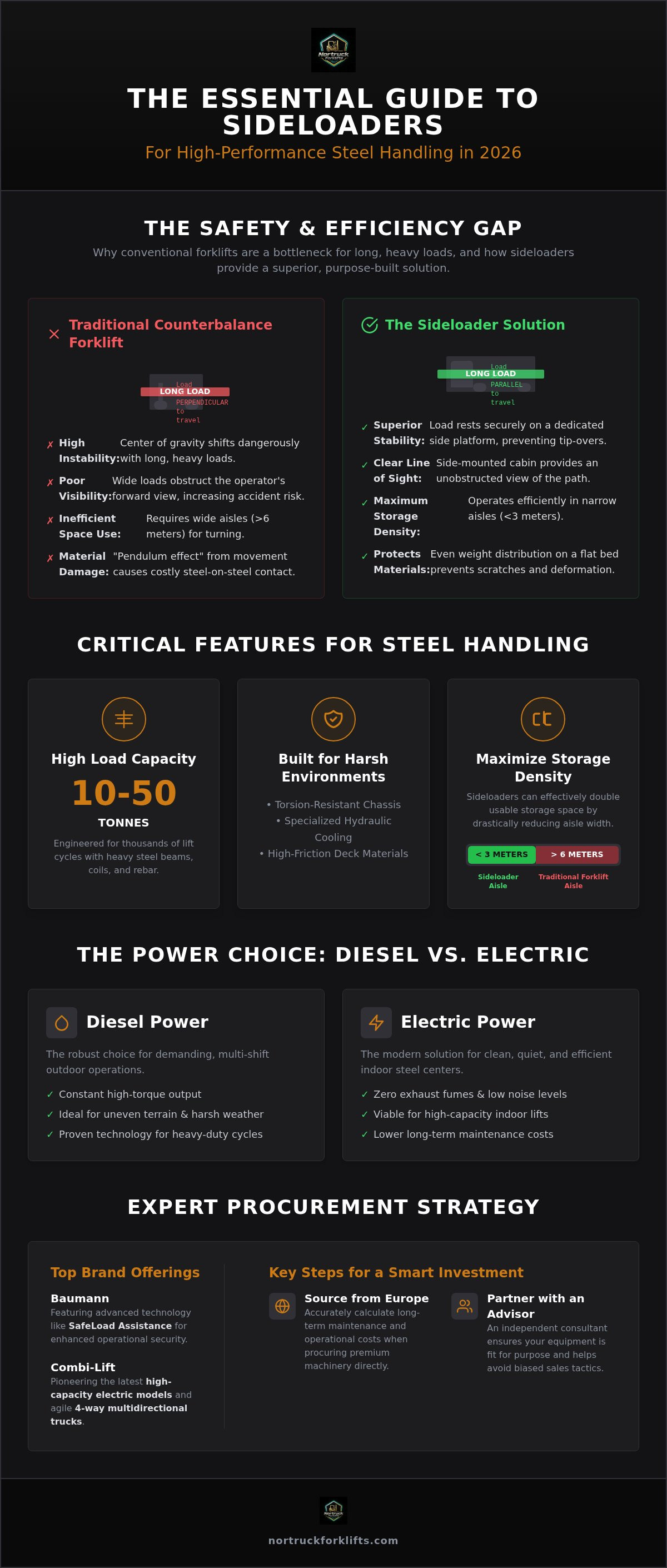
Transporting 12-meter steel beams requires more than just raw lifting power. Traditional counterbalance forklifts carry loads perpendicular to the direction of travel, which creates a massive physical footprint. This setup is inherently unstable for long materials. When an operator lifts a heavy bundle of rebar or a structural I-beam high, the center of gravity shifts dangerously. Sideloader forklifts solve this by carrying the load parallel to the direction of travel, resting the weight securely on a dedicated platform.
To see this mechanical advantage in action, watch this demonstration of long material handling:
Sideloaders vs. Traditional Forklifts: The Safety Gap
Identifying the best sideloader for steel handling requires looking at how these machines bridge the safety gap. Standard forklifts often suffer from visual obstruction. If you're carrying a wide load in front of the mast, your field of vision is compromised, increasing the risk of accidents. Sideloaders place the operator in a cabin to the side, providing a clear view of the path ahead. The deck acts as a stabilizer, preventing "dead weight" from shifting during transit. This eliminates the pendulum effect that causes many tip-over accidents in steel yards.
Maximizing Storage Density in Steel Yards
Efficiency in steel logistics is often measured in square meters. Traditional front-loading trucks require aisles wider than 6 meters to turn and maneuver long loads. By contrast, the best sideloader for steel handling can operate in aisles narrower than 3 meters. This is possible because the machine doesn't need to turn the entire load to place it in a rack.
Multidirectional steering takes this a step further. Machines like Combi-Lift 4-way trucks allow operators to change direction 90 degrees at the touch of a button. This agility lets you transition from outdoor yard storage to high-density indoor racking without changing equipment. It's a direct way to double your usable storage space while protecting inventory from the elements.
Steel-on-steel contact is a silent profit killer. When beams are balanced on narrow forks, they often slide or vibrate, leading to surface scratches or structural deformation. A sideloader’s flat bed distributes the weight evenly across a larger surface area. This reduces localized pressure points and minimizes material damage during long-distance transport across your facility. It's a simple change that yields significant returns in material integrity.
Critical Features of the Best Sideloaders for Steel
Steel is dense, heavy, and often abrasive. The best sideloader for steel handling needs a load capacity that matches the scale of the operation. While standard forklifts top out early, specialized sideloaders for this sector typically offer ratings from 10 tonnes to 50 tonnes. This ensures that even the largest structural beams or heavy coils don't push the machine to its mechanical limit, which is vital for long-term reliability. It's not just about the lift; it's about the machine's ability to sustain that lift through thousands of cycles in a demanding environment.
The Power Choice: Diesel vs. Electric for Heavy Steel
High-capacity electric sideloaders are now a viable reality for indoor steel service centers. They eliminate exhaust fumes and significantly reduce noise levels in enclosed spaces. However, diesel remains a strong choice for outdoor yards with uneven terrain. Diesel engines provide the constant high-torque output required for multi-shift operations in harsh weather. When choosing, consider that electric models often have lower maintenance intervals, though the initial investment in charging infrastructure is higher. It's a balance between immediate performance and long-term energy costs.
Durability in Harsh Environments
Foundry environments and steel mills present unique challenges like extreme heat and dust. Machines working near furnaces require specialized hydraulic cooling systems to prevent fluid breakdown. The chassis must be torsion-resistant. A rigid, well-engineered frame prevents the machine from flexing under the weight of an off-center steel load. Specialized deck materials also help manage the metal-on-metal challenge, providing a high-friction surface that keeps loads from sliding without damaging the steel's finish.
Modern safety systems have evolved beyond simple backup alarms. Many units now feature pedestrian recognition and zonal lighting to define a safe working perimeter. By improving safety and efficiency through these technical features, facilities can maintain high throughput. Mast stability is equally non-negotiable. When handling heavy plates at height, any sway can be dangerous. Look for masts with high-grade steel profiles that ensure precision even at full reach. If you're unsure which specifications align with your yard's layout, reaching out for expert procurement advice can help prevent costly mismatches between machinery and material.
Top Sideloader Brands for Steel Handling: 2026 Roundup
Selecting the best sideloader for steel handling depends entirely on your site's physical constraints and material volume. Three names dominate the 2026 market: Baumann, Combi-Lift, and Hubtex. Each manufacturer offers a distinct mechanical philosophy. While some focus on raw lifting power for massive bundles, others prioritize the agility needed to move 12-meter beams through narrow warehouse doors. Understanding these differences is the first step toward a safe and efficient procurement decision.
Baumann: Engineered for the Toughest Steel Loads
Baumann is widely considered the industry benchmark for high-tonnage applications. Their heavy-duty series handles capacities up to 50 tonnes, making them the primary choice for production mills and large-scale stockholders. A standout feature is their patented auto-stabilizing system. This technology ensures the platform remains level even on uneven yard surfaces, which is critical for maintaining forklift safety standards for long loads. If your operation involves moving massive I-beams or heavy plate steel in a high-duty cycle environment, Baumann’s heritage in durability is difficult to match. They're built for the specialized demands of the steel and foundry sectors, where heat and weight are constant factors.
Combi-Lift & Hubtex: Versatility and Space Optimization
Not every steel facility has the luxury of wide open spaces. This is where multidirectional machines excel. Combi-Lift specializes in multidirectional agility, allowing a single truck to act as a sideloader, counterbalance forklift, and narrow-aisle reach truck. It’s the right choice when you need to move long pipes through standard doorways or around tight corners. Their 4-way capability eliminates the need for wide turning circles, directly increasing your usable storage density.
Hubtex offers similar multidirectional capability but focuses heavily on precision indoor integration. Their electric range is particularly well-regarded for specialized long-load warehousing where floor space is at a premium and zero emissions are required. When deciding between these two specialists or a traditional heavy-duty unit, you might find our detailed Baumann Sideloader vs Combi-Lift comparison helpful for evaluating new and used inventory options.
When searching for the best sideloader for steel handling, your choice should follow your specific load profile. If you're lifting 30-tonne bundles in an outdoor yard, you're in Baumann territory. If you're picking 5-tonne tubes from high racking in a narrow-aisle warehouse, Combi-Lift or Hubtex will likely serve you better. Based on our 40 years of industry experience, we advise looking past the brand name to focus on the specific hydraulic and steering requirements of your most challenging material.
Procurement Strategy: Sourcing the Right Sideloader in Europe
Sourcing the best sideloader for steel handling often leads buyers to the European market. This region serves as the manufacturing heartland for premium brands like Baumann and Combilift. Buying from this market offers access to a deeper pool of specialized inventory that has often been maintained under strict service contracts. However, the logistical complexity of moving a 40-tonne machine across borders requires a methodical approach. You aren't just buying a truck. You're managing an international logistics project where precision matters.
The Inspection Checklist for Used Sideloaders
When evaluating a used machine, surface-level aesthetics are secondary to structural integrity. In steel handling, the deck surfaces take the most abuse. Look for signs of warping, excessive metal fatigue, or structural cracks. Mast rollers and hydraulic seals are also high-wear components that require close scrutiny. Verifying engine or motor hours against a documented maintenance history is essential to avoid purchasing a machine nearing a major overhaul. For a deeper dive into what to look for, consult our Used Heavy Lifting Equipment Inspection Checklist for detailed guidance.
TCO: Beyond the Initial Purchase Price
The total cost of ownership (TCO) is where many procurement strategies fail. While a used machine has a lower entry price, you must factor in the availability of spare parts for older Baumann or Kalmar models. Steel yards are also notorious for rapid tire wear. Using specialized, puncture-resistant tires is a significant but necessary operational cost to prevent downtime. Identifying the best sideloader for steel handling also requires a look at resale value. Premium brands tend to hold their worth better in the heavy lift market, making them a safer long-term investment even if the upfront cost is higher.
Moving heavy equipment requires specialized transport companies capable of handling "out of gauge" loads. This isn't a standard freight job; it involves meticulous route planning, oversized load permits, and specialized low-loader trailers. Paperwork errors at international borders can lead to expensive delays. Working with an advisor who manages these nuances daily ensures your asset arrives on site without unexpected customs or storage fees. It's the difference between a seamless transition and a logistical nightmare.
Why an Independent Advisor is Key to Your Steel Logistics
When you deal directly with a manufacturer, the conversation inevitably centers on why their specific model is the best sideloader for steel handling. It's a "one-brand-fits-all" trap that can lead to costly operational mismatches. An independent advisor works differently. We aren't tied to a single factory production line. Instead, we prioritize your operational reality. If a Baumann is the right fit for your foundry, we'll say so. If a Combi-Lift suits your narrow aisles better, that's where we'll focus. This objectivity ensures you don't end up with an expensive asset that's poorly matched to your specific material flow.
Lars G Tarby's Consultancy Approach
Lars G Tarby brings over 40 years of specialized industry experience to every consultation. This depth of knowledge is vital for identifying "hidden" machine issues that might not appear on a standard spec sheet. We've seen how different hydraulic systems perform under 24/7 stress and which chassis designs actually hold up in corrosive environments. For example, we recently facilitated the sourcing of a high-capacity Kalmar heavy lift truck for a specialized industrial client. By leveraging a vast European network, we located a machine with the exact mast height and heat-shielding required for their foundry layout, a configuration that was unavailable through local dealers.
Transparency is the cornerstone of our sourcing process. We operate without unnecessary intermediaries, which means there are no hidden markups or layers of commission. You get a direct line to premium European inventory. Nortruck Forklifts facilitates the entire journey, from the initial technical assessment and price negotiation to the final cross-border delivery. This end-to-end involvement removes the administrative burden from your team and ensures that the technical specifications promised are the ones delivered to your yard.
Getting Started with Your Sourcing Project
Every successful procurement begins with clear data. Before reaching out, it's helpful to define your primary load dimensions and maximum weight requirements. Are you handling 12-meter beams or 25-tonne coils? Your timeline also dictates the strategy. If you need a machine immediately, we focus on the used market where high-quality, refurbished stock is available. If your project allows for a longer lead time, we can guide you through the custom-build process for a new unit. Finding the best sideloader for steel handling is a significant investment; we're here to make sure it's the right one.
Optimizing Your Heavy Material Handling Strategy
Choosing the right equipment transforms a hazardous yard into a high-capacity, efficient operation. We've explored how specialized features like auto-stabilization and multidirectional steering solve the unique physical challenges of transporting 12-meter beams. Identifying the best sideloader for steel handling is a technical decision that impacts your safety standards and operational bottom line for years to come.
Our 40 years of specialized industry experience allows us to navigate the European market with absolute transparency. We provide direct access to premium inventory from brands like Baumann and Kalmar without the bias of manufacturer-direct sales. By focusing on your specific load dimensions and site constraints, we help you secure machinery that is genuinely fit for purpose and verified for your environment.
We're ready to help you build a safer and more productive yard with the right heavy lift solutions.
Frequently Asked Questions
What is the maximum capacity for a steel handling sideloader?
Sideloaders for the steel industry typically reach a maximum capacity of 50 tonnes. These high-tonnage machines are engineered specifically for the heaviest structural beams and industrial coils found in production mills. While most general-purpose units range between 10 and 25 tonnes, the specialized heavy-duty series from brands like Baumann ensure that even the largest loads don't exceed the machine's mechanical limits during 24/7 operations.
Can a sideloader handle both steel beams and large steel plates?
Yes, the best sideloader for steel handling is designed to be versatile enough for both beams and plates. While beams sit naturally on the side platform, handling large steel plates often requires specialized mast tilt functions or wider deck configurations to ensure the center of gravity remains stable. Proper load distribution across the platform is the key to preventing material deformation and ensuring safe transport through narrow warehouse aisles.
Are electric sideloaders powerful enough for 20-tonne steel loads?
Modern electric sideloaders are now capable of handling 20-tonne steel loads with ease. Recent advancements in battery technology and high-torque electric motors have closed the performance gap with diesel. High-capacity electric models are now considered a viable alternative to diesel-powered machines in heavy steel centers. These units provide a zero-emission solution without sacrificing the raw lifting capacity needed for the best sideloader for steel handling in indoor environments.
How much aisle space can I save by switching to a sideloader?
You can typically reduce your aisle width from over 6 meters to less than 3 meters. Traditional forklifts require significant space to turn a long beam perpendicular to the aisle. Since a sideloader carries the load parallel to the direction of travel, it only needs an aisle slightly wider than the machine itself. This shift can increase your usable warehouse storage capacity by up to 100% in many steel yard layouts.
What are the most common maintenance issues with sideloaders in steel mills?
The most frequent maintenance issues involve hydraulic seal degradation and deck surface wear. In the abrasive environment of a steel mill, metal-on-metal contact causes localized damage to the loading platform. Additionally, the high-duty cycles of heavy lifting put immense pressure on hydraulic systems and specialized tires. Regular inspections of the mast rollers and cooling systems are necessary to prevent the premature failure of these critical components under heat stress.
How do I verify the condition of a used Baumann sideloader before buying?
Verifying a used Baumann requires a technical focus on the patented auto-stabilizing system and mast integrity. You should look for documented service history that confirms regular hydraulic fluid changes and seal replacements. It's also vital to check for structural cracks in the chassis and excessive wear on the mast profiles. Our 40 years of expertise helps us identify these mechanical issues that might not be visible during a basic inspection.
Why should I source a sideloader from Europe instead of locally?
Sourcing from Europe provides direct access to the manufacturing heartland of the world's leading sideloader brands. Because these machines are produced and widely used across the continent, the secondary market is deeper and higher in quality. You'll find a better selection of specialized configurations, such as heat-shielded foundry models, which are often difficult to locate in local markets with limited heavy-lifting inventory and fewer specialized options.
What is the typical lead time for a new heavy-duty sideloader in 2026?
Lead times for new heavy-duty sideloaders in 2026 vary significantly based on brand and customization. While some standard configurations might be available more quickly, custom-engineered units for specialized steel applications often involve a wait of several months. For businesses with immediate needs, we recommend exploring our European network for high-quality used stock. This approach allows for faster acquisition and deployment compared to the current production timelines for new machinery.

Article by
Lars Gunnar Tärby
Disclaimer
1. General Information and No AdviceThe information, articles, product descriptions, and specifications provided on this website (www.nortruckforklifts.com) are for general informational and educational purposes only. While we strive to provide accurate and up-to-date content regarding new and used forklifts and heavy machinery, the material published does not constitute professional, technical, or legal advice.
2. Product Specifications and PricingNortruck Forklifts acts as a facilitator for the trade of new and used forklifts. All equipment details, including but not limited to year of manufacture, operating hours, lift capacity, dimensions, conditions, and pricing, are provided based on the information available to us at the time of publication. Specifications and availability are subject to change without prior notice.
3. "As Is" and VerificationAll articles and product listings are provided on an "as is" and "as available" basis without any warranties of any kind, either express or implied. Nortruck Forklifts does not guarantee that the descriptions are entirely error-free, complete, or reliable. Buyers and traders are strongly encouraged to independently verify all technical specifications, machine history, and equipment conditions directly with the seller or an authorized inspector before finalizing any purchase or transaction.
4. Limitation of LiabilityIn no event shall Nortruck Forklifts, its owners, or its contributors be held liable for any direct, indirect, incidental, consequential, or economic loss or damage arising out of the use of, or the inability to use, the information provided on this website, or any transactions facilitated through this platform. This includes, but is not limited to, damages caused by technical inaccuracies, typographical errors, or reliance on the content of our articles.
5. Third-Party LinksOur website may contain links to external websites, dealer networks, or third-party services that are not owned or controlled by Nortruck Forklifts. We have no control over, and assume no responsibility for, the content, privacy policies, or practices of any third-party websites.


