
Would you hand over $400,000 for a machine if you knew it had a hidden hairline crack in the boom? In the heavy lift industry, a used reachstacker inspection checklist is more than a maintenance task; it's a financial audit of your future operating budget. It's natural to feel uneasy when evaluating equipment that's worked thousands of hours in a busy port terminal. You're likely concerned about hydraulic system longevity or the sudden cost of replacing a spreader twistlock. These aren't just mechanical worries; they're direct threats to your bottom line and operational uptime.
I'll show you how to master the technical inspection of used reachstackers to protect your investment and forecast the total cost of ownership with precision. We'll explore the critical failure points in structural components and powertrains while accounting for 2026 regulatory shifts like the CARB zero-emission mandates. By the end, you'll have a reliable framework to decide whether to negotiate a better deal or walk away from a potential money pit. Let's look at what really happens beneath the paint and grease.
Key Takeaways
- Learn how to link pre-purchase condition to long-term operational expenditure to protect your capital investment.
- Master a comprehensive used reachstacker inspection checklist that covers high-stakes structural components, including the boom and spreader twistlocks.
- Understand the specific diagnostic tests required to evaluate engine health and transmission longevity before finalizing a deal.
- Discover how to interpret ECU fault codes to ensure the machine complies with 2026 safety and emissions standards.
- Translate technical findings into a clear acquisition strategy that empowers you to negotiate the final price or walk away with confidence.
Why the Inspection Defines Your Reachstacker Total Cost of Ownership
Buying a used reachstacker is effectively signing a contract for future maintenance. If you don't read the fine print during the physical assessment, you'll pay for it in unplanned downtime. A technical reach stacker overview shows these machines are the primary workhorses of the modern port, but their mechanical complexity means repair costs can quickly eclipse the original purchase price. Using a comprehensive used reachstacker inspection checklist shifts your perspective from the sticker price to the long-term operational expenditure (OPEX). It's about seeing the machine as a financial asset rather than just a piece of steel.
The 2026 Standard for Heavy Lifting Procurement
Terminal managers in 2026 face tighter margins and increasingly strict environmental regulations, such as the CARB zero-emission mandates. In this environment, machine uptime isn't just a performance metric; it's the difference between a profitable shift and a logistical bottleneck. Expert advisory from industry veterans like Lars G Tarby, who brings over 40 years of specialized experience, is vital for navigating these complexities. At Nortruck Forklifts, we specialize in sourcing Kalmar and Volvo units from across Europe, ensuring that every machine has a verifiable history. We bridge the gap between raw technical data and your final financial decision, helping you avoid low-quality machinery that looks good on the surface but hides deep-seated issues. Choosing the right machine requires looking beyond the basic spec sheet. For more context on selecting equipment for high-intensity environments, see our guide on the Best Forklift for Port Operations: A Consultant's Guide to Heavy Lifting.
Categorising Faults: Minor Wear vs. TCO Killers
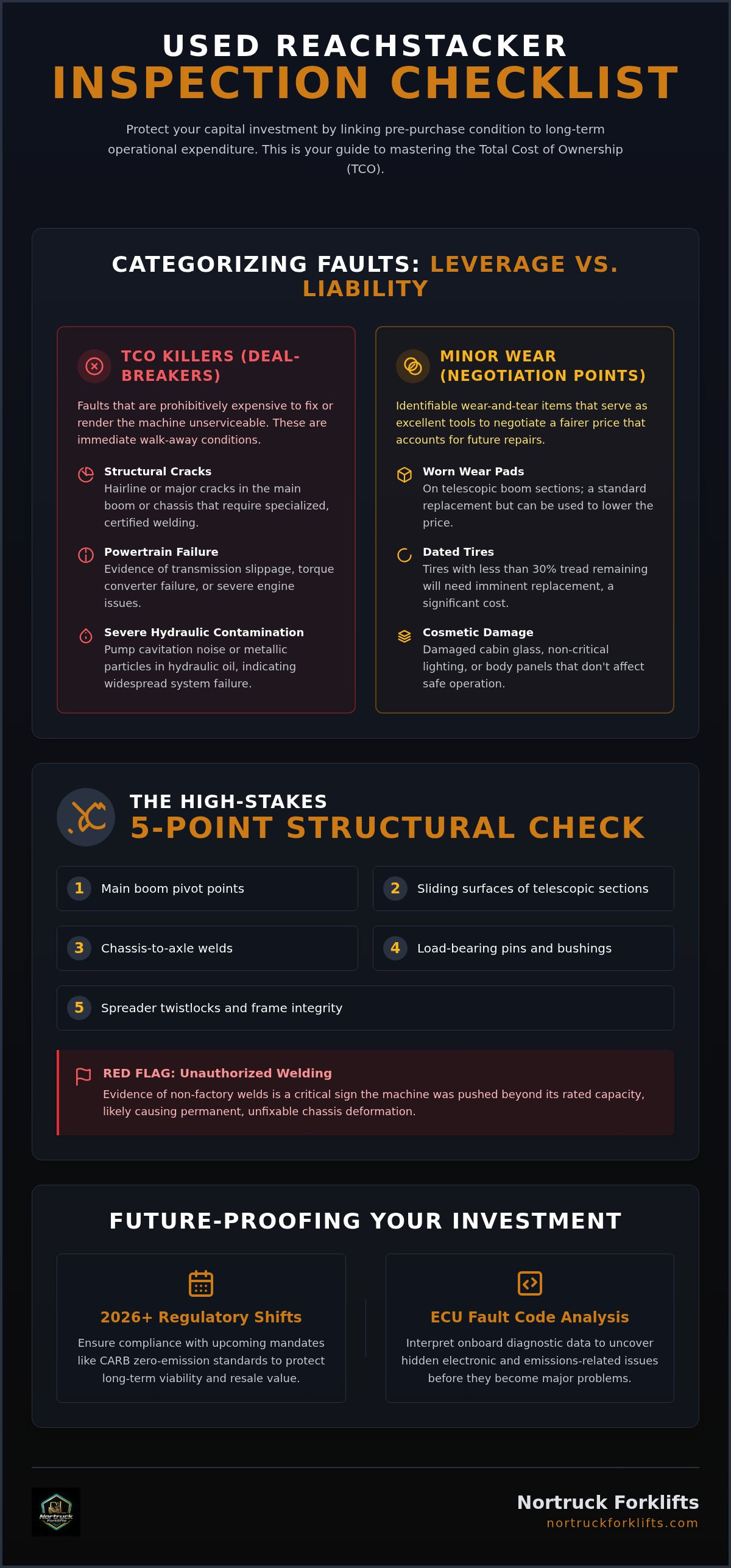
Total Cost of Ownership in reachstacker acquisition is the aggregate of the purchase price, fuel consumption, and the projected cost of all mechanical interventions over the asset's remaining life. Not all faults carry the same weight. We categorize them into two distinct groups: leverage points and deal-breakers. Identifying these during the used reachstacker inspection checklist process is critical for a successful acquisition.
TCO Killers: These are faults that often make a unit unserviceable or prohibitively expensive to fix.
- Structural cracks in the main boom or chassis that require specialized welding.
- Transmission slippage or signs of torque converter failure.
- Severe hydraulic pump cavitation or contamination in the main valve blocks.
Minor Wear: These items require attention but serve as excellent tools for price negotiation.
- Worn wear pads on the telescopic boom sections.
- Dated tires with less than 30% tread remaining.
- Cosmetic damage to the cabin glass or external lighting systems.
By identifying these issues before the money changes hands, you gain the confidence to either negotiate a fair price that accounts for future repairs or walk away from a potential money pit. This methodical approach ensures your investment stays productive and your terminal stays moving.
Structural and Spreader Inspection: The High-Stakes Checklist
The structural integrity of a reachstacker is the bedrock of its safety and long-term resale value. While a worn engine represents a significant expense, a compromised boom or chassis often renders the machine a total loss. When applying a used reachstacker inspection checklist, you must look beyond fresh paint to find the history of the machine's physical stress. Adhering to Industrial Truck Association standards ensures that you are evaluating the equipment against recognized safety benchmarks that prioritize structural stability under load.
Boom and Chassis Integrity
Your primary goal is to identify "TCO Killers" before they enter your fleet. A rigorous audit should focus on the 5-point structural check: the main boom pivot points, the sliding surfaces of telescopic sections, the chassis-to-axle welds, the load-bearing pins, and the bushings. On Kalmar models, specifically examine the junction where the lift cylinders attach to the boom. Stress fractures in these high-tension zones are often masked by heavy grease or recent touch-up paint. If you find evidence of unauthorized welding, it's a sign the machine was pushed beyond its rated capacity; this likely caused permanent chassis deformation that no repair can truly fix.
Spreader Functionality and Wear
A spreader that lacks precision isn't just a maintenance headache; it's a safety risk for your operators and ground crew. You should perform multiple twistlock cycle tests to ensure engagement is fast, perfectly synchronized, and secure. Any lag suggests hydraulic decay or mechanical linkage wear. Inspect the wear pads on the telescopic arms; if these are neglected, the resulting steel-on-steel friction will eventually pull the spreader out of alignment. Don't overlook the side-shift and rotation cylinders for hydraulic weeping. For those specifically targeting premium European brands, our guide on the Kalmar Reachstacker for Sale: The Expert Buyer’s Inspection Checklist (2026) provides granular details on brand-specific wear patterns.
If you're evaluating a machine across borders and can't be there in person, partnering with an independent advisor helps ensure that what you see in photos matches the actual structural reality on the ground. Verifying the condition of pins and bushings now prevents a complete teardown of the lifting assembly six months into operation.
Power Train and Hydraulics: Evaluating the Machine’s Heart
While structural integrity is non-negotiable, the power train and hydraulic systems dictate your daily operational costs. A machine that lifts but does so slowly or with excessive fuel consumption will erode your margins over time. Integrating these deep-dive mechanical checks into your used reachstacker inspection checklist is essential to avoid inheriting a unit with a failing heart. You aren't just looking for a machine that runs; you're looking for one that maintains peak efficiency under the 24/7 pressure of a port environment.
Engine and Transmission Diagnostics
Every inspection should begin with a cold start. Listen for irregular idling and watch the exhaust for blue smoke, which suggests oil burning, or white smoke, which often points to coolant leaks or injector issues. Most high-tier reachstackers utilize Volvo or Cummins engines. You should check these for "blow-by" by removing the oil filler cap while the engine is running; excessive pressure here indicates worn piston rings. Don't overlook the turbocharger; look for oil residue around the seals and listen for high-pitched whining that signals imminent failure.
The transmission is equally critical. Perform a transmission stall test to determine the remaining life of the torque converter. By engaging the brakes and throttle simultaneously in gear, you can verify if the engine reaches the manufacturer’s specified RPM range. If it over-revs, the clutches are likely slipping. Always pull the transmission dipstick to check the oil. If the fluid is dark or smells burnt, the internal clutch packs are already compromised. Cross-referencing these findings with service records is vital. If the hour-meter shows 15,000 hours but the transmission oil hasn't been changed in the last 2,000, you're looking at a high-risk asset.
Hydraulic Efficiency and Seal Health
Hydraulic performance is the visible measure of a reachstacker's health. You should time the lift and extension cycles against the original factory specifications. Slow cycle times usually point to a worn main pump or internal leaking in the valve blocks. To check for "creep," lift a loaded container and let it sit for ten minutes. Any noticeable descent indicates that the cylinder seals or the holding valves are failing. This isn't just a maintenance issue; it's a safety hazard that can lead to dropped loads.
Finally, insist on a hydraulic oil analysis. This inexpensive test reveals the presence of metal shavings or water contamination that the naked eye can't see. It's a professional "insider" step that separates a thorough audit from a superficial walk-around. Heavy-duty drive axles and wet disc brakes are also hidden cost centers. If the axle oil contains significant metallic debris, you may be facing a complete hub or differential rebuild. These components are designed for longevity, but neglect in the first 10,000 hours of operation will lead to catastrophic expenses for the second owner.
Cabin, Electronics, and 2026 Safety Standards
Modern reachstackers are as much about software as they are about steel. When you're using a used reachstacker inspection checklist, the digital health of the machine is just as critical as the engine's compression. A machine with a pristine exterior but a history of CAN-bus errors is a ticking financial time bomb. You're evaluating the nerve center where your operator will spend eight to twelve hours a day; if the interface is degraded, productivity inevitably follows. This isn't just about whether the lights turn on; it's about the integrity of the entire control logic that prevents catastrophic failure under load.
Digital Health and Error Log Analysis
Accessing the Electronic Control Unit (ECU) is a non-negotiable step in any professional audit. On many modern units, the onboard diagnostic display provides a window into the machine's operational history. You should navigate the menus to look for recurring fault codes related to hydraulic pressure sensors or transmission temperature spikes. These aren't just "glitches" that can be reset; they often signal systemic failures that have been ignored or patched over. A clean error log is a prerequisite for a TCO-positive machine because it proves the previous owner didn't just clear codes right before the inspection. Identifying recurring sensor failures early prevents you from inheriting a machine that spends more time in "limp mode" than it does moving containers.
Safety and Compliance Verification
Safety standards have evolved significantly in recent years. As of 2026, OSHA has updated its guidance under standard 29 CFR 1910.178, which now emphasizes "continuous behavioral verification." This means your machine's safety systems, including proximity sensors and Load Moment Indicators (LMI), must be fully functional and capable of logging performance data. You must test the LMI to ensure it correctly restricts the boom if a load exceeds the safe working radius. Don't forget the physical safety basics: check the emergency stop buttons, the overload protection bypass, and the integrity of the fire suppression system if one is fitted. A machine that fails to meet these 2026 regional safety certifications is effectively unserviceable in high-compliance port terminals.
Finally, assess the operator's physical environment. A cracked cabin glass or a failing HVAC system isn't just a comfort issue; it's a safety and compliance risk that leads to operator fatigue. Ensure the seat suspension is functional and the joysticks provide precise, tactile feedback without excessive play. In today's market, the "soft" components of the cabin are just as vital to your bottom line as the heavy iron components.
The Sourcing Strategy: From Inspection to Acquisition
Once the technical assessment is complete, the focus shifts from mechanical discovery to financial strategy. You've gathered the data; now you must decide if the unit fits your operational profile. Synthesizing your used reachstacker inspection checklist into a final "Go/No-Go" decision requires a balanced view of immediate costs versus long-term value. A machine with 15,000 hours might be a "Go" if the transmission stall test was perfect and the structural audit was clean, even if it needs new tires and wear pads. Conversely, a low-hour machine with a single hairline crack in the boom pivot should be an immediate "No." Your goal is to acquire an asset, not a project.
Negotiating Based on Technical Evidence
Transparency is your greatest asset during a transaction. By quantifying the repair costs found during your inspection, you can adjust your acquisition budget with precision. If a machine is sold "as-is," these findings are your primary leverage for a price reduction. You aren't just asking for a discount; you're presenting a documented case for a price that reflects the machine's true condition. If the seller refuses to acknowledge documented "TCO Killers," it's a clear signal to walk away. This same methodical approach to procurement applies across various heavy equipment categories. For instance, our Expert Guide to Sourcing a Used Volvo Wheel Loader in 2026 highlights how similar technical audits protect your capital in the wheel loader market.
Expert Sourcing with Nortruck Forklifts
Navigating the European market for heavy lift trucks requires an "insider" perspective that most buyers simply don't have. Lars G Tarby uses over 40 years of industry expertise to identify high-value machines, often before they hit the open market. This independent advisory removes the middleman, ensuring you get direct, honest communication about a machine's true condition. When sourcing across borders, having a partner who understands the nuances of Kalmar and Volvo equipment is the difference between a successful fleet addition and a logistical nightmare.
Acquisition is only the first step. Because reachstackers are massive assets, post-purchase logistics like dismantling for transport, shipping, and site re-assembly require specialized planning. We help coordinate these movements and plan your first-service interval to ensure your machine arrives ready for immediate deployment. This comprehensive approach ensures that your investment starts paying for itself the moment it reaches your terminal.
Securing Your Terminal's Operational Future
A successful acquisition is built on the details you uncover before the contract is signed. By shifting from a simple walk-around to a "TCO-first" mindset, you protect your capital from the hidden costs of structural fatigue and hydraulic decay. Implementing a rigorous used reachstacker inspection checklist bridges the gap between mechanical data and financial reality, ensuring that your fleet remains productive in an increasingly regulated port environment. Whether it's verifying ECU error logs or testing the torque converter, these steps are your primary defense against unplanned downtime.
At Nortruck, we provide the independent advisory you need to navigate these high-stakes decisions without manufacturer bias. Our global sourcing network and 40+ years of heavy lifting expertise allow us to identify machines that truly meet your operational needs. You don't have to face the complexities of cross-border procurement alone. We're here to ensure your next reachstacker is a reliable workhorse rather than a budgetary burden.
Take the uncertainty out of your next heavy equipment purchase. Your terminal deserves the confidence that comes with expert guidance and a proven sourcing strategy.
Frequently Asked Questions
What is the most common failure point on a used Kalmar reachstacker?
Spreader twistlocks and lift cylinder seals are the most common mechanical failure points on used Kalmar reachstackers. These components bear the brunt of high-cycle operations in busy port terminals. You should also check the boom pivot bushings for excessive play during your assessment. Wear in these areas often indicates a history of overloading or neglected lubrication, which can lead to expensive hydraulic leaks and safety risks.
How many hours is too many for a used reachstacker?
A reachstacker with 20,000 to 25,000 hours is typically approaching the end of its first major lifecycle. At this stage, major components like the engine, transmission, and hydraulic pumps often require significant overhauls. However, a well-maintained unit with 15,000 hours might be a better investment than a neglected machine with 8,000. Focus on the service history and current component health rather than just the hour-meter reading.
Can I perform a reachstacker inspection myself without a technician?
You can perform a preliminary visual check, but a comprehensive technical audit requires a specialized technician. Modern machines rely on complex CAN-bus electronics and high-pressure hydraulics that aren't easily diagnosed by sight alone. A professional uses diagnostic tools to read ECU fault logs and perform transmission stall tests. Skipping this step often leads to inheriting expensive faults that are invisible to the untrained eye during a walk-around.
How does the reachstacker total cost of ownership differ between brands like Volvo and Kalmar?
Volvo units are frequently praised for their fuel efficiency and engine longevity, which can lower your daily operational expenditure. Kalmar machines often command a higher resale value due to their extensive global parts network and specialized spreader designs. The total cost of ownership depends largely on your local service support. If you can't get parts quickly, any initial savings on the purchase price will be lost to downtime.
What documents should I request before inspecting a used reachstacker?
You should request full service logs, recent hydraulic oil analysis reports, and valid safety inspection certifications. Look for evidence of major repairs, such as boom welding or transmission rebuilds. It's also vital to verify the machine's model year against its model plate. These documents provide the paper trail necessary to confirm the hour-meter is accurate and the machine has been maintained to manufacturer standards before you finalize your used reachstacker inspection checklist.
Are structural cracks in a reachstacker boom always a deal-breaker?
Structural cracks in the main boom or chassis are almost always deal-breakers for port operations. While some minor welds on non-load-bearing components are repairable, cracks in high-stress zones compromise the machine's safety certification. These faults often indicate permanent chassis deformation from "over-lifting." Attempting to repair these sections is prohibitively expensive and rarely restores the machine to its original rated capacity or safety standard, making it a high-risk asset.
How much does a professional reachstacker inspection typically cost?
Professional inspection costs vary based on the machine's location and the depth of the technical audit. A standard industry assessment typically covers a full day of labor by a qualified heavy-lift technician plus travel expenses. While this represents an upfront cost, it's a small fraction of the potential repair bills hidden in a neglected machine. Investing in an expert review is the most effective way to protect your capital and ensure long-term uptime.
What is the impact of salt-water environments on used port equipment?
Salt-water environments cause accelerated corrosion on the chassis and deep-seated decay in electrical connectors. You'll often find bubbling paint that hides significant metal loss on the spreader and boom sections. Salt also invades the main valve blocks and sensor housings, leading to recurring electronic fault codes. If a machine has worked in a coastal terminal, your used reachstacker inspection checklist must prioritize a thorough search for rust and wiring degradation.

Article by
Lars Gunnar Tärby
Disclaimer
1. General Information and No AdviceThe information, articles, product descriptions, and specifications provided on this website (www.nortruckforklifts.com) are for general informational and educational purposes only. While we strive to provide accurate and up-to-date content regarding new and used forklifts and heavy machinery, the material published does not constitute professional, technical, or legal advice.
2. Product Specifications and PricingNortruck Forklifts acts as a facilitator for the trade of new and used forklifts. All equipment details, including but not limited to year of manufacture, operating hours, lift capacity, dimensions, conditions, and pricing, are provided based on the information available to us at the time of publication. Specifications and availability are subject to change without prior notice.
3. "As Is" and VerificationAll articles and product listings are provided on an "as is" and "as available" basis without any warranties of any kind, either express or implied. Nortruck Forklifts does not guarantee that the descriptions are entirely error-free, complete, or reliable. Buyers and traders are strongly encouraged to independently verify all technical specifications, machine history, and equipment conditions directly with the seller or an authorized inspector before finalizing any purchase or transaction.
4. Limitation of LiabilityIn no event shall Nortruck Forklifts, its owners, or its contributors be held liable for any direct, indirect, incidental, consequential, or economic loss or damage arising out of the use of, or the inability to use, the information provided on this website, or any transactions facilitated through this platform. This includes, but is not limited to, damages caused by technical inaccuracies, typographical errors, or reliance on the content of our articles.
5. Third-Party LinksOur website may contain links to external websites, dealer networks, or third-party services that are not owned or controlled by Nortruck Forklifts. We have no control over, and assume no responsibility for, the content, privacy policies, or practices of any third-party websites.


