
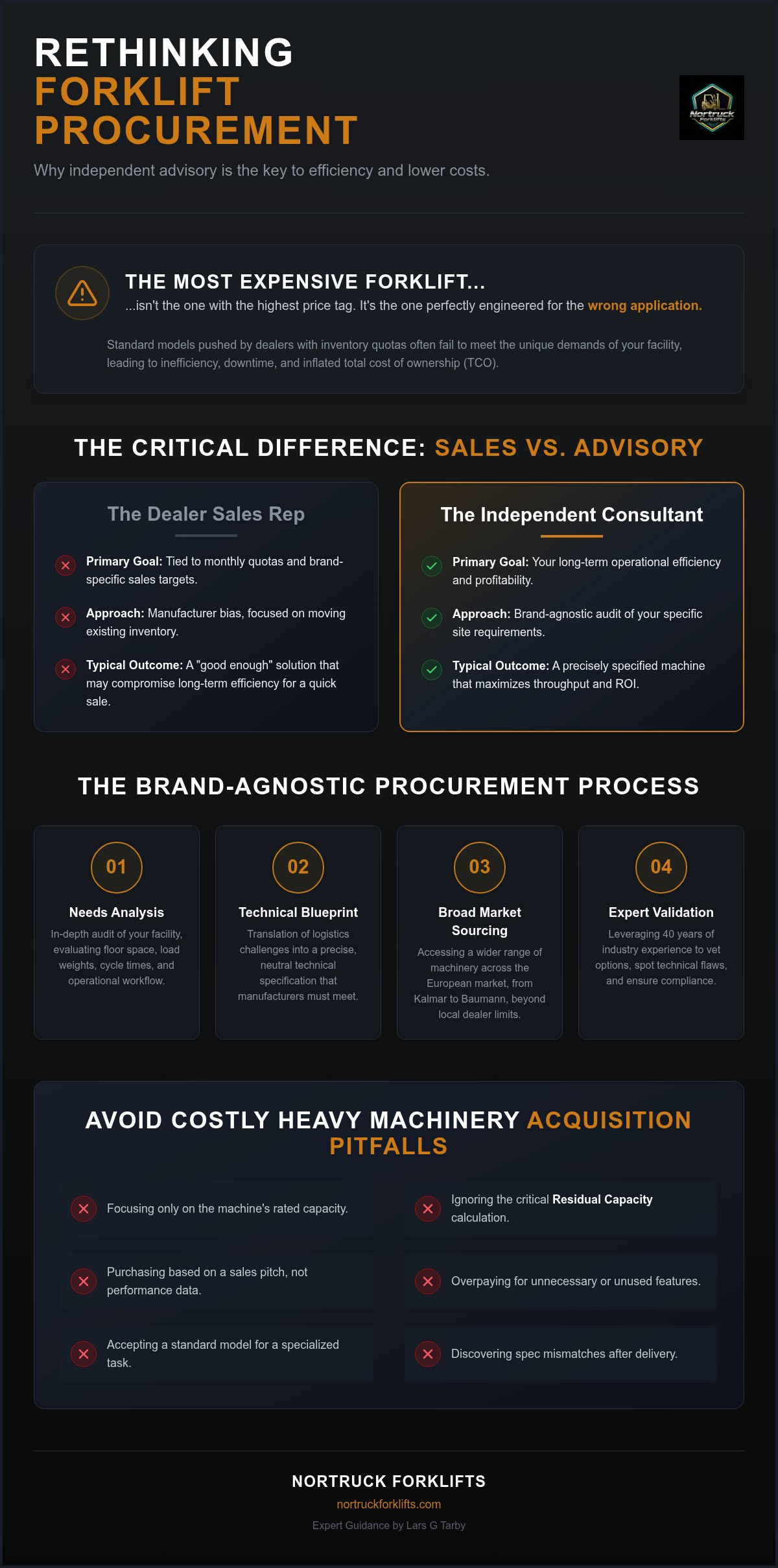
The most expensive forklift in your fleet isn't the one with the highest purchase price; it's the one perfectly engineered for the wrong application. When you're managing heavy lift operations, the difference between a machine that fits your workflow and one that merely occupies space comes down to technical precision. You likely recognize the frustration of a dealer pushing a standard model that doesn't quite clear your narrow aisle constraints. Working with an independent forklift specification consultant allows you to bypass these manufacturer biases and focus strictly on what your facility requires to remain efficient.
This article explains why independent advisory is the most effective way to protect your bottom line in 2026. You'll learn how to cut through the noise of sales pitches to source equipment based on data and site requirements rather than what a dealer has in stock. We will explore how this approach lowers your total cost of ownership and provides access to a much broader range of machinery across the European market, from Kalmar heavy trucks to Baumann sideloaders. You'll discover how to secure a machine that's actually built for the job at hand without overpaying for unnecessary features.
Key Takeaways
- Learn why removing OEM bias is the first step toward securing heavy lifting equipment that actually matches your operational reality.
- Discover how a forklift specification consultant conducts a brand-agnostic audit to identify the precise technical requirements your facility needs.
- Understand the process of sourcing specialized machinery across Europe to find the best value beyond your local dealer's limited inventory.
- Identify the common pitfalls in heavy machinery acquisition that lead to inflated total cost of ownership and operational downtime.
- Gain insights into leveraging 40 years of industry experience to navigate the complex used market with transparency and expert guidance.
What is an Independent Forklift Advisor and Why Do You Need One?
An independent forklift advisor is a technical specialist who prioritizes your operational throughput over brand loyalty. Unlike a dealer, they don't have a specific inventory to clear. Instead, they evaluate your floor space, load weights, and cycle times to determine the exact requirements for your next powered industrial truck. As a forklift specification consultant, their primary value lies in neutrality. They act as a translator, turning your logistics challenges into a technical blueprint that manufacturers must meet. In 2026, global logistics is shifting toward higher capacity and specialized machinery to handle increased container density. This makes the "one size fits all" approach of standard dealers obsolete.
The Difference Between a Sales Rep and a Consultant
Sales representatives are essential to the supply chain, but their goal is tied to monthly quotas and brand-specific targets. A consultant's only metric is your long-term operational efficiency. Choosing a machine based on a sales pitch often leads to under-specified equipment or paying for features that never get used. Brand-agnostic advice ensures your investment in a new equipment fleet is based on performance data, not a marketing brochure. With 40 years of industry experience, an advisor like Lars G Tarby can spot technical flaws in a spec sheet that a junior rep might overlook. This level of insight prevents you from purchasing a machine that looks good on paper but fails in your specific environment.
When to Engage an Independent Advisor
Timing is critical for a high-stakes acquisition. You should involve a forklift specification consultant well before signing a purchase order, especially during facility expansions or when designing new port terminal layouts. If you are moving away from standard warehouse units toward specialized equipment like Kalmar heavy-lift trucks or Baumann sideloaders, the margin for error shrinks. The technical nuances of mast stability and turning radii in these categories are complex. You also need an expert eye when exploring the European forklift market guide to ensure that a machine sourced from another region meets your local operational standards. Proactive advisory ensures you don't discover a specification mismatch after the equipment arrives on your dock.
The Critical Role of a Forklift Specification Consultant
Purchasing a machine based solely on its rated capacity is a common error that leads to operational bottlenecks. While a truck might be rated for 10 tonnes, its actual performance depends on the load center and mast elevation. A forklift specification consultant examines these variables alongside your facility's turning radius and floor composition to ensure the machine remains stable under real-world conditions. This technical scrutiny is essential for Avoiding Costly Mistakes that compromise safety or violate regional compliance standards. By adopting a heavy machinery procurement services approach, you define the technical solution before looking at the price tag.
Deep Dive into Heavy Lift Specifications
Heavy lift requirements vary significantly by industry. A Kalmar truck spec'd for a steel mill requires heat protection and specialized hydraulics that a concrete yard application simply doesn't need. Similarly, a port terminal reachstacker must be configured differently if it's handling heavy industrial components instead of standard ISO containers. Understanding these nuances is critical to maintaining safety. Residual capacity is the actual lifting strength of a forklift after accounting for the mast height, attachment weight, and load center distance, making it the most vital specification for ensuring operational safety. If you need help calculating these complex figures, consulting with an expert ensures your fleet remains safe and productive.
Specialized Equipment: Sideloaders and 4-Way Trucks
Standard counterbalanced trucks often fail when handling long loads like timber or steel beams. This is where Baumann sideloader specifications become vital. These machines require precise deck heights and tilt configurations to transport long materials through narrow gates safely. For facilities with extreme space constraints, Combi-Lift 4-way trucks offer a solution, but only if the steering specs are perfectly matched to your aisle widths. Even the choice of tires and attachments affects operational longevity. Solid tires might offer durability on smooth concrete, but they'll destroy the axle of a machine working on uneven outdoor terrain. A forklift specification consultant ensures every component, from the forks to the fuel type, is fit for purpose.
The Procurement Process: From Needs Analysis to European Sourcing
The procurement of heavy lifting equipment is a methodical journey that transforms operational data into physical assets. It begins with a comprehensive operational audit. A forklift specification consultant examines load dimensions, surface gradients, and duty cycles to build a precise technical profile. This profile becomes a brand-agnostic specification sheet. By focusing on specs rather than brands, you ensure the machine serves the facility, not the dealer's sales target. Once the requirements are set, the search moves to the broader market. Partnering with a heavy equipment broker Europe allows you to look beyond local constraints to find the specific configuration your site demands. This step involves scanning dealer networks across multiple countries to find units that meet the exact mast height and attachment needs defined in the audit.
Why Sourcing from Europe is a Strategic Advantage
Europe remains the global hub for high-capacity machinery, offering a dense inventory of Kalmar, Linde, and Volvo units. There are significant benefits of sourcing used forklifts from Europe, particularly when you require specialized reachstackers or heavy-duty wheel loaders that are scarce in other regions. Regional market saturation in parts of Germany or Scandinavia often leads to more competitive pricing on well-maintained machinery. While exchange rates fluctuate, the sheer volume of available units often offsets currency shifts, providing a wider selection of late-model equipment that fits strict 2026 operational budgets. Accessing these markets gives you the leverage to choose based on condition rather than proximity.
Verifying Used Equipment Integrity
A machine is only as reliable as its maintenance history. Part of the consultant's role involves a forensic review of hour meters and service logs to ensure the equipment hasn't been overworked. They look for structural fatigue in high-capacity masts and stress fractures in the chassis, areas where standard inspections might fail. Compliance is another hurdle. Every machine must align with OSHA's Powered Industrial Truck standard or equivalent European safety regulations to ensure it meets 2026 emission and safety benchmarks. After verification, the process concludes with managed logistics and customs clearance, ensuring the unit arrives ready for immediate deployment. This end-to-end oversight by a forklift specification consultant removes the risk of importing a liability and ensures the final delivery matches the original technical blueprint.
Avoiding Costly Mistakes in Heavy Machinery Acquisition
The financial risk of procurement is highest when the focus remains solely on the initial invoice. It's common for facility managers to attempt to save on the purchase price by under-specifying equipment, only to find the machine can't handle the duty cycle required. A forklift specification consultant helps you look beyond the sticker price to calculate the Total Cost of Ownership (TCO). This includes fuel consumption, maintenance intervals, and the projected cost of downtime. Ignoring the TCO often results in a machine that is cheap to buy but impossible to maintain profitably. In the 2026 global supply chain, lead times for new equipment can stretch significantly, making the used market a strategic necessity. However, buying without a technical advocate often results in acquiring a machine that doesn't fit the task. Choosing a standard counterbalanced forklift for a role that requires a sideloader's lateral stability is a recipe for operational failure.
The True Cost of Wrong Specifications
Technical errors have physical consequences. If a machine's turning radius is even slightly larger than your aisle specifications, you risk constant damage to racking and warehouse infrastructure. Beyond the physical, the hidden costs of importing heavy machinery without correct technical documentation or emission certifications can lead to expensive delays at customs. A well-maintained used Kalmar with 5,000 hours often provides superior structural integrity and residual value compared to a brand-new machine from a lower-tier manufacturer with unproven long-term performance. It's essential to ensure these details are correct before the wire transfer is made to protect your capital.
Mitigating Risk Through Independent Inspection
Third-party verification is non-negotiable for high-capacity used equipment. An independent forklift specification consultant acts as your eyes on the ground, verifying that the machine's actual condition matches the seller's description. They identify wear patterns in the hydraulic systems or stress in the chassis that a standard dealer might ignore. These findings provide powerful leverage during price negotiations. Instead of accepting the asking price, you can negotiate based on the technical reality of the unit. The goal is to ensure the machine is ready to work the moment it arrives on your site, minimizing the downtime that typically follows a blind purchase. Professional oversight turns a high-risk transaction into a calculated operational upgrade.
Partnering with Nortruck: Expert Guidance by Lars G Tarby
Navigating the complex technicalities of heavy lifting requires more than just a brochure; it requires a partner who's spent decades on the workshop floor and in the boardroom. Lars G Tarby brings over 40 years of industry experience to every engagement, serving as a dedicated forklift specification consultant for businesses that cannot afford a procurement error. Nortruck Forklifts operates with a clear, no-nonsense philosophy: you receive honest advice based on technical reality rather than sales quotas. By eliminating unnecessary intermediaries, you get direct, transparent communication and a sourcing process that's free from hidden fees or OEM bias.
Our track record spans the most respected names in the industry, including Kalmar, Linde, Toyota, and Baumann. We don't just find a machine; we verify that its configuration matches your site's specific demands. Whether you need a high-capacity reachstacker for a port or a specialized sideloader for long-load handling, our European-wide network provides access to the best available inventory. This "expert guide" approach ensures that you aren't just another transaction in a dealer's ledger. Instead, you're a partner receiving tailored advice from a seasoned industry veteran who understands the internal nuances of heavy equipment acquisition.
Tailored Solutions for Specialized Industries
Heavy logistics varies wildly between a steel mill, a timber yard, and a port terminal. Each environment presents unique challenges, from heat-resistant hydraulic requirements to the precise steering needed for narrow-aisle timber storage. Nortruck Forklifts understands these nuances because we've seen how machines perform in these specific contexts over four decades. We manage the entire lifecycle of the acquisition, including the logistical complexities of cross-border delivery and customs clearance. This specialized approach ensures that your customized sourcing strategy, whether for new or used machinery, accounts for every operational variable before the unit leaves the seller's yard.
Start Your Procurement Consultation Today
The first step toward a more efficient fleet is a direct conversation about your specific lifting challenges. We simplify the acquisition of high-capacity machinery by acting as your technical advocate. As your forklift specification consultant, we ensure that every specification is verified and every risk is mitigated. Don't leave your capital investment to chance or dealer preference. We focus on long-term solutions that prioritize your operational efficiency over quick transactions. It's about finding the right tool for the job, backed by the integrity of a trusted advisor.
Don't leave your next major investment to chance. Take the guesswork out of your next acquisition and build a fleet designed for long-term performance.
Frequently Asked Questions
What exactly does a forklift specification consultant do?
A forklift specification consultant acts as a technical intermediary who translates your operational challenges into a precise equipment blueprint. They analyze your facility's floor gradients, load dimensions, and cycle times to determine exactly what machinery you need. Instead of relying on a dealer's stock, they provide a brand-agnostic recommendation. This ensures you invest in a machine that fits your workflow rather than one that simply fits a salesperson's monthly quota.
How can an independent advisor save my company money?
An independent advisor identifies the hidden costs that standard sales pitches often ignore. By focusing on the Total Cost of Ownership, they help you avoid over-specifying for features you won't use or under-specifying a machine that will fail under heavy duty cycles. This prevents expensive downtime and premature equipment replacement. Their ability to negotiate based on technical findings rather than list prices also provides significant leverage during the procurement process.
Is it better to buy a new forklift or source a used one from Europe?
The decision depends on your operational timeline and specific capacity needs. In 2026, new equipment lead times remain a challenge for many businesses. Sourcing a well-maintained, used Kalmar or Linde from Europe often provides a high-quality machine at a lower price point with immediate availability. A consultant ensures that any used unit meets your technical requirements and safety standards, making it a strategic alternative to waiting for a new build.
Which brands do you specialize in sourcing?
We specialize in sourcing high-capacity and specialized machinery from the industry's most reliable manufacturers. Our network focuses on Kalmar heavy lift trucks, Baumann sideloaders, and Combi-Lift 4-way trucks. We also provide advisory for Linde and Toyota forklift fleets, as well as Volvo wheel loaders and reachstackers for port terminals. This broad access across Europe ensures we find the best machine for your application regardless of the brand's local presence.
How do you verify the condition of a used heavy lift truck?
Condition verification involves a forensic approach to the machine's history and physical integrity. We conduct a thorough review of maintenance logs and hour meters to detect any irregularities in usage. Our inspection specifically targets high-stress areas like the mast assembly and chassis for signs of structural fatigue. By identifying these issues before the purchase, we protect you from acquiring a machine that requires immediate, costly repairs upon delivery.
Can you help with the logistics of importing a forklift from Europe?
Yes, we manage the entire logistical chain from the seller's yard to your facility. This includes handling the complexities of customs documentation, emission compliance, and specialized heavy transport. Navigating cross-border regulations can be difficult without experience; we ensure all technical paperwork is correct to avoid delays at port. Our goal is to provide a seamless transition so your equipment arrives ready for immediate deployment without administrative headaches.
What is the difference between a reachstacker and a heavy forklift for port use?
A reachstacker uses a telescopic boom to stack containers multiple rows deep, providing flexibility in crowded port terminals. In contrast, a heavy forklift uses a vertical mast and is typically used for high-capacity lifting in industrial yards or for moving containers where depth isn't the primary concern. Choosing between them depends on your yard's layout and the specific density of your storage requirements. We help you determine which configuration maximizes your throughput.
Why is an independent consultant better than an OEM dealer's advisor?
An independent forklift specification consultant prioritizes your operational efficiency over manufacturer quotas. OEM advisors are naturally incentivized to recommend their own brand's solutions, even if another manufacturer has a more suitable machine for your specific aisle width or load type. Our independence allows us to be completely transparent. We focus on finding the right tool for the job, providing honest advice that isn't restricted by a single product catalog or sales target.

Article by
Lars Gunnar Tärby
Disclaimer
1. General Information and No AdviceThe information, articles, product descriptions, and specifications provided on this website (www.nortruckforklifts.com) are for general informational and educational purposes only. While we strive to provide accurate and up-to-date content regarding new and used forklifts and heavy machinery, the material published does not constitute professional, technical, or legal advice.
2. Product Specifications and PricingNortruck Forklifts acts as a facilitator for the trade of new and used forklifts. All equipment details, including but not limited to year of manufacture, operating hours, lift capacity, dimensions, conditions, and pricing, are provided based on the information available to us at the time of publication. Specifications and availability are subject to change without prior notice.
3. "As Is" and VerificationAll articles and product listings are provided on an "as is" and "as available" basis without any warranties of any kind, either express or implied. Nortruck Forklifts does not guarantee that the descriptions are entirely error-free, complete, or reliable. Buyers and traders are strongly encouraged to independently verify all technical specifications, machine history, and equipment conditions directly with the seller or an authorized inspector before finalizing any purchase or transaction.
4. Limitation of LiabilityIn no event shall Nortruck Forklifts, its owners, or its contributors be held liable for any direct, indirect, incidental, consequential, or economic loss or damage arising out of the use of, or the inability to use, the information provided on this website, or any transactions facilitated through this platform. This includes, but is not limited to, damages caused by technical inaccuracies, typographical errors, or reliance on the content of our articles.
5. Third-Party LinksOur website may contain links to external websites, dealer networks, or third-party services that are not owned or controlled by Nortruck Forklifts. We have no control over, and assume no responsibility for, the content, privacy policies, or practices of any third-party websites.


