
Buying a high-capacity lift truck based strictly on the nominal capacity listed on a data plate is often the fastest way to compromise both site safety and your long-term bottom line. In heavy-duty environments, the sticker price is rarely the true cost of ownership, especially when you factor in the complexities of de-rating at height. You likely already understand that moving 25 tons requires more than just raw power; it requires a machine that remains stable and efficient under specific, real-world conditions. This guide provides the clarity you need to evaluate these options, focusing on the core heavy duty forklift selection criteria that separate a reliable workhorse from a costly mistake.
We'll move beyond basic specs to explore the technical and strategic factors that drive operational ROI. You'll gain a clear checklist for evaluating equipment, an honest look at the performance of premium European brands like Kalmar and Linde, and a proven strategy for sourcing directly from the European market. By the end of this professional guide, you'll have the expert perspective needed to secure a machine that delivers precision and durability for the next decade of service. This is about finding the right tool for your specific industrial application without the noise of single-brand sales pitches.
Key Takeaways
- Learn why the transition to heavy-capacity equipment requires a fundamental shift in how you evaluate load centers and mast stability compared to standard warehouse trucks.
- Master the essential heavy duty forklift selection criteria to ensure your equipment maintains safe lifting capacity at height without the risk of unexpected de-rating.
- Understand how specialized machines, such as robust sideloaders or versatile multi-directional trucks, solve unique environmental challenges that traditional forklifts often fail to address.
- Evaluate the true total cost of ownership by looking beyond the initial purchase price to the long-term resale value and operational efficiency offered by leading manufacturers.
- Discover how an independent, transparent sourcing strategy leverages decades of industry expertise to navigate the European market and find the ideal machine for your specific application.
Defining Heavy-Duty Forklift Selection: Capacity and Classification
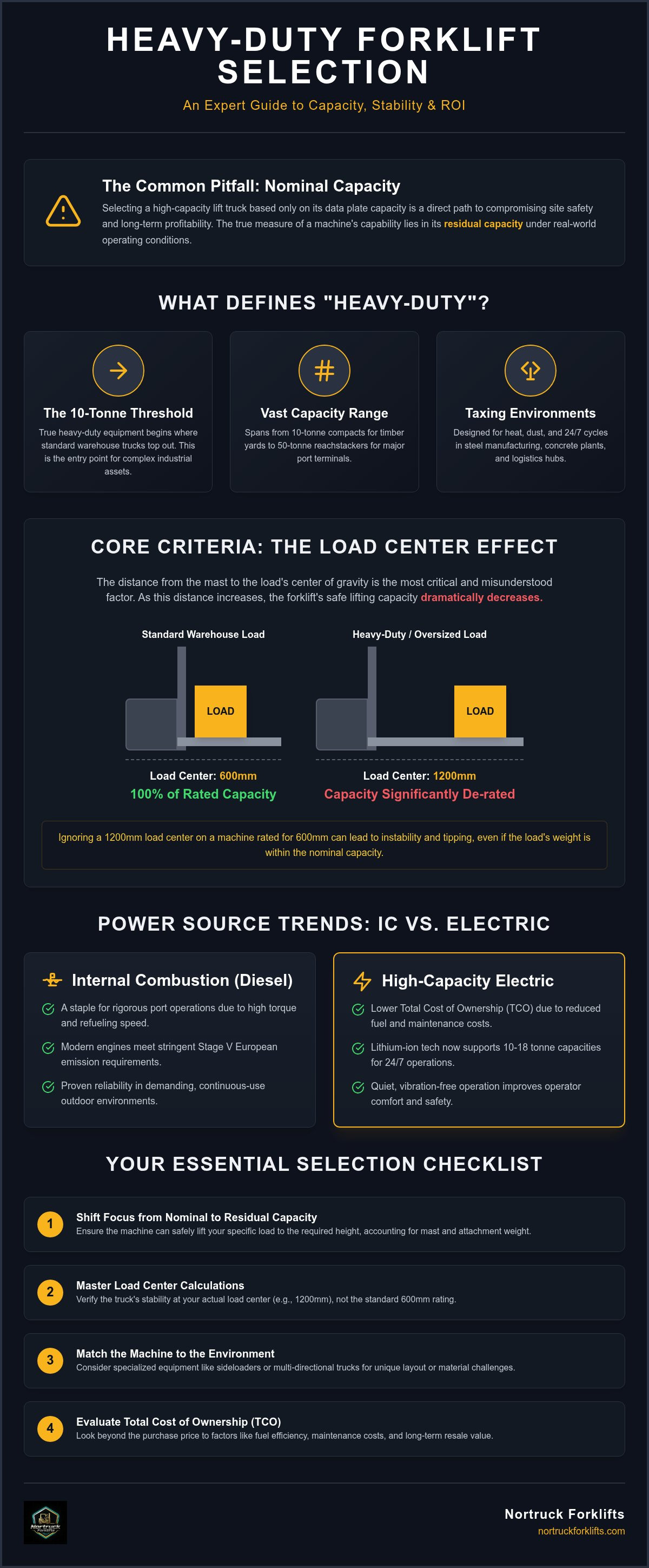
In the material handling industry, the term "heavy duty" is often used loosely, but for professional procurement, it marks a specific engineering threshold. Standard warehouse equipment typically tops out at 7 or 8 tonnes; however, true heavy duty forklift selection criteria begin at the 10-tonne mark. At this level, the machinery transitions from simple lifting tools to complex industrial assets designed for high-stress environments. These machines manage everything from 10-tonne compact units used in tight timber yards to 50-tonne reachstackers that dominate port terminal operations. Selecting a machine for steel manufacturing requires understanding that the environment is often as taxing as the load itself. Heat, dust, and continuous operation mean the chassis must be over-engineered to prevent structural fatigue.
By 2026, the landscape has shifted significantly. While internal combustion engines once held a monopoly on high-capacity lifting, the rise of high-capacity electric counterbalance forklifts has changed the math for steel manufacturing and concrete plants. These industries require equipment that can withstand 24/7 cycles while meeting stricter emission standards. This shift isn't just about compliance; it's about matching the machine to the specific demands of the application.
To better understand this concept, watch this helpful video:
Understanding Weight Classes and Lift Ratings
Professional sourcing requires a deep dive into Forklift Classifications to distinguish between general-purpose trucks and ultra-high capacity specialized logistics equipment. A common pitfall is focusing solely on nominal capacity, which is the maximum weight a truck can lift at a specific load center. In reality, the residual capacity, which accounts for mast height and attachment weight, is the only metric that ensures operational safety. Premium brands like Kalmar maintain higher residual ratings because their chassis and masts are engineered for structural longevity rather than just meeting a minimum price point. This structural integrity is what allows a 25-tonne truck to perform reliably at its limit for years.
Power Source Trends: IC vs. Electric for Heavy Lifts
For European port operations, diesel remains a staple due to the rigorous Stage V emission requirements that ensure cleaner operation. However, the operational ROI of heavy-duty electric forklifts has reached a tipping point in 2026. With lithium-ion technology now supporting 10 to 18-tonne capacities, the total cost of ownership often drops due to lower fuel and maintenance expenses. Electric models now offer the torque required for heavy lifts without the noise or vibration of traditional diesel engines, which also improves operator comfort over long shifts. The choice between power sources often comes down to the duty cycle. The duty cycle is the total amount of time a machine is actively working versus idling or charging during a standard shift, and it dictates whether electric or diesel is the most efficient fuel choice for your specific 24/7 operation.
Core Technical Selection Criteria: Stability and Load Centers
The load center is perhaps the most misunderstood variable in heavy duty forklift selection criteria. While a standard warehouse truck is often rated at a 500mm or 600mm load center, high-capacity loads like steel coils, oversized timber, or shipping containers frequently require a 1200mm center. If you ignore this distance, you risk tipping the machine even if the load weight is technically within the nominal capacity. Precision in hydraulic components also plays a vital role. When you are handling multi-million dollar loads, the ability to make minute adjustments without jerky movements is a necessity, not a luxury. This level of control depends on the quality of the valves and pumps, which is why high-tier European components are often preferred for specialized lifting.
Ground pressure is another critical factor that dictates operational safety. Rugged industrial terrains, like uneven concrete yards or port terminals, demand specific tire selections to maintain stability and traction. Solid pneumatic tires are common for puncture resistance, but they transmit more vibration to the chassis than air-filled tires. Adhering to OSHA Forklift Standards (29 CFR 1910.178) is a baseline requirement for any operation. In 2026, with penalty maximums reaching $16,550 for serious violations and $165,514 for willful ones, technical compliance is also a significant financial safeguard. If you are unsure how these variables interact for your specific site, consulting with an independent specialist can prevent a costly procurement error.
Calculating Residual Capacity and De-rating
De-rating is the reduction in lifting capacity that occurs as the mast extends or as attachments move the load center forward. You must calculate the residual capacity for your specific lift height to ensure the machine remains stable. Premium brands like Linde and Kalmar are engineered with wider stances and optimized counterweights to offer superior stability at maximum extension. Warning signs that a machine is being pushed beyond its safe structural limit include excessive mast sway or the rear wheels losing consistent contact with the ground. Always prioritize machines that offer a safety margin above your heaviest expected lift.
Specialized Attachments and Their Impact
Integrating side-shifters, fork positioners, or heavy-duty clamps is essential for operational efficiency, but these tools are not "weight-free" additions. Every attachment adds weight to the front of the carriage and shifts the horizontal load center further away from the drive axle. This shift directly impacts the machine's total cost of ownership by increasing stress on the hydraulic system and front tires. The data plate is the most critical document on the machine because it provides the only legally and technically valid confirmation of what the truck can safely lift with its specific configuration of mast and attachments.
Application-Specific Requirements: Matching Environment to Machine
While weight capacity is the baseline, the physical geometry of your cargo often dictates the most efficient machine type. Traditional counterbalance trucks are excellent for open-space logistics, but they become operational bottlenecks in narrow aisles. In port terminal logistics, the choice between a heavy forklift and a reachstacker usually depends on stacking density. Reachstackers provide the ability to reach over a front row of containers, which is a key heavy duty forklift selection criteria for terminals looking to maximize footprint. Conversely, heavy forklifts are often more efficient for specialized cargo that requires precise, vertical lifting without the complexity of a boom. Corrosive environments, such as coastal concrete yards or chemical processing plants, require specialized protection for hydraulic cylinders and electrical connectors to prevent premature failure from salt or airborne particulates.
In narrow aisle timber or steel yards, space is money. Utilizing Combi-Lift 4-way trucks for sale allows operators to transition from standard pallet handling to side-travel mode for long loads. This flexibility eliminates the need for wide transfer aisles and increases storage capacity significantly. Matching the machine to the environment isn't just about the lift; it's about the flow of the entire facility.
Timber and Steel: The Case for Sideloaders
Traditional forklifts often fail in long-load aisle efficiency because they must carry loads perpendicularly to the direction of travel. This requires massive aisle widths to accommodate the length of the timber or steel beams. Baumann sideloaders solve this by carrying the load parallel to the truck's travel on a dedicated platform. Key specs for these machines include platform height and tilting features that stabilize the load on uneven ground. If you're debating between a standard truck and a specialized unit, understanding the technical differences in a multidirectional forklift vs reach truck comparison can clarify which configuration suits your aisle widths.
Heavy Industry: Kalmar and Linde Performance
For operations exceeding 20 tonnes, Kalmar heavy lift trucks for sale are widely considered the industry standard. Their chassis are engineered for high-duty cycles in the most demanding port and industrial settings. When comparing Linde to other brands, the focus often shifts to their hydrostatic drive system. Unlike a traditional torque converter, Linde's hydrostatic drive offers millimeter-precision control and automatic braking, which is ideal for frequent direction changes in tight spaces. This precision is particularly valuable when selecting a forklift for concrete industry applications, where heavy, fragile loads like precast sections must be positioned with absolute accuracy to avoid damage.
Evaluating Total Cost of Ownership (TCO) and ROI
The initial purchase price of a high-capacity lift truck is often the least significant number in its lifecycle cost. A comprehensive approach to heavy duty forklift selection criteria must prioritize the total cost of ownership, which includes fuel consumption, scheduled maintenance, and the efficiency of the operator. For example, while a heavy-duty electric forklift with a capacity over 4 tons can cost between $30,000 and $55,000 in 2026, the absence of traditional engine maintenance and lower energy costs often results in a lower TCO compared to diesel alternatives. In high-intensity environments like ports or steel mills, the cost of a single day of downtime can easily exceed the monthly financing payment of the machine itself. Reliability is not a luxury; it is a fundamental requirement for maintaining operational uptime.
Premium European brands like Kalmar and Linde offer what many industry veterans call the 'Premium Brand' dividend. These machines are engineered for longevity, which translates into significantly higher resale values on the secondary market. Sourcing parts for these specialized brands is also more predictable due to established supply chains across Europe. When you invest in a machine with a proven track record, you are essentially buying insurance against the catastrophic failure of a critical industrial asset. Transparency in the sourcing process ensures you understand exactly where your maintenance budget will go over the next decade.
New vs. Used Heavy Forklift ROI
Deciding between new and used equipment requires a strategic look at your specific application. There are scenarios where a well-maintained, used 30-tonne unit provides a better return on investment than a brand new 15-tonne unit, especially if your operation requires high capacity but lower daily hours. In the 2026 market, New vs used heavy forklift ROI depends heavily on the machine's documented service history. Verifying hour meters and structural integrity on high-capacity used equipment is vital to ensure you aren't inheriting another firm's maintenance nightmare. A machine with 10,000 hours in a clean warehouse is a different asset than one with 5,000 hours in a corrosive coastal port.
Operator Ergonomics and Retention
In a tight labor market, the quality of the equipment you provide is a powerful retention tool. Modern cabin designs with intuitive controls and 360-degree camera systems don't just improve safety; they reduce the physical toll on the operator. When an operator feels confident and comfortable, they work more efficiently and make fewer mistakes that lead to product damage or safety incidents. The ergonomic impact on heavy lifting operations is measured by the reduction in operator fatigue, which directly maintains consistent cycle times throughout an eight-hour shift. Investing in a high-tier cabin environment is a direct investment in your site's safety culture and productivity.
The Strategic Sourcing Process: Why Independent Advisory Matters
Single-brand dealerships operate under specific contracts that limit their recommendations to a narrow catalog. If you need a specialized solution, such as a Baumann sideloader for long loads or a high-capacity Kalmar for port work, a local dealer might try to fit a "standard" truck to a "specialized" problem. This is where an independent advisor adds value. By focusing on your heavy duty forklift selection criteria rather than a sales quota, an advisor like Nortruck Forklifts leverages 40+ years of experience to identify the exact machine for your operation. Direct sourcing from Europe eliminates unnecessary intermediaries, ensuring you don't pay for multiple layers of markup before the machine reaches your facility. It's a transparent, direct-to-expert approach that prioritizes your bottom line over a manufacturer's inventory list.
Navigating the European Forklift Market
Europe remains the global hub for high-quality, high-spec heavy lifting equipment. The density of heavy industry and strict regulatory standards means the secondary market is filled with well-maintained units from brands like Linde and Toyota. Our European forklift market guide outlines how to navigate this landscape safely in 2026. We manage the entire logistics chain, including cross-border inspections and technical verifications, so you aren't buying a machine based on photos alone. Lars G Tarby's deep industry connections across the EU provide access to machinery that often never hits public auction sites, giving you a competitive edge in procurement.
Tailored Procurement: Finding the 'Specific' Machine
An "off-the-shelf" solution rarely suffices for 30-tonne applications. These machines often require specific mast heights, specialized hydraulic attachments, or reinforced chassis configurations that aren't sitting on a lot. The sourcing process begins with a thorough operational audit to define your requirements before we even look at the market. This methodical approach ensures that the heavy duty forklift selection criteria we establish are met by a machine that will actually perform in your specific environment. Whether you are handling precast concrete or steel coils, the goal is to find a machine that matches your duty cycle and site constraints perfectly. It's about securing a long-term asset that delivers consistent ROI through precision engineering.
Securing Your Operational Future with Precision Sourcing
Selecting the right high-capacity equipment is a decision that impacts your site's safety and profitability for the next decade. By mastering the heavy duty forklift selection criteria outlined in this guide, you move beyond simple capacity ratings to understand the critical relationship between load centers, stability, and long-term resale value. Whether your operation requires the multidirectional flexibility of a Combi-Lift or the raw power of a 50-tonne Kalmar, the goal is always to match the machine to the specific demands of your industrial application.
True value is found in transparency and expertise rather than the quickest transaction. Leveraging a direct European sourcing network allows you to bypass unnecessary intermediaries and access high-spec machinery that fits your budget and operational cycle. It's about making an informed investment backed by decades of industry knowledge. We look forward to helping you navigate the complexities of the heavy lifting market with independent, brand-agnostic advice.
With 40+ years of heavy lifting expertise, we are here to ensure your next acquisition is a strategic success that supports your growth for years to come.
Frequently Asked Questions
What is the most important factor in heavy duty forklift selection?
The most critical factor is matching the machine's residual capacity to your specific load geometry and lift height. While nominal capacity is a starting point, actual performance depends on how the truck handles weight at full extension. Safety and operational efficiency rely on this precise technical match. This alignment is a core part of the heavy duty forklift selection criteria that prevents site incidents and ensures the machine remains a productive asset for its entire service life.
How do I calculate the residual capacity for a 20-tonne forklift?
You calculate residual capacity by consulting the manufacturer's specific load chart for that model and mast configuration. This chart accounts for the weight of attachments, the height of the lift, and the distance of the load center. It's not a generic calculation; it's a structural limit defined by the truck's engineering. If you add a side-shifter or a clamp, the capacity drops. Always verify these figures before committing to a purchase to ensure compliance with site safety standards.
Is it better to buy a new or used Kalmar heavy lift truck in 2026?
Deciding between a new or used Kalmar depends entirely on your annual operating hours and budget constraints. A new truck offers the latest Stage V engine technology and full warranty protection, which is ideal for high-intensity 24/7 port operations. However, a well-maintained used unit provides significant capital savings while retaining high resale value. In 2026, the availability of documented service histories makes used European stock a highly reliable alternative for many industrial applications.
What are the benefits of sourcing a forklift from the European market?
Sourcing from Europe provides access to a wider inventory of high-specification machinery that often features better maintenance records than other regions. European industrial standards for brands like Linde and Baumann are exceptionally high, meaning used units are typically in excellent structural condition. Direct sourcing also allows you to find specialized configurations, such as specific mast heights or hydraulic attachments, that aren't readily available in smaller, local markets, ensuring a better fit for your operation.
How does the load center affect the lifting capacity of a heavy forklift?
The load center acts as a fulcrum point; as the center moves further from the mast, the lifting capacity decreases due to the laws of physics. A truck rated for 20 tonnes at a 600mm load center cannot safely lift that same weight at 1200mm. Understanding this relationship is vital for heavy duty forklift selection criteria when handling oversized cargo like timber or steel. Ignoring the load center is a primary cause of tip-over accidents in heavy industrial environments.
Why should I use an independent forklift advisor instead of a dealer?
An independent advisor provides brand-agnostic guidance focused on your operational needs rather than moving specific dealer inventory. While a dealership is contractually obligated to sell their own brand, an advisor like Nortruck evaluates the entire market to find the best machine for your application. This transparency ensures you don't overpay for features you don't need or settle for a machine that isn't perfectly suited to your site's unique constraints and duty cycles.
What is the expected lifespan of a high-capacity Linde or Toyota forklift?
A high-capacity forklift from a premium brand like Linde or Toyota can realistically last between 15,000 and 20,000 operating hours with a disciplined maintenance schedule. These machines are engineered with heavy-duty chassis and superior hydraulic components designed for long-term industrial service. While the initial investment is higher, the extended lifespan and high resale value result in a lower total cost of ownership compared to budget brands that may require major structural repairs much earlier.
Can electric forklifts handle 30-tonne loads effectively?
Modern electric forklifts in 2026 are fully capable of handling 30-tonne loads with performance that rivals or exceeds diesel counterparts. High-voltage lithium-ion systems provide the immediate torque required for heavy lifts while significantly reducing noise and vibration for the operator. These machines are particularly effective in indoor-outdoor applications where emissions are a concern. While the upfront cost for the battery and charger is higher, the reduction in fuel and maintenance expenses creates a compelling ROI.

Article by
Lars Gunnar Tärby
Disclaimer
1. General Information and No AdviceThe information, articles, product descriptions, and specifications provided on this website (www.nortruckforklifts.com) are for general informational and educational purposes only. While we strive to provide accurate and up-to-date content regarding new and used forklifts and heavy machinery, the material published does not constitute professional, technical, or legal advice.
2. Product Specifications and PricingNortruck Forklifts acts as a facilitator for the trade of new and used forklifts. All equipment details, including but not limited to year of manufacture, operating hours, lift capacity, dimensions, conditions, and pricing, are provided based on the information available to us at the time of publication. Specifications and availability are subject to change without prior notice.
3. "As Is" and VerificationAll articles and product listings are provided on an "as is" and "as available" basis without any warranties of any kind, either express or implied. Nortruck Forklifts does not guarantee that the descriptions are entirely error-free, complete, or reliable. Buyers and traders are strongly encouraged to independently verify all technical specifications, machine history, and equipment conditions directly with the seller or an authorized inspector before finalizing any purchase or transaction.
4. Limitation of LiabilityIn no event shall Nortruck Forklifts, its owners, or its contributors be held liable for any direct, indirect, incidental, consequential, or economic loss or damage arising out of the use of, or the inability to use, the information provided on this website, or any transactions facilitated through this platform. This includes, but is not limited to, damages caused by technical inaccuracies, typographical errors, or reliance on the content of our articles.
5. Third-Party LinksOur website may contain links to external websites, dealer networks, or third-party services that are not owned or controlled by Nortruck Forklifts. We have no control over, and assume no responsibility for, the content, privacy policies, or practices of any third-party websites.


