
Choosing a heavy duty forklift 30 tonne based on the sticker price alone is often the most expensive mistake a procurement manager can make. You likely recognize that at this capacity, a machine isn't just a piece of equipment; it's the operational heartbeat of your terminal or industrial site. When a 30-tonne unit goes offline because of a mismatched load center or a hidden mechanical history, the cost of downtime quickly eclipses any initial savings.
We're here to ensure your next acquisition is backed by forty years of industry expertise rather than guesswork. This 2026 sourcing guide provides the technical framework needed to navigate the fragmented European inventory and secure a machine that delivers genuine long-term value. We will examine critical stability nuances, compare market leaders like Kalmar, and break down the total cost of ownership. By the end, you'll have a clear roadmap for sourcing a reliable lifting solution that minimizes operational risk and protects your bottom line.
Key Takeaways
- Identify why the 30-tonne threshold represents a critical engineering shift for high-intensity applications in ports, steel mills, and concrete manufacturing.
- Evaluate essential technical benchmarks, specifically how load center variations affect the stability and safety of a heavy duty forklift 30 tonne.
- Navigate the 2026 European inventory to locate premium Kalmar and Linde units while avoiding the hidden costs of unnecessary intermediaries.
- Analyze total cost of ownership by looking past the sticker price to account for fuel consumption and Stage V emission compliance.
- Leverage four decades of specialized sourcing expertise to verify machine history and ensure long-term operational reliability.
The 30-Tonne Weight Class: Industrial Applications and Demands
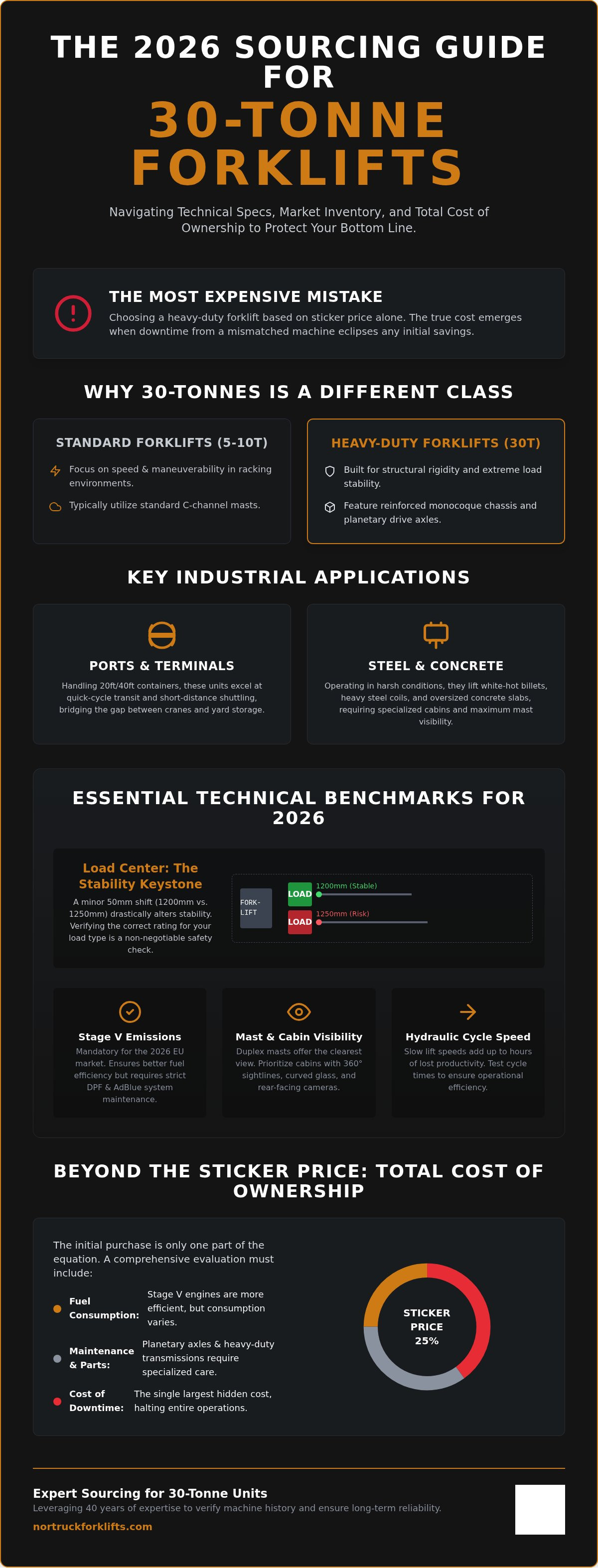
Moving from a 5 or 10-tonne capacity to a 30-tonne threshold isn't just a scale-up. It's a complete shift in industrial engineering. While standard forklift technology and design focus on maneuverability and speed in racking environments, a heavy duty forklift 30 tonne is built for structural rigidity and extreme load stability. At this weight class, the chassis transitions to a reinforced monocoque design, and the axles are engineered to handle massive torque. Sourcing these units requires an insider approach because the inventory is fragmented across Europe. You aren't just buying a lift; you're investing in the heart of your operation.
Port and Terminal Logistics
In port environments, these machines act as versatile workhorses that bridge the gap between ship-to-shore cranes and yard storage. They often handle 20ft and 40ft containers using specialized top-lift or side-lift attachments. While reachstackers are the primary choice for deep stacking, the 30-tonne forklift excels in narrow aisles and quick-cycle transit tasks. It's often more efficient for short-distance shuttling. If you're weighing these two options, it helps to understand the trade-offs between a heavy forklift vs reachstacker to ensure your yard flow remains uninterrupted.
Steel and Concrete Manufacturing
Industrial sites like steel mills and concrete pre-casting plants present some of the harshest conditions for heavy machinery. In steel production, forklifts must handle white-hot billets or heavy coils. This often requires specialized cabins with heat-shielding and fire-resistant hydraulic fluids. For concrete manufacturers, the challenge is different. Lifting oversized slabs or pipes demands exceptional mast visibility and lateral stability. A heavy duty forklift 30 tonne in this sector needs specific mast configurations to ensure the operator can see past the load. You can find more detail on these specific stressors in our high-capacity forklifts for steel buying guide.
The structural differences between these machines and standard warehouse trucks are significant. Standard trucks use C-channel masts, but 30-tonne units often feature heavy-duty, reinforced steel plate masts and planetary drive axles. This complexity is why specialized sourcing is mandatory. Sourcing a 30-tonne unit requires verifying several high-stakes factors:
- The specific load center rating, which is typically 1200mm at this capacity.
- The service history of the planetary axles and heavy-duty transmission.
- Compliance with European Stage V emission standards for the 2026 market.
You can't treat a 30-tonne procurement like a warehouse purchase. It requires a partner who understands the machine's history and the specific application it was built for.
Technical Benchmarks: What Defines a Quality 30t Forklift?
Technical specifications for a heavy duty forklift 30 tonne are more than just figures on a data sheet. They determine if your machine is safe, legal, and operationally efficient. Most 30-tonne units are rated at a 1200mm load center. Some manufacturers spec at 1250mm. This 50mm difference might seem minor, but it drastically alters the machine's stability when handling oversized steel coils or concrete slabs. Adhering to Material handling industry standards ensures that these ratings are verified for real-world safety.
By 2026, the European market is fully committed to Stage V engines. These powerplants offer better fuel efficiency but require strict maintenance of DPF and AdBlue systems. If you're sourcing used machinery, check if the engine was originally built to meet these standards or retrofitted later. High-volume operations also need to evaluate hydraulic cycle speeds. A slow lift speed doesn't just frustrate operators; it adds minutes to every truck-loading cycle, which translates to hours of lost productivity each week.
Safety Systems and Operator Ergonomics
Modern heavy lift trucks prioritize visibility. A duplex mast is the industry standard because it offers a clear window between the rails. Triplex masts are available but often compromise visibility for a lower collapsed height. You should look for cabins that provide 360-degree sightlines, often achieved through curved glass panels and rear-facing cameras. Integrated weighing systems are now standard, preventing operators from exceeding the rated capacity of the heavy duty forklift 30 tonne before they begin a move. If you're unsure which mast configuration fits your facility, consulting with an independent specialist can help you avoid a costly mismatch.
Chassis and Component Durability
Longevity depends on the quality of the chassis and drive components. A long wheelbase provides better longitudinal stability when braking with a full load, though it increases the space needed for maneuvers. In these high-capacity diesel trucks, the drive axle is a massive investment. Brands like Kalmar use heavy-duty planetary axles that distribute the load more effectively across the gears. A longer wheelbase increases the turning radius while providing greater stability during high-capacity lifts. Tire wear is another factor; ensure the unit uses high-ply pneumatic or solid tires rated for the extreme pressures of a 30-tonne load.
Sourcing 30-Tonne Forklifts in Europe: New vs. Used
The 2026 European market for heavy lifting equipment remains tight. While Kalmar, Linde, and Toyota continue to lead in engineering, the primary barrier for many procurement managers is the lead-time for new factory orders. It isn't uncommon for a new heavy duty forklift 30 tonne to have a production window of 6 to 12 months. When your operation needs immediate capacity to meet a new contract, waiting a year simply isn't an option. This delay can stall projects and lead to missed revenue opportunities.
Sourcing used machinery from established European fleets offers a strategic bypass. These units are often maintained to rigorous standards and are available for immediate deployment. You also avoid the steep initial depreciation that accompanies a brand-new machine. To understand the specific nuances of acquiring these high-capacity units, see our expert guide to sourcing Kalmar heavy lift trucks. The goal is to find a machine that has been utilized within its design limits and serviced by factory-trained technicians.
Verifying Performance Data in Used Machinery
You can't rely solely on an hour meter when evaluating a pre-owned heavy duty forklift 30 tonne. High hours in a clean port environment might be less concerning than low hours in a corrosive steel mill or a dusty concrete plant. We look for signs of stress in the mast pivots and check the hydraulic seal integrity under load. A documented service history from a major European manufacturer is the only way to verify that critical preventative maintenance was performed on schedule. Without this paper trail, the risk of catastrophic component failure is too high. You should review our expert sourcing checklist to avoid the pitfalls of private, unverified sales.
Navigating Cross-Border Logistics and Inspections
Buying a machine in one European country for use in another involves more than just a wire transfer. You have to manage technical inspections, local safety certifications, and specialized heavy-haul logistics. An independent advisor acts as your eyes on the ground, conducting physical inspections across Europe so you don't have to travel to every site. This direct approach removes the layers of unnecessary intermediaries who often add substantial markups without providing any technical oversight. By dealing directly with the source and having an expert verify the machine's condition, you ensure that your investment is sound and compliant with all regional regulations. This transparency is what builds long-term operational reliability.
Procurement Framework: Evaluating the 30t Investment
Evaluating a capital investment of this magnitude requires a shift from short-term savings to long-term operational value. The purchase price of a heavy duty forklift 30 tonne is merely the baseline; the real impact on your balance sheet comes from the Total Cost of Ownership (TCO). You need to account for fuel consumption, as a 30-tonne diesel engine under full load can consume significant volumes depending on the duty cycle and engine generation. Maintenance accessibility is equally critical for your procurement framework. Sourcing a machine from a manufacturer with a thin support network in your region is a recipe for extended downtime that can cost thousands per day in lost productivity. Brands like Kalmar and Linde remain industry favorites because their parts are globally accessible and their resale value stays high even after a decade of service. This brand strength provides a secure exit strategy that cheaper, less recognized manufacturers cannot match. Working with an independent advisor ensures these variables are audited before you commit capital.
Customization and Attachments
A 30-tonne machine is rarely used with standard forks alone. To maximize your ROI, you must match the attachment to the specific stressors of your industry. Steel mills often require heavy-duty coil rams or specialized magnets designed for high-heat environments. Timber operations, on the other hand, benefit from wide carriages and hydraulic clamps for oversized bundles. Implementing quick-change technology allows your fleet to remain versatile, switching between forks and specialized attachments in minutes rather than hours. This level of flexibility ensures that your heavy duty forklift 30 tonne isn't sitting idle when specific tasks are completed. Choosing the right attachment isn't just about capability; it's about protecting the load and the machine from unnecessary structural wear and hydraulic stress. Expert verification of these components is vital, as mismatched attachments can compromise the machine's stability and safety ratings.
Operational ROI and Efficiency
The primary driver for moving to the 30-tonne class is throughput. By utilizing a high-capacity machine, you can consolidate multiple smaller lifts into a single efficient cycle. This reduction in movement directly lowers labor costs and decreases yard congestion, creating a safer environment for ground staff and operators alike. It also extends the life of your smaller fleet by removing them from high-stress tasks they weren't designed to handle. Integrating a 30t capacity machine into port operations significantly reduces vessel turnaround times by streamlining the movement of heavy breakbulk and specialized containers. Efficiency in these high-stakes environments is measured in minutes saved per shift, which compounds into substantial annual operational savings. When you calculate the reduction in fuel per tonne moved, the economic case for the 30t class becomes clear. Our 40 years of industry experience helps you identify these efficiency gains before the machine even arrives on site.
The Nortruck Advantage: Expert Sourcing for 30-Tonne Units
Securing a heavy duty forklift 30 tonne in today's market requires more than just a search engine. It demands a level of industry insight that only comes from decades on the front lines of heavy lifting. Lars G Tarby brings over 40 years of specialized experience to every acquisition, acting as an independent advisor rather than a traditional equipment dealer. This distinction is vital. We don't answer to manufacturing quotas or stock levels; we answer to your operational requirements. By sourcing directly from the European market, we eliminate the unnecessary intermediaries that typically inflate costs and obscure a machine's true history. This transparency ensures you're paying for the machine's capability, not a broker's commission.
A Consultative Approach to Heavy Lifting
Our process begins by understanding your site's specific stressors. Does your terminal require the high-duty cycle performance of a Kalmar, or is the precision of a Linde more suited to your manufacturing floor? We provide tailored advice across all major brands, including Toyota and Volvo, to ensure the machine matches your reality. Sourcing hard-to-find 30-tonne specifications, such as specific mast heights or specialized attachments, is a core part of our service. We provide a clear, unbiased view of the global inventory, giving you access to premium units that never reach the public portals. This insider perspective is what prevents the high risk of downtime associated with poorly sourced equipment.
Get Started with a Professional Consultation
Initiating a search for your next heavy duty forklift 30 tonne is a straightforward, professional process. We begin with a detailed assessment of your lifting needs, looking at everything from load centers to regional emissions compliance. From there, we leverage our network to identify and evaluate the best available units in the European inventory. You'll receive a comprehensive report on the machine's condition, service history, and suitability for your application. This independent verification is the most effective way to reduce your total cost of ownership and ensure long-term reliability. Are you ready to secure a lifting solution backed by 40 years of expertise? Contact us today for a direct, honest conversation about your equipment needs.
Securing Your High-Capacity Lifting Infrastructure
Sourcing a 30-tonne unit is a high-stakes decision that impacts your operational throughput for the next decade. We've established why technical benchmarks like load centers and Stage V compliance are non-negotiable for the 2026 market. You now have the framework to evaluate total cost of ownership and the strategic advantages of navigating the European used market to bypass long factory lead times. Investing in a heavy duty forklift 30 tonne requires a partner who prioritizes machine history and mechanical integrity over quick transactions.
With 40 years of industry expertise, Lars G Tarby provides independent advisory on Kalmar, Linde, and Toyota machinery. We give you direct access to industrial inventory across Europe without unnecessary markups or intermediaries. This transparent approach ensures your equipment is fit for purpose and ready for immediate deployment.
Your next acquisition should be a reliable asset that drives efficiency from day one. We look forward to helping you find the right machine for your specific industrial application.
Frequently Asked Questions
What is the typical load center for a 30-tonne heavy duty forklift?
The standard load center for a heavy duty forklift 30 tonne is typically 1200mm. Some manufacturers provide ratings at 1250mm to offer a slight edge in stability for oversized loads. This measurement is critical because it defines the distance from the face of the forks to the center of gravity of the load. Exceeding this distance reduces the machine's actual lifting capacity and compromises safety during high-lift maneuvers.
Can I source a used 30-tonne Kalmar forklift from Europe?
Yes, sourcing used Kalmar units from European industrial hubs is a primary method for bypassing the 12-month lead times of new factory orders. Europe has a high concentration of 30-tonne machinery in major port terminals and steel production centers. These units are often maintained under strict factory service contracts. We specialize in identifying these premium machines and verifying their mechanical history before they enter the open market.
What are the main differences between a 30-tonne forklift and a reachstacker?
The main difference lies in the lifting mechanism and application. A reachstacker uses a telescopic boom to stack containers up to three rows deep, making it the standard for port container yards. In contrast, a 30-tonne forklift uses a vertical mast. This design is more compact and better suited for narrow-aisle work, shuttling heavy breakbulk, or handling specialized industrial materials like steel coils and concrete slabs.
How much does a 30-tonne heavy duty forklift weigh?
A typical 30-tonne forklift has an unladen service weight between 40,000kg and 45,000kg. This massive weight is necessary to provide the counterweight required for lifting 30,000kg safely. You must ensure your facility's floor loading capacity and ground stability can handle the combined weight of the machine and its maximum load, which can exceed 70 tonnes during operation. Always verify the specific service weight on the unit's data plate.
What engine types are available for 30-tonne forklifts in 2026?
In the 2026 European market, high-performance diesel engines meeting Stage V emission standards are the dominant choice for the heavy duty forklift 30 tonne class. These engines use advanced selective catalytic reduction and diesel particulate filters to minimize environmental impact. While electric prototypes are entering the market, diesel remains the preferred power source for high-intensity, multi-shift operations due to its proven torque and rapid refueling capabilities.
Is a special license required to operate a 30-tonne forklift?
Operating a 30-tonne forklift requires a specialized heavy-lift license, which is distinct from standard warehouse forklift certifications. Requirements vary by country, but operators generally need a high-risk work license or a specific heavy-machinery endorsement. Training focuses on the unique stability challenges and visibility constraints of 30-tonne loads. You should always verify local regulatory requirements and ensure your operators have undergone brand-specific training for the equipment you source.
How do I verify the condition of a used 30-tonne forklift?
Verifying condition requires a multi-step technical audit beyond a simple visual check. We focus on oil analysis for the engine and transmission to detect internal wear patterns. Physical inspections must include checking for stress fractures in the mast and chassis pivots. Reviewing the complete service history from authorized dealers is the only way to confirm that critical maintenance, such as hydraulic seal replacements and axle servicing, was performed on schedule.
What attachments are most common for 30-tonne forklifts in the steel industry?
The steel industry most commonly utilizes coil rams to handle heavy rolled steel. Other frequent attachments include high-capacity magnets for moving billets and wide fork carriages for stabilized transport of long plates. These attachments must be specifically rated for the 30-tonne capacity and often require reinforced hydraulic lines to handle the extreme pressure of continuous industrial cycles. Expert verification is vital to ensure the attachment doesn't negatively impact the machine's residual capacity.

Article by
Lars Gunnar Tärby
Disclaimer
1. General Information and No AdviceThe information, articles, product descriptions, and specifications provided on this website (www.nortruckforklifts.com) are for general informational and educational purposes only. While we strive to provide accurate and up-to-date content regarding new and used forklifts and heavy machinery, the material published does not constitute professional, technical, or legal advice.
2. Product Specifications and PricingNortruck Forklifts acts as a facilitator for the trade of new and used forklifts. All equipment details, including but not limited to year of manufacture, operating hours, lift capacity, dimensions, conditions, and pricing, are provided based on the information available to us at the time of publication. Specifications and availability are subject to change without prior notice.
3. "As Is" and VerificationAll articles and product listings are provided on an "as is" and "as available" basis without any warranties of any kind, either express or implied. Nortruck Forklifts does not guarantee that the descriptions are entirely error-free, complete, or reliable. Buyers and traders are strongly encouraged to independently verify all technical specifications, machine history, and equipment conditions directly with the seller or an authorized inspector before finalizing any purchase or transaction.
4. Limitation of LiabilityIn no event shall Nortruck Forklifts, its owners, or its contributors be held liable for any direct, indirect, incidental, consequential, or economic loss or damage arising out of the use of, or the inability to use, the information provided on this website, or any transactions facilitated through this platform. This includes, but is not limited to, damages caused by technical inaccuracies, typographical errors, or reliance on the content of our articles.
5. Third-Party LinksOur website may contain links to external websites, dealer networks, or third-party services that are not owned or controlled by Nortruck Forklifts. We have no control over, and assume no responsibility for, the content, privacy policies, or practices of any third-party websites.


