
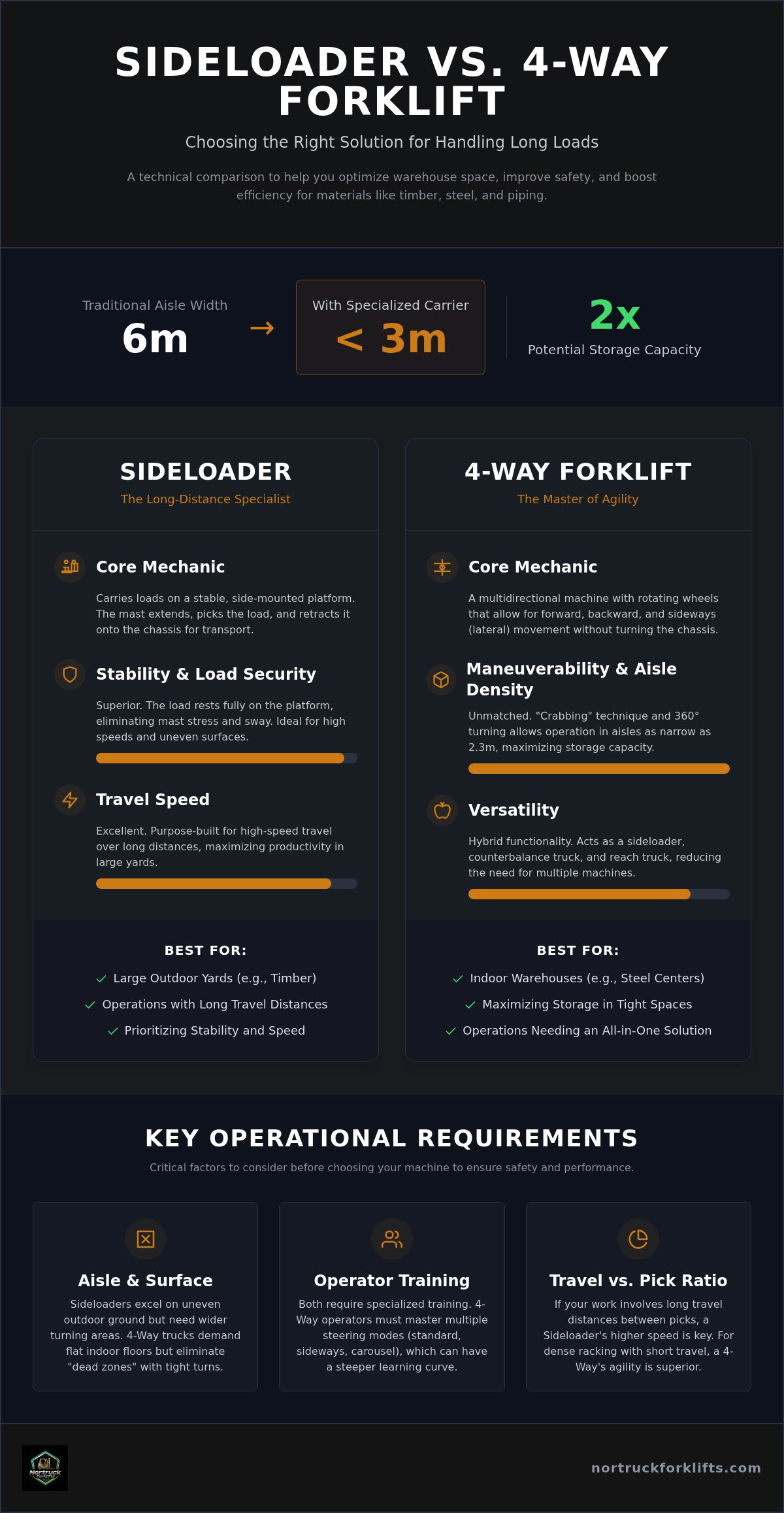
Did you know that switching to a specialized long-load carrier can reduce your aisle width from six meters to less than three, potentially doubling your storage capacity? Managing timber, steel, or piping is a unique challenge where every wide turn risks damaging expensive inventory or compromising safety. It's frustrating to watch your warehouse efficiency drop because your equipment isn't built for the load. You shouldn't have to settle for inefficient picking speeds or high material loss.
This guide explores the technical differences in the sideloader vs 4-way forklift debate to ensure you choose the right tool for your specific operational needs. We'll examine how travel distances and aisle widths dictate the best machine for your site. You'll also discover how to balance your budget by choosing between the latest 2026 models and reliable used equipment. Our goal is to provide the transparent, expert perspective you need to optimize your handling processes and maximize every square meter of your facility. By the end of this article, you'll have a clear path toward a safer and more profitable warehouse layout.
Key Takeaways
- Compare the mechanical stability of side-platform loading with the multidirectional agility of 4-way steering systems.
- Identify the critical performance factors in the sideloader vs 4-way forklift choice, focusing on travel speed, surface conditions, and aisle density.
- Learn why floor levelness and operator training requirements differ significantly between these two specialized long-load solutions.
- Determine which environments, from outdoor timber yards to indoor steel centers, favor specific machinery designs.
- Follow a professional site survey and procurement process to choose between new and used equipment that fits your warehouse goals.
Defining the Mechanics: What is a Sideloader vs. a 4-Way Forklift?
Choosing between a sideloader vs 4-way forklift isn't just about picking a brand; it's about understanding how physics and mechanics interact with your specific workspace. While both machines handle long loads, they do so through fundamentally different engineering paths. A Sideloader forklift is a dedicated machine that carries its cargo on a side-mounted platform, ensuring the weight is distributed across the chassis rather than being suspended by the mast alone. In contrast, a 4-way forklift is a multidirectional machine that can travel forward, backward, and sideways by rotating its wheels. Multidirectional travel is the ability to shift 90 degrees without turning the chassis.
How a Dedicated Sideloader Works
The heart of a sideloader, such as those produced by Baumann, is the "well" and the retracting mast mechanism. The operator positions the machine alongside the load, the mast reaches out to pick it up, and then retracts the material onto the transport platform. This platform is a game-changer for safety. It supports the load entirely, which eliminates mast stress and prevents the dangerous load sway often seen with standard forklifts. Because the load is secure on the deck, these machines can maintain higher travel speeds over long distances. They are the workhorses of large timber yards and outdoor manufacturing sites where stability at speed is the priority.
Understanding the 4-Way/Multidirectional Mechanism
A 4-way truck, like those from Combi-Lift, operates on a different principle. Instead of a fixed side platform, it uses sophisticated wheel rotation technology. Every wheel can pivot, allowing for 360-degree agility in tight spaces. This makes the machine a versatile hybrid that functions as a sideloader in narrow aisles, a counterbalance truck for standard pallet work, and a reach truck for high racking. The evolution of these machines has led to several specialized steering modes:
- Sideways mode: For navigating narrow aisles with long loads.
- Carousel mode: For turning the machine 360 degrees on its own axis.
- Standard mode: For traditional automotive-style driving in open areas.
While they might not match the top travel speed of a dedicated sideloader on a long straightaway, their ability to maneuver around corners without a massive turning radius is unmatched. This distinction is vital for the sideloader vs 4-way forklift comparison because it determines how much space you must leave for transfer aisles and "dead zones" in your warehouse layout.
Performance Comparison: Stability, Speed, and Manoeuvrability
Performance is measured by how quickly and safely you move material from point A to point B. In the sideloader vs 4-way forklift comparison, the winner depends on your "travel to pick" ratio. Sideloaders are purpose-built for high-speed travel over long distances, especially on uneven outdoor surfaces. Their fixed chassis and large wheels provide superior stability when transporting heavy timber or steel. If your operation involves moving loads across a large yard, the sideloader's duty cycle will likely outperform a multidirectional truck because it maintains higher momentum between picks.
Safety is a non-negotiable part of performance. Adhering to OSHA regulations for powered industrial trucks requires operators to maintain control at all times, and sideloaders make this easier by resting the load on a physical platform. This design reduces the risk of the load tipping during sudden braking or sharp turns. While sideloaders need wider transfer aisles to turn around, 4-way trucks can transition from an aisle into a sideways travel mode instantly. This effectively eliminates the need for large "dead zones" at the ends of your racking rows.
Manoeuvring in Narrow Aisles
4-way forklifts excel when storage density is the priority. They use a "crabbing" technique to navigate tight corners, allowing them to enter aisles that would be inaccessible to a standard sideloader. While sideloaders often require rail or wire guidance to operate safely in narrow aisles, 4-way trucks can often work unguided. Research shows that switching to a specialized long-load carrier can reduce aisle width from over 6 meters to less than 3 meters, potentially doubling your storage capacity. A 3-tonne 4-way truck can operate in aisles as narrow as 2.3 meters, whereas a sideloader of the same capacity might require a slightly wider path to account for its fixed-chassis turning circle.
Transport Speed and Load Security
Physics dictates that a load carried on a platform is more secure than one suspended on forks. Sideloaders use this advantage to reach higher travel speeds without compromising safety. Multidirectional trucks are generally slower because their "underslung" load is more susceptible to centrifugal forces. If you're looking for the most efficient way to source equipment, you might want to consult with an independent advisor to see which performance profile matches your floor plan. This ensures you don't overpay for agility you don't need or speed you can't use. Balancing these factors is the key to minimizing your total cost of ownership in 2026.
Industry Applications: Timber, Steel, and Specialized Materials
The physical properties of your inventory dictate the mechanical requirements of your machinery. A steel beam is rigid and heavy. A bundle of PVC piping is flexible and prone to "whip" during transport. These differences are central to the sideloader vs 4-way forklift decision. Handling flexible materials requires precise fork positioning to support the load evenly. Without proper support, long pipes can sag or bounce, which creates safety hazards and potential material fatigue. For utility or construction suppliers, choosing the best sideloader for plastic pipe handling in 2026 means prioritizing extra-long fork carriages or spreader bars that stabilize the load across its entire length.
The Timber Industry Perspective
Timber yards are often the harshest environments for lifting equipment. You're likely moving raw logs or finished planks over unpaved gravel or packed earth. The durability of a dedicated sideloader is usually the preferred choice in these settings. Baumann machines are widely regarded as the industry standard for durability because their chassis and suspension systems are specifically engineered to handle the vibration of outdoor use. When you compare a Baumann sideloader vs Combi-Lift for timber yard efficiency, look closely at your ground conditions. Sideloaders equipped with large tires and heavy-duty suspension provide the ground clearance and traction needed for mud and uneven yards.
Steel and Heavy Manufacturing Requirements
Steel distribution centers manage extreme weights and high-density storage simultaneously. While a 4-way forklift offers the agility to navigate tight indoor racks, heavy-duty applications often require the sheer lifting power and platform stability of a large-capacity sideloader. Modern multidirectional sideloaders have evolved to bridge this gap. They offer higher capacities than older models while maintaining some of the narrow-aisle agility required for modern warehouses.
If you're operating in a foundry or mill, sourcing machines with specialized cabs and heat-resistant components is essential for operator safety and machine longevity. Our best sideloader for steel handling procurement guide details the specific technical requirements for these intense environments. Many of our clients find that sourcing a high-quality used machine allows them to acquire a higher capacity unit than their initial budget for new equipment would allow. This is a practical way to manage capital expenditure while still meeting the safety requirements of heavy steel handling. Sourcing the right machine depends on whether your priority is indoor density or outdoor durability.
Operational Requirements: Floors, Aisles, and Training
The success of your long-load solution depends on factors beneath the surface of your warehouse. When evaluating the sideloader vs 4-way forklift, you must account for the physical environment and the people operating the machines. Precision starts at the ground level. While a dedicated sideloader often operates on standard industrial concrete or even outdoor gravel, multidirectional trucks are significantly more sensitive to floor quality. Their complex steering systems and multiple pivot points require a high degree of floor flatness to maintain consistent traction and stability.
Maintenance is another differentiating factor. A traditional sideloader uses a relatively straightforward fixed-axle design, which simplifies routine servicing. Multidirectional trucks utilize all-wheel steering systems that involve more moving parts, sensors, and hydraulic lines. While this provides unmatched agility, it also means your maintenance cycles require a technician familiar with complex steering geometries. If your site is remote, the mechanical simplicity of a sideloader might be a safer long-term investment.
The Critical Role of Floor Levelness
Floor levelness, often measured by FF/FL numbers, is critical for high-lift operations. Small floor deviations cause "mast sway" that amplifies as the forks rise. A 3mm bump at the base can translate into a significant shift at an eight-meter lift height, making it difficult to place loads accurately in racking. Multidirectional trucks typically require higher floor specifications than sideloaders to operate at peak efficiency. If your floor is uneven, you face a choice: invest in floor remediation or choose a sideloader with a more forgiving suspension system. Outdoor operations almost always favor the sideloader because its larger tire compounds and suspension are designed to absorb the shocks of unpaved surfaces.
Operator Competency and Safety
The learning curve for these machines varies. Sideloaders typically use automotive-style steering, which feels familiar to most forklift operators. 4-way trucks often utilize joystick controls and require the operator to master multidirectional logic. This transition takes time. An operator must understand how the machine will react when shifting from forward travel to "crabbing" mode. Safety protocols are also different; the side-seated position in a sideloader offers excellent visibility for long-load travel, whereas a 4-way operator must be more diligent when navigating tight 360-degree turns. High picking speeds are only possible when the operator feels confident in the machine's steering response.
Maximizing aisle speed often involves guidance systems. Rail-guided sideloaders can travel much faster within an aisle because the operator doesn't need to steer. Wire-guidance is a cleaner alternative for multidirectional trucks, allowing them to maintain high speeds in narrow aisles while retaining the ability to exit the aisle and maneuver freely around the warehouse. Your choice should balance these infrastructure costs against the expected gains in picking frequency.
Procurement Strategy: How to Source the Right Long-Load Solution
Sourcing heavy machinery is a high-stakes investment that requires a methodical approach. Precision starts at the ground level. You shouldn't make a final decision based on marketing brochures alone; you need a strategy rooted in your specific site data. To ensure you select the most efficient machine for your facility, follow these four professional steps:
- Step 1: Conduct a comprehensive site survey focusing on your narrowest "bottleneck" and your longest load.
- Step 2: Determine the Total Cost of Ownership (TCO), which includes maintenance cycles and the cost of specialized tires.
- Step 3: Decide between investing in a new custom build or sourcing high-quality used heavy lifting equipment.
- Step 4: Leverage an independent advisor to source the best machine across manufacturers like Baumann and Combi-Lift.
This data directly informs the sideloader vs 4-way forklift decision. While the sticker price is important, the TCO often reveals that a more expensive machine with lower maintenance requirements is the better long-term value. For those managing high-capacity requirements in demanding sectors, our Heavy Duty Forklifts for Concrete: 2026 Procurement Guide offers specific technical insights for heavy material handling.
New vs. Used: Managing Capital Expenditure
Sourcing used equipment is a practical way to reduce initial capital expenditure without sacrificing performance. A well-maintained used Baumann sideloader often provides better value for outdoor timber yards than a new multidirectional truck with features your site doesn't require. When sourcing from the European market, it's vital to verify the machine's performance history and service records. We recommend an independent inspection before finalizing any heavy equipment purchase to ensure the hydraulic systems and masts meet current safety standards. This transparency prevents unexpected repair costs after the machine arrives at your facility.
The Advantage of Independent Sourcing
An independent advisor acts as a partner who understands the internal nuances of the industry. Unlike brand-specific dealers, an advisor can help you navigate the choice between Baumann and Combi-Lift without bias. This approach ensures you get the machine that fits your specific aisle width rather than the one a dealer is incentivized to sell. Sourcing across the European market also grants access to a wider inventory of specialized machines. This allows you to find the exact specifications you need for your long-load challenges, whether you're handling steel beams or flexible PVC piping.
Optimizing Your Long-Load Logistics
Choosing the right equipment isn't just about the machine; it's about how your floor's levelness and your team's training interact with your specific cargo. The sideloader vs 4-way forklift decision often hinges on whether you value high-speed outdoor travel or maximum indoor storage density. By conducting a thorough site survey and calculating the total cost of ownership, you'll avoid expensive bottlenecks. Sourcing high-quality used machinery from the European market is a proven way to access premium brands like Baumann or Combi-Lift while keeping your capital expenditure under control.
With 40+ years of heavy lifting expertise, we provide the independent guidance you need to find a perfect fit. We focus on transparency and direct communication to ensure your investment pays off for years to come. Whether you're handling steel beams or timber bundles, the right machine will transform your operational safety and efficiency.
We're ready to help you build a more productive warehouse layout. Let's start a conversation about your long-load handling goals today.
Frequently Asked Questions
Is a 4-way forklift better than a sideloader for narrow aisles?
A 4-way forklift is typically the superior choice for maximizing storage density in narrow aisles. In the sideloader vs 4-way forklift comparison, the 4-way's ability to operate in aisles as narrow as 2.3 meters gives it the edge for indoor racking. While sideloaders can work in tight spaces when rail-guided, the 4-way's 360-degree agility allows you to eliminate wide transfer aisles and potentially double your warehouse storage capacity.
Can a sideloader be used on uneven outdoor surfaces?
Sideloaders are the preferred choice for uneven outdoor surfaces like gravel or packed earth. Unlike 4-way trucks, they feature large tires and specialized suspension systems designed to absorb ground shocks. This engineering protects the load and the chassis from vibration. If your operation involves moving timber or steel across a large, unpaved yard, the stability and ground clearance of a sideloader will outperform a multidirectional truck.
What are the main maintenance differences between a sideloader and a Combi-Lift?
The primary difference lies in steering complexity. Sideloaders utilize a straightforward fixed-axle design that's easier for standard technicians to service. In the sideloader vs 4-way forklift debate, maintenance is a key factor; a 4-way truck features an all-wheel steering system with intricate hydraulic lines. While this provides incredible maneuverability, it requires more frequent checks of the steering geometry. Choosing a sideloader can often lead to lower long-term maintenance costs.
How much operator training is required for a multidirectional forklift?
Multidirectional forklifts require more specialized training than traditional sideloaders. Operators must learn to manage joystick controls and master the transition between different steering modes, such as "crabbing" or carousel turns. This is a significant shift from the automotive-style steering wheel found in most sideloaders. Proper certification ensures operators can safely navigate tight corners without damaging inventory. We recommend allowing extra time for staff to become proficient with these complex controls.
Which machine is safer for transporting 12-meter steel beams?
For 12-meter steel beams, a sideloader offers the highest level of transport safety. The beam sits securely on the machine's physical transport platform, which prevents the "whip" and load sway common with underslung forks. This platform support is critical when traveling over long distances or at higher speeds. While a 4-way forklift can handle such loads in tight racks, it doesn't match the stability of a dedicated platform machine.
Can I source used sideloaders across Europe to save on costs?
Sourcing used equipment across Europe is an excellent way to manage high capital expenditure. Nortruck leverages 40 years of expertise to find reliable, refurbished Baumann and Combi-Lift units from European manufacturers. This approach often allows you to buy a higher-capacity machine than your budget for new equipment would permit. It's a strategic move for businesses that need specialized lifting power without the six-figure price tag of a 2026 model.
What is the typical lifespan of a heavy-duty Baumann sideloader?
A heavy-duty Baumann sideloader typically has a lifespan of 15 to 20 years when maintained correctly. These machines are engineered for the rigors of timber and steel distribution, featuring robust chassis that resist fatigue. Many used units sourced from Europe still have over 10 years of operational life remaining. Regular servicing of the mast and hydraulic systems is the key to ensuring your sideloader remains a reliable asset for two decades.
Do 4-way forklifts require special warehouse flooring?
Yes, 4-way forklifts are more sensitive to floor quality than sideloaders. They require high floor levelness (FF/FL) to prevent mast sway, which becomes more dangerous as you increase lift heights. Small bumps can cause significant movement at the forks, leading to accidents or material damage. If your warehouse floor is uneven, you'll either need to invest in floor remediation or choose a sideloader, which is generally more forgiving of surface imperfections.

Article by
Lars Gunnar Tärby
Disclaimer
1. General Information and No AdviceThe information, articles, product descriptions, and specifications provided on this website (www.nortruckforklifts.com) are for general informational and educational purposes only. While we strive to provide accurate and up-to-date content regarding new and used forklifts and heavy machinery, the material published does not constitute professional, technical, or legal advice.
2. Product Specifications and PricingNortruck Forklifts acts as a facilitator for the trade of new and used forklifts. All equipment details, including but not limited to year of manufacture, operating hours, lift capacity, dimensions, conditions, and pricing, are provided based on the information available to us at the time of publication. Specifications and availability are subject to change without prior notice.
3. "As Is" and VerificationAll articles and product listings are provided on an "as is" and "as available" basis without any warranties of any kind, either express or implied. Nortruck Forklifts does not guarantee that the descriptions are entirely error-free, complete, or reliable. Buyers and traders are strongly encouraged to independently verify all technical specifications, machine history, and equipment conditions directly with the seller or an authorized inspector before finalizing any purchase or transaction.
4. Limitation of LiabilityIn no event shall Nortruck Forklifts, its owners, or its contributors be held liable for any direct, indirect, incidental, consequential, or economic loss or damage arising out of the use of, or the inability to use, the information provided on this website, or any transactions facilitated through this platform. This includes, but is not limited to, damages caused by technical inaccuracies, typographical errors, or reliance on the content of our articles.
5. Third-Party LinksOur website may contain links to external websites, dealer networks, or third-party services that are not owned or controlled by Nortruck Forklifts. We have no control over, and assume no responsibility for, the content, privacy policies, or practices of any third-party websites.


